Why Communication Boards Belong in Every Playground
Imagine this: kids laughing, friends climbing, parents chatting on benches, and the joyful hum of play all around. Now picture a child standing nearby—watching, wanting to join in—but unable to find the words. Maybe they’re nonverbal, minimally verbal, or use a device that’s not playground-friendly. For that child, the fun can feel just out of reach.
That’s where communication boards change everything.
Communication boards are simple yet powerful tools that help children and adults express themselves through symbols, pictures, and words. When installed in playgrounds, these boards open the door to connection, inclusion, and belonging for every child. And the truth is—every playground should have one.
Let’s explore why communication boards are more than a nice idea—they’re an essential part of modern, inclusive, and ADA-friendly play spaces.
1. Communication Is a Right, Not a Privilege
Every child has the right to communicate, play, and be included. But for children who have speech or language challenges—such as those with autism, Down syndrome, apraxia, or other communication differences—traditional playgrounds often fall short in meeting their needs.
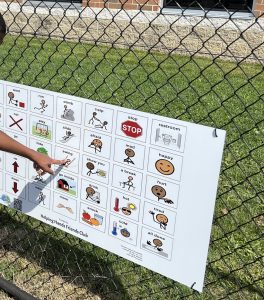
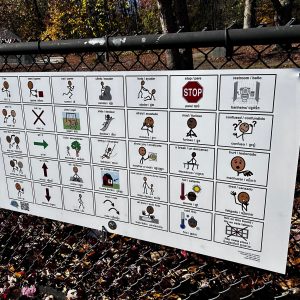
A communication board bridges that gap. It gives children access to core words like “go,” “help,” “stop,” “yes,” and “no,” along with activity-related symbols like “slide,” “swing,” or “play.” These core words allow for endless combinations and meaningful exchanges—without needing verbal speech.
With a communication board, a child who might otherwise remain silent can:
- Ask for a turn on the swing
- Tell a friend “I like you”
- Say “help” when they’re stuck
- Join in a game instead of watching from the sidelines
It’s not just about language—it’s about belonging.
2. Inclusion Should Be Both Physical and Communicative
We often think of accessibility in physical terms—ramps, sensory equipment, rubber surfacing—but communication access is just as vital. The Americans with Disabilities Act (ADA) emphasizes equal opportunity for participation, and that includes the ability to interact and communicate during play.
Many playgrounds proudly display features that support mobility or sensory needs. Yet, without a communication board, they’re still missing a key part of accessibility—language access.
Playgrounds should be places where every child can connect with others, regardless of their speech ability. Communication boards make that possible. They create environments where children who use AAC (Augmentative and Alternative Communication) systems or who are learning to communicate can be fully included in the joy of play.
When you install a communication board, you’re not just checking an ADA box—you’re building a community that values all kinds of communication.
3. Communication Boards Encourage Peer Understanding and Empathy
Something special happens when children use a communication board together. When neurotypical kids see peers pointing to pictures to talk, they naturally begin to imitate and include that form of communication in their play.
It teaches empathy, patience, and awareness. Kids quickly learn that communication comes in many forms—spoken words, gestures, symbols, or signs. This understanding extends far beyond the playground.
When children grow up seeing communication diversity as normal, they become the next generation of inclusive thinkers. Installing a communication board today helps build a more understanding, compassionate tomorrow.

4. They Support Everyone—Not Just Nonverbal Kids
One of the biggest misconceptions is that communication boards are “only for kids with special needs.” That couldn’t be further from the truth.
Communication boards are universal tools. They can help:
- Toddlers still learning to talk
- Children learning English as a second language
- Kids who are shy or anxious in new settings
- Adults giving directions or prompting play
- Visitors or tourists unfamiliar with local language
When we label something as “special,” we often unintentionally limit its value. In reality, communication boards make play easier and more engaging for everyone.
Think of them like playground ramps: originally designed for wheelchair users, but beneficial for strollers, scooters, and carts too. Communication boards offer that same level of universal design—helpful for some, but valuable for all.
5. They Foster Social Connection and Reduce Isolation
For many families, visiting the playground can be stressful when a child struggles to communicate. Parents often act as the “voice” for their child, interpreting behaviors or trying to bridge communication gaps.
A playground with a communication board changes that dynamic. Now, a child can initiate or respond directly. They can make friends, express feelings, and take part in play more independently.
For parents, it’s a relief to see their child heard and included without constant translation. For kids, it’s freedom—the ability to be part of the group, to laugh and play alongside their peers rather than watching from a distance.
Communication boards don’t just make playgrounds inclusive—they make them joyful for everyone.
6. They’re Easy to Use and Maintain
Another great reason every playground should have a communication board? They’re simple.
Outdoor communication boards are designed for durability and ease. Most are made of weather-resistant aluminum composite material with UV protection and anti-graffiti coating—so they withstand sun, rain, and busy play.
They require virtually no maintenance, and once installed, they become a long-term feature that enhances the space for years.
Boards can be customized with local vocabulary—names of equipment, school mascots, or playground themes—to create a sense of ownership and pride. They’re available in multiple sizes and mounting options (fence, post, or wall mount), so there’s a fit for every play area.
Adding one to an existing playground is simple, cost-effective, and has an immediate community impact.
7. Communication Boards Demonstrate a Commitment to Inclusion
When a city, school, or community installs a communication board, it sends a powerful message:
“Everyone is welcome here.”
That statement builds community trust and pride. It shows that accessibility isn’t just a buzzword—it’s a value.
Playgrounds are community gathering spaces, and when they reflect inclusion, families notice. Parents of children with disabilities often choose where to live or where to spend their time based on accessibility and inclusion. A playground with a communication board becomes a destination—a place where every child is invited to play, communicate, and belong.
It’s also great public relations for parks and recreation departments, municipalities, schools, and organizations that want to highlight their dedication to equity, inclusion, and ADA compliance.

8. Installing Communication Boards Is Easier Than You Think
One of the best parts? Adding communication boards to playgrounds is achievable for communities of any size.
Projects can be funded through:
- PTA/PTO initiatives
- Eagle Scout or Girl Scout Gold Award projects
- Local businesses or service clubs (like Rotary or Kiwanis)
- Grants focused on inclusion and accessibility
- Nonprofit sponsorships
Many organizations, including ours, offer full support—from board design to material selection and mounting guidance. Whether you’re a parent advocating for your neighborhood park or a city planner designing a new play space, we can help you create an inclusive playground that truly reflects your community’s heart.
9. Playgrounds Should Be a Reflection of Every Child’s Voice
At the end of the day, a playground is more than slides and swings—it’s a place where children build friendships, confidence, and communication skills that last a lifetime.
When we add communication boards, we’re giving every child the chance to say, “I want to play!” and to be heard. That’s not just inclusion—it’s empowerment.
A truly inclusive playground doesn’t just remove physical barriers—it removes communication barriers too. Because inclusion isn’t complete until everyone has a voice.
Let’s Make Every Playground a Place for Every Voice
If your local playground doesn’t have a communication board yet, now’s the time to start the conversation. Reach out to your parks department, school district, or local advocacy group. Share this article. Ask how you can help.
At Resources at Lakeshore Speech, we believe that every playground should be a place where all children can connect, play, and be heard. That’s why we design durable, ADA-friendly, customizable communication boards for playgrounds, pools, and community spaces nationwide.
Together, we can create play spaces that speak to everyone.
Key Takeaways:
- Communication boards promote true inclusion by giving all children a way to participate in play.
- They support ADA compliance and accessibility standards beyond physical needs.
- Communication boards teach empathy, encourage connection, and foster community pride.
- They’re durable, affordable, and simple to install—making them an easy win for any public play space.
Because every child deserves to say, “Let’s play!”