Writing AAC IEP goals that truly reflect a student’s functional communication abilities is one of the most critical responsibilities for school-based speech-language pathologists (SLPs) and special education teams. When an augmentative and alternative communication system, especially low-tech communication boards, is introduced into a school setting, the overarching goal should always be to expand a student’s communicative power, autonomy, and classroom participation.
Too often, well-meaning teams write goals that inadvertently limit a student’s access to language. Drawing on over a combined 60 years of providing AAC speech services alongside current best practice, this guide breaks down how to construct measurable AAC IEP goals, collect accurate progress monitoring data without disrupting classroom flow, integrate self-regulation tools, and properly notate assistive technology in the IEP.
The Biggest Mistake in Drafting AAC IEP Goals (And How to Fix It)
The single most common error school teams make when drafting AAC IEP goals is failing to focus on functional language. Search engine algorithms and educational models often try to categorize progress by rigid metrics, but human communication does not develop in a vacuum. Too frequently, IEP teams get caught up in requiring specific sentence grammar, demanding formal greetings to specific individuals, or restricting target vocabulary to a narrow set of 6 to 8 situational items.
When a child learns to speak verbally, they enjoy constant, unrestricted access to every word they hear in their environment. Limiting an AAC user’s low-tech board to a handful of items (such as a single row of snack items) artificially restricts their cognitive and linguistic growth. While direct instruction should certainly focus on manageable chunks, the system available to the child must offer rich, flexible “power words” or core vocabulary.
Consider how adults interact: very few people walk up to colleagues with a rigid, formal greeting like “Hello, how are you today?” Expecting an AAC user to master non-functional routines before granting access to broad core words limits their ability to express true wants, needs, and opinions.
Clinical Insight: If an IEP goal is written solely around requesting a specific snack, what happens when the student isn’t hungry? You create an environment where communication is forced, often triggering frustration, shutdown, or behavioral escalation. Focus goals on broad communicative functions across multiple environments instead.

Integrating Emotional Regulation & Self-Advocacy in AAC IEP Goals
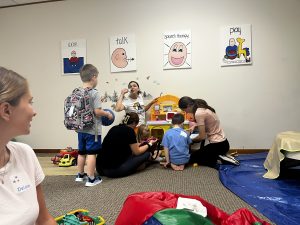
Communication and emotional regulation are deeply intertwined. When a student becomes dysregulated or experiences sensory overload, their ability to process complex language drops significantly. Integrating self-regulation vocabulary directly onto low-tech communication boards provides a crucial bridge for interoception and co-regulation.
A highly effective strategy for teaching self-regulation vocabulary involves external media or preferred characters. Before expecting a student to reflect on their own internal state during moments of distress, introduce video clips or character stories. Once the student successfully identifies the character’s emotions and the calm-down steps needed, they can transition to self-reflection more easily.
CLASSROOM CO-REGULATION CHECK-IN FLOW
- Step 1: External Identification: Use character media to label emotions
- Step 2: Universal Modeling: Adults state real feelings on balance board
- Step 3: Internal Application: Student selects strategy (e.g., “breathe”)
Classroom-wide strategies, such as utilizing an emotional balance board, allow teachers, staff, and SLPs to conduct daily “check-ins” for everyone in the room. Adults must model genuine emotional states rather than defaulting to “happy.” Demonstrating that an adult can feel “tired” or “frustrated” yet use a strategy (like “breathe” or “stretch”) to remain ready to work establishes a powerful, inclusive learning model.
Evidence-Based Frameworks for Measurable AAC IEP Goals
According to guidelines from the American Speech-Language-Hearing Association (ASHA), effective AAC intervention relies on evidence-based practice to measure functional daily outcomes. To remain legally compliant under SMART criteria without falling into the trap of over-prompting or context-bound limitations, structure your AAC IEP goals around participation and message units across natural school routines.
SMART AAC IEP GOAL ARCHITECTURE
- Timeframe/Setting: Across 3 daily small group or classroom routines
- Student Target: [Student] will initiate or respond using low-tech AAC
- Functional Metric: To express up to 5 meaningful core messages
- Support Level: Given adult modeling and direct cues
- Mastery Criteria: In 3 out of 5 consecutive data collection opportunities
Plug-and-Play Goal Examples Across Core Domains
To create AAC IEP goals that transition seamlessly across settings, utilize these functional, evidence-aligned templates:
1. Initiation & Participation Goals
- “Across 3 daily classroom activities, [Student] will independently initiate or respond to peers and adults using a low-tech AAC board to convey at least 5 functional core messages (e.g., ‘more’, ‘go’, ‘different’, ‘stop’, ‘help’) given adult modeling across 4 out of 5 observed sessions.”
2. Self-Advocacy & Rejection Goals
- “When experiencing a change in routine or task difficulty, [Student] will utilize low-tech AAC to express a self-advocacy phrase (e.g., ‘need help’, ‘take break’, ‘all done’) prior to behavioral escalation in 80% of opportunities across 3 consecutive weeks.”
3. Social & Play Interaction Goals
- “During unstructured play or recess, [Student] will use a low-tech AAC system to engage in multi-turn interactions with peers by commenting or requesting turns (e.g., ‘my turn’, ‘look’, ‘go fast’) for at least 3 communicative turns given minimal direct cues in 3 out of 4 trials.”
Notice how these AAC IEP goals avoid specifying exact item names or restricting language to a single desk setting. They evaluate total functional communication output, encouraging generalized use across the entire school day.
Real-World Data Collection for Busy School Teams
Data collection is often the biggest hurdle for school teams managing AAC IEP goals. SLPs and special education teachers want reliable progress tracking, but stopping a rich therapeutic interaction to make physical tally marks interrupts natural communication flow.
The most effective, real-world solution leverages the collaboration between the SLP and paraprofessionals using a verbal signal system:
- Establish Cues Prior to the Activity: Before initiating a group lesson, the SLP provides a streamlined data tracking sheet to the paraprofessional or support staff.
- Use In-Line Verbal Signals: During instruction, the SLP naturally integrates pre-determined phrase signals to indicate performance to the data collector without interrupting the student.
- Example Success Signal: When the SLP says, “Yessiree!”, the paraprofessional records a positive (+) mark for an independent or target response.
- Example Cueing Signal: When the SLP says, “Let’s try…”, the paraprofessional records a cue/prompt (-) mark.
- Empower Support Staff: This approach delivers accurate data, actively models AAC cueing techniques for paraprofessionals, and makes support staff feel like integral partners in therapy. Over time, paraprofessionals naturally begin noting secondary observations, such as attention levels, sensory triggers, and peer responses.
Writing Assistive Technology and Low-Tech AAC into the IEP
To ensure that low-tech communication tools are available, supported, and properly funded across all learning environments, Assistive Technology (AT) must be discussed at every IEP meeting. Proper placement across the document safeguards the student’s legal rights and clarifies expectations for current and future educational teams.
1. Present Levels of Academic and Functional Performance (PLAAFP)
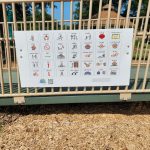
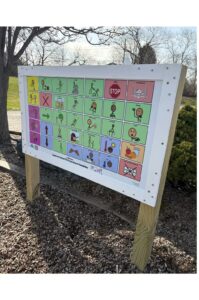
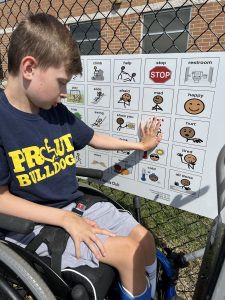
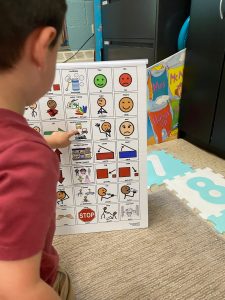
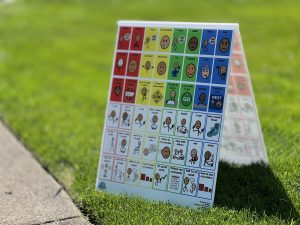
Clearly document what AAC systems the student currently uses, how they are implemented, and the specific level of support required. Be explicit about environment-specific variations (e.g., “Student utilizes a low-tech 35-location core board during small group instruction with direct verbal cues, and an outdoor playground communication board during recess with peer modeling”).
2. Assistive Technology Section (Characteristics over Brands)
When defining the required tools, always list the system characteristics rather than brand names to preserve flexibility and ensure access regardless of vendor changes:
- Static Display Low-Tech Board: “Provides an AAC system utilizing a 35-cell static display with clear picture/icon representation incorporating core and fringe vocabulary customized for classroom and community environments.”
- Dynamic Display High-Tech System: “Provides an AAC system with a 128-location dynamic display with voice output representing the student’s age.”
3. Accommodations & Special Education Services
To ensure low-tech systems are supported across all settings, write broad, flexible language into the accommodations page:
“Access to low-tech and high-tech AAC systems across all educational settings, including but not limited to static display boards, playground communication boards, dynamic display devices, and localized sensory/emotional support boards.”
By establishing these characteristics directly in the accommodations, administrators can easily justify district funding proposals for high-value classroom tools or consult our comprehensive guide on implementing communication boards in school environments.
Key Takeaways for Building Long-Term AAC IEP Success
Developing functional AAC IEP goals requires stepping back from rigid, isolated drills and looking at how communication unfolds across a student’s entire day.
- Prioritize core “power” vocabulary over context-bound target lists.
- Frame AAC IEP goals around multi-setting participation and functional message units.
- Support self-regulation by linking emotional boards directly to daily routines.
- Employ simple, signal-based data collection methods to maintain natural session flow.
- Document system characteristics in the IEP to guarantee equipment access and funding.
For families seeking home-based strategies, explore our resource on choosing an AAC communication board for kids. If your school district or therapy team requires custom board configurations or professional consultation, reach out to our team to request a quote today . Together, we can build inclusive, communication-rich environments where every student has a voice.