
The Dangerous Misconception of the DIY Communication Board
If you are a parks department director, a school administrator, a camp coordinator, or a community leader looking to make your local spaces more inclusive, the word easy is likely at the very top of your project checklist. You want a solution that is easy to understand, easy to order, easy to install, and easy for the public to navigate. When you begin searching for inclusive communication tools, you will find countless vendors and articles online promising that creating a custom communication board is as simple as clicking a few buttons, picking a handful of pictures, and printing them onto a piece of plastic.
This has led to a widespread, well-intentioned, but highly damaging misconception in the community space. The prevailing myth is that anyone with a computer and a design program can put together an effective communication board by simply arranging a grid of random icons and images anywhere on a board. People look at a finished augmentative and alternative communication (AAC) board and see a collection of colorful illustrations, assuming that the arrangement is merely aesthetic or arbitrary. They believe that customizing a board simply means picking words that match the local scenery and scattering them across a grid.
The reality of communication board development is vastly different. True ease refers to the ability of the purchaser to understand, navigate, and utilize the clinical information embedded within the tool to create a successful, functional custom setup. The development of a communication board is not a graphic design project, it is a clinical process backed by decades of language science.
A certified speech-language pathologist is the individual with the true credentials and expertise required to complete this type of task. Without a clinical foundation, a customized board risks becoming a decorative piece of plastic that looks inclusive on the surface but fails to provide a functional voice to the individuals who rely on it. When we treat communication board customization as a simple matching game, we inadvertently silences the very people we are trying to empower.
Understanding the Clinical Science of Augmentative Communication
To understand why customization requires a speech-language pathologist, you have to look closely at how non-verbal individuals, or individuals with limited speech, actually process visual language. When a certified speech-language pathologist designs or alters a communication board, they are balancing complex cognitive, neurological, and linguistic factors. There are three specific, science-backed pillars that must guide every single customization decision, ensuring that the final product remains highly functional no matter what local elements are added.
The Power of Core Vocabulary Over Fringe Vocabulary
The first and most critical pillar of an effective communication board is a heavy reliance on core vocabulary. Core vocabulary consists of the high-frequency words that make up approximately eighty percent of the words we use in daily communication across all settings. These are words like go, stop, more, detailed, help, like, you, me, up, and down.
The first and most critical pillar of an effective communication board is a heavy reliance on core vocabulary. Core vocabulary consists of the high-frequency words that make up approximately eighty percent of the words we use in daily communication across all settings. These are words like go, stop, more, detailed, help, like, you, me, up, and down. Understanding how to choose vocabulary for augmentative communication tools requires looking past standard word lists and focusing on true functional language.
The incredible power of core vocabulary lies in its flexibility and its vital importance to overall language development. Core words allow a user to create flexible, spontaneous messages without needing highly specific or literal visual references. For example, if a child wants to use a slide at a playground, a board focused on core vocabulary allows them to point to the icons for go and there. This simple combination communicates the exact same intent as pointing to a specific picture of a slide.
The magic of this approach is that go there can also be used to ask to visit the swings, the picnic pavilion, the parking lot, or a friend across the field. If your customization process involves removing core vocabulary to make room for dozens of specific nouns, also known as fringe vocabulary, you are severely limiting the user. If a board only features specific nouns like slide, swing, and sandbox, the child can only talk about those exact objects. They cannot use those words to express an action, a feeling, or a complex thought. Our approach always focuses on preserving a robust core vocabulary layout first, ensuring that the non-verbal individual has a functional framework for actual language generation rather than just a menu of local objects.
Motor Planning and Spatial Consistency Across Boards
The second pillar that cannot be compromised during customization is motor planning. When neurotypical, verbal individuals speak, they do not consciously think about how to move their tongue, lips, and vocal cords for every single syllable. Muscle memory takes over, allowing speech to flow seamlessly. For an individual using an AAC device or a physical communication board, the exact same principle applies to motor planning and muscle memory. They learn the location of a word based on where it lives spatially on the grid.
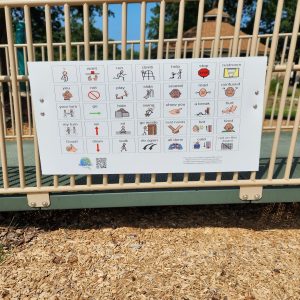
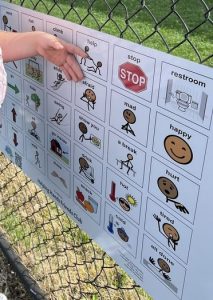
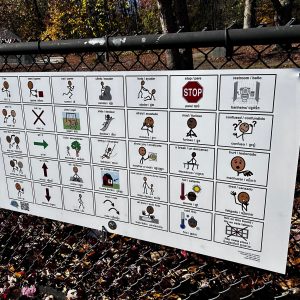
Motor planning depends entirely on the absolute consistency of the placement of the icons moving from location to location, and from board to board. If you are installing multiple communication boards across a large park system, a school campus, or a town center, you must maintain a fixed spatial architecture. If a user learns that the icon for the restroom is located in the upper right-hand corner of the board at the main playground, they must be able to walk down to the baseball fields or into the community center and find the restroom icon in that exact same upper right-hand corner.
When well-meaning individuals attempt to customize boards without clinical oversight, they often scramble the grid to make room for new images. They might move the restroom icon to the bottom left on one board because they wanted to put a picture of a tree in the top right. This completely disrupts the user’s motor planning. It forces a non-verbal individual to completely re-scan, re-learn, and search the board every time they move to a new area. This significantly increases their cognitive load and can lead to immense frustration, causing them to abandon using the board entirely.
Protecting Symbol System Consistency
The third pillar is maintaining strict consistency within the symbol system itself. Non-verbal individuals who use high-tech speech-generating devices or low-tech communication books at school spend years learning a specific visual language dialect. Different software programs and clinical frameworks use distinct symbol sets, such as SymbolStix or PCS, which represent concepts in specific visual styles.
When customizing a public communication board, it is vital that the symbol system used on the sign matches or closely mirrors the actual icons that the users see daily at school and on their personal AAC devices. If a child uses a specific symbol for want or help in their classroom, seeing a completely different, randomized clip-art icon on a park board can cause massive confusion. True customization means understanding the local demographic, working with the local school districts to see what symbol systems are prevalent, and ensuring the public boards align with those existing tools.
The Real World of Collaborative Customization
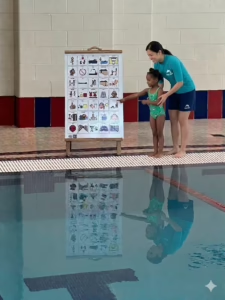
When working with clients who purchase our communication boards for public spaces, we always begin from a scientifically verified, standard layout that honors core vocabulary, motor planning, and symbol consistency. We do not start with a blank canvas, because a blank canvas encourages the random placement of icons. Instead, we use our clinical framework as the foundation, and then we sit down with the purchaser to discuss what specific items they may need to add, where those items should go, and, most importantly, the clinical reasons why those additions are being made.
This collaborative approach transforms the customization process into an educational experience for the purchaser. The biggest logistical and design challenge we face in this line of work is not necessarily knowing what the specific playground, facility, or location looks like, or where the board will ultimately be installed. We are creating physical, durable signs that must live in a real environment, and the layout of that environment dictates how people interact with the sign.
To overcome this lack of physical context, we work closely with city planners, park directors, and school administrators to gather blueprints, site maps, and photographs of the exact location where the board will stand. Once we understand the spatial realities of the environment, we develop a custom draft. We then enter an iterative phase with the client, continuing to work closely with them to tweak the customized elements until they are completely satisfied. This process ensures that the client fully understands why the boards are designed the way they are, giving them ownership over the clinical rationale behind their new community tool.
The North Olmsted Case Study and the Camp Board Breakthrough
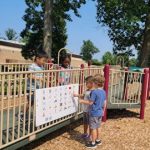
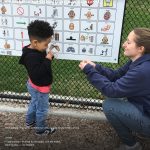
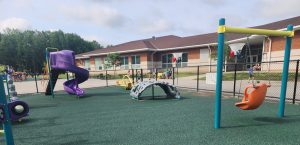
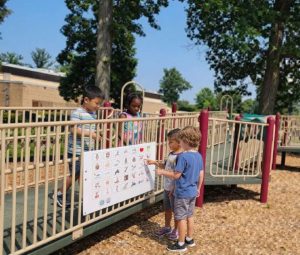
A perfect example of this deep, environmental customization occurred recently during a project with the city of North Olmsted. The city was actively retrofitting and fitting their beautiful new playground equipment with accessible communication boards to ensure that their spaces were welcoming to all children.
During the design process, we worked closely with the director of the parks department. As we analyzed the blueprints and discussed how the space would be utilized throughout the year, the director mentioned a specific demographic and operational need that a standard playground sign could not completely address. She highlighted their extensive summer camp programs.
During the summer, dozens of campers, including individuals with diverse communication needs, gather in the parks. The camp counselors needed a tool that allowed students to better express themselves during camp activities, but they also desperately needed a way for the counselors themselves to give directions more clearly and model language in real-time as they moved around the property.
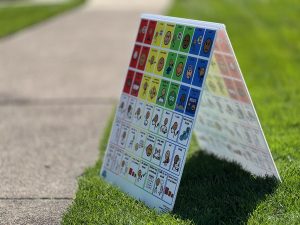
At that exact moment, we had an incredible breakthrough. We realized that a static, post-mounted sign next to a swing set was not enough for a dynamic, mobile summer camp environment. To solve this problem, we designed a completely custom, portable camp board built into a heavy-duty sandwich sign structure.
We utilized both sides of the sandwich sign to create a multi-functional communication hub:
- One side of the sandwich board was carefully customized and intended for the campers to express their personal feelings, immediate physical needs, choices, and social interactions with peers.
- The opposite side of the sandwich board was custom-designed specifically for the camp counselors and staff to use to give directions, clarify schedules, model expectations, and visually reinforce instructions out in the field.
Because this sign was a portable sandwich board, counselors could easily carry it from the main pavilion over to the grassy fields, or down to the shade trees depending on where the camp activities were taking place.
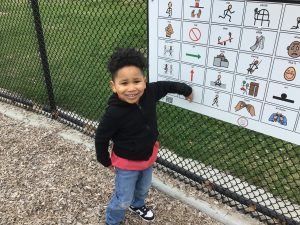
In tandem with this mobile camp board, we fully customized their permanent, post-mounted playground signs to include specific local amenities, including their brand-new splash pad, the nearby ballpark, and the soccer fields. We seamlessly integrated these local fringe vocabulary terms into the existing clinical layout without disrupting the core vocabulary framework or ruining the motor planning architecture. This project successfully provided clear, accessible communication for everyone in the park, matching the physical layout of North Olmsted with the clinical needs of its residents.
The Ultimate Litmus Test for Your Communication Board
If you are a reader who is currently preparing to purchase, design, or customize a communication board for your local school, public park, non-profit organization, or community space, it is easy to get overwhelmed by the graphics, the colors, and the logistics of sign procurement. Before you approve a final proof, send a design to a printer, or sign off on a customization project, you need a way to ensure that your tool is genuinely effective. You need to verify that your board is a legitimate, powerful gateway to language, and not just a collection of random, well-meaning icons.
To do this, you must apply the ultimate clinical litmus test. Step away from your role as an administrator, a designer, or a purchaser. Put yourself completely and entirely into the shoes of an individual who cannot communicate verbally. Look at the draft of your custom board through their eyes, imagine standing in front of it in the middle of your park or facility, and ask yourself the following deeply important questions:
- If I am feeling overwhelmed, tired, or hurt, can I easily look at this board and communicate exactly how I feel to an adult, or am I limited to just pointing at equipment?
- If I need a basic, critical human necessity, can I instantly look at this board and request to go to the restroom, or find a drink of water, without having to hunt through a randomized jumble of icons?
- If I want to interact with the children around me, does this board give me a specific way to comment on what I see, share a joke, or ask to join a game, allowing me to truly be an active part of the community or space I am standing in?
When you evaluate your custom communication board using these questions, you will quickly see whether your design provides true autonomy. If an individual looks at your board and can only answer simple yes or no questions, or if they can only point to a picture of a swing to indicate they want to swing, your board is not truly customized for communication. It is severely limited.
A non-verbal person has complex thoughts, deep emotions, specific needs, and a desire for social connection just like anyone else. They are not thinking in one-word noun labels. They want to tell you that a game is fun, that they want to go faster, that they are finished, or that they want to go somewhere else.
A truly effective custom communication board does not simply display a handful of local icons. It respects the science of language development, protects the spatial consistency that muscle memory requires, and provides a rich framework of core vocabulary. By partnering with certified speech-language pathologists and committing to a clinical customization process, you can ensure that your community investment does something truly life-changing. It will give a profound, enduring voice to those who need it most, creating an environment where everyone can truly communicate how they feel, what they want, and where they would like to go.
Bring true inclusivity to your community. Avoid the pitfalls of a DIY setup and invest in signs designed by clinical experts. Explore our scientifically backed, durable communication boards for public spaces and start your collaborative customization project today.