
The tantrum didn’t come out of nowhere.
It started with a whimper. Then stomping feet. By the time the caregiver realized something was wrong, the child had thrown herself to the ground, the caregiver’s voice had risen several decibels, and what began as a perfectly good afternoon at the playground ended with everyone — child and adult alike — in tears.
Sound familiar?
Here’s what most people get wrong about that moment: the behavior was not the problem. The behavior was the message.
This is one of the most common questions we hear from parents, teachers, school administrators, and park and recreation directors: can communication boards help with behavior? After a combined 60+ years working as ASHA-certified Speech-Language Pathologists, our answer is an unequivocal yes — and in this post, we’ll show you exactly why, using a real before-and-after scenario, the clinical reasoning behind it, and what you can do about it starting today.
All Behavior Is Communication
As Speech-Language Pathologists, we hold one belief above all others: communication is a human right. And when that right is compromised — when a person cannot clearly express what they need, want, or feel — behavior fills the gap.
This is the most common misconception we encounter among parents, school administrators, and park and recreation directors: that a child’s difficult behavior is the result of bad parenting, poor discipline, or a behavioral problem that needs to be managed. In our clinical experience, the vast majority of challenging behaviors trace back to a single root cause — an unmet communication need.
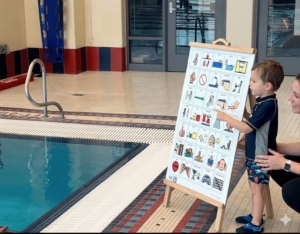
The child who screams at the pool isn’t being difficult. She may be overwhelmed and have no way to say I need a break.
The child who kicks and throws objects in the classroom isn’t defiant. He may not be able to say I don’t understand what you’re asking me to do.
The child who has a full meltdown at the park? He may simply have been trying to say I want a snack — and had no tools to do it.
This isn’t just our clinical opinion — it’s backed by a growing body of research. According to ASHA’s own guidance on augmentative and alternative communication (AAC) in early intervention, AAC plays a crucial role in supporting early language development, and there are no prerequisites for considering or introducing it — including with very young children. In other words: you don’t have to wait for a behavior to become a crisis before giving a child a tool to communicate. The tool comes first. The behavior change follows.
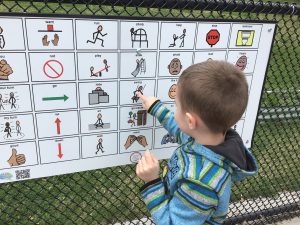
What Happened When We Introduced a Communication Board
Let us walk you through a real scenario we see play out, before and after the introduction of a playground communication board.
Before:
A child on the playground begins to whimper and stomp her feet. The caregiver tries to figure out what’s wrong, but the child cannot explain. The behavior escalates — she throws her body to the ground in a full tantrum. The caregiver’s voice rises. Eventually, the child is scooped up and removed from the playground. Everyone leaves upset. The child’s need was never identified. The underlying cause was never addressed.
Notice what’s happening here from a clinical standpoint: this isn’t a “behavior problem” in the traditional sense. It’s a communication breakdown. The child has a need — and very likely knows what that need is — but has no reliable way to express it to the adult standing right next to her. The caregiver, doing the best she can, starts guessing. Guessing takes time. Time without resolution increases dysregulation. Dysregulation becomes a tantrum. By the time the meltdown is in full swing, the original need (a snack, a turn on the slide, relief from the heat) has been buried under a wave of frustration that has nothing to do with parenting skill and everything to do with access.
After:
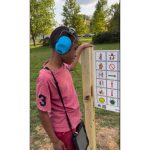
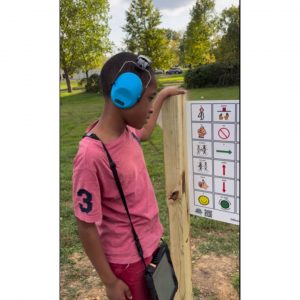
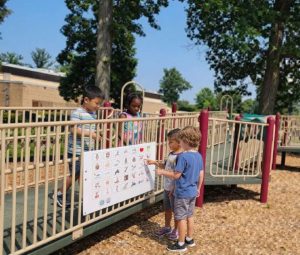
The same early warning signs appear — the whimpering, the stomping feet. This time, the caregiver leads the child to a communication board nearby. The caregiver gently models the interaction, touching icons to form the message: “I want slide” or “I am hot” — and asks the child what she needs. The child scans the board. She points to the icon for snack. The caregiver models the full message: “I want snack.” The child imitates, touching the icons herself. The caregiver brings her to a bench, gives her a snack. The child eats, and returns to play without incident.
Same child. Same environment. Completely different outcome — because she had a way to communicate.
What changed wasn’t the child’s temperament, her parenting, or her “compliance.” What changed was access. The board gave her a visual, low-pressure way to scan options and land on the right one, instead of relying on speech she may not have had readily available in a moment of rising frustration. The caregiver’s modeling — physically touching the icons herself before prompting the child — is a core AAC strategy called aided language modeling, and it’s one of the simplest, most effective things any adult can do to teach a child how the board works.
This is the difference between managing a behavior after it happens and preventing it by meeting the need underneath it.
Who Benefits From Communication Boards?
This is where we want to challenge another common assumption: communication boards are not only for nonverbal children.
Communication supports benefit a wide range of individuals, including:
- Children and adults with autism spectrum disorder
- Individuals with cerebral palsy or Down syndrome
- People who are recovering from a stroke or traumatic brain injury
- Anyone who processes information more slowly under stress or in loud, stimulating environments
- Individuals who speak a language different from their caregiver or service provider
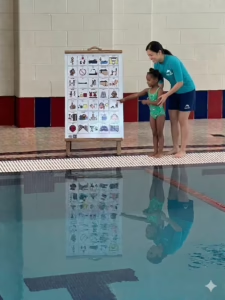
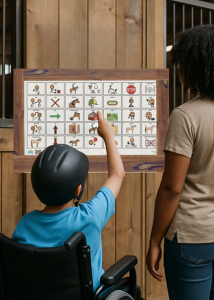
In short: any person, in any environment, who may struggle to communicate their needs in the moment can benefit from a well-designed communication board. This is why we design boards for so many different settings — from pool and aquatic centers to therapy clinics and special education classrooms, from therapeutic riding stables to schools and recreation centers. Each environment carries its own communication demands, and the vocabulary on the board should reflect that.
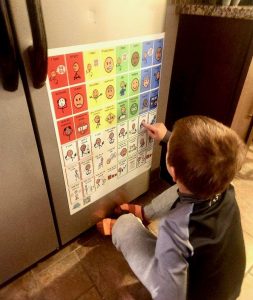
We also want to highlight a specific tool that’s especially relevant to the behavior conversation: emotional balance boards. While a core vocabulary board helps a child express a want or need (“I want snack,” “I want slide”), an emotional balance board helps them identify and name a feeling — frustrated, overwhelmed, excited, tired. For many children, the inability to name an emotion is just as much a driver of challenging behavior as the inability to request an item. Giving a child the words for “I feel frustrated” before that frustration turns into a thrown object is one of the most proactive interventions we offer. We go deeper into this in our ultimate guide to emotional balance communication boards, including how speech production itself is affected during a meltdown.
Why Environment Matters
Behavior does not happen in a vacuum. It happens on the playground. In the gym. At the pool. In the classroom. In the community.
That is exactly where communication tools need to be — not locked in a therapy room, but present and accessible in the spaces where real life happens. A communication board at the splash pad is a safety tool. A board in the park pavilion is a de-escalation tool. A board in the classroom is an academic and social tool.
When administrators and park directors make the decision to install communication boards in their spaces, they are not just accommodating individuals with disabilities. They are creating environments that are safer, more inclusive, and more functional for everyone who passes through.
Behavior and Safety Are Directly Linked
The behaviors that communication boards reduce are not minor inconveniences. They include tantrums, screaming, kicking, and throwing — and in more extreme cases, hitting, punching, flipping furniture, and physical aggression that puts both the individual and those around them at risk of injury. In each of these cases, the behavior is communicating something the person could not otherwise express. Give them a voice — and the behavior changes.
This is also why we think of communication access as a safety issue, not just a developmental one. Picture a child at a public pool who is overheated, overwhelmed by noise, or in mild distress and cannot say so. Picture a participant at a therapeutic riding center who cannot tell their instructor that they feel unsteady or unsafe on the horse. Picture a student in a gym class who cannot communicate that an activity is causing them pain. In every one of these situations, clear communication isn’t a “nice to have” — it’s the difference between a quick, calm resolution and an emergency.
This is precisely why we design boards for such a wide range of public and semi-public spaces: parks, playgrounds, pools, splash pads, gyms, recreation centers, schools, and therapeutic riding stables. Each of these environments brings people together — staff, caregivers, peers, and the individuals themselves — and every one of those interactions depends on the ability to communicate clearly, quickly, and without barriers.
A Communication Board Is Not a Last Resort
We want to be clear: a communication board is not something you pull out after everything else has failed. It is a proactive, evidence-based tool that, when introduced early and used consistently, prevents the escalation that leads to those difficult moments in the first place.
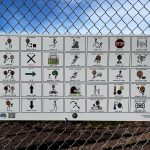
The most effective communication boards share a few key qualities. They use core vocabulary — high-frequency, flexible words like want, more, stop, help, go — that can be combined to express a huge range of needs across settings. They’re paired with adult modeling, meaning the adults around the child use the board too, rather than only prompting the child to use it — a strategy we break down further in our guide to AAC training. And they’re placed where the need actually arises, not tucked away in an office or a binder.
If you’ve heard conflicting things about communication boards — that they’ll delay speech, that a child has to “earn” one, that only nonverbal children qualify — our post on 5 myths about alternative communication (AAC) addresses these misconceptions directly with the evidence behind why they’re false.
At Resources at Lakeshore Speech, our ASHA-certified speech-language pathologists design fully customized communication boards built around the specific needs of the individual, the environment, and the population being served. We use diverse symbol systems, incorporate QR-coded caregiver support resources, and provide free customization for donor-funded placements — because we believe access to communication tools should never be a barrier. If you’re a school district or parks department wondering how to fund a project like this, we’ve put together a guide to grant and local funding resources to help you get started, and we accept official purchase orders for institutional buyers.
If you still have questions about how communication boards work, who they’re designed for, or what makes ours different, our FAQ page covers the questions we hear most often from parents, educators, and administrators.
What You Can Do Today
If you are a parent, a teacher, a school administrator, or a park or recreation director reading this — here is the most important thing we want you to walk away with:
The next time you see a behavior, ask yourself: what is this person trying to tell me?
And then ask whether they have the tools to tell you more clearly.
If you’re ready to explore custom communication boards for your home, school, or public space, we’d love to help.
👉 Request a free quote at www.lakeshorespeech.com
Resources at Lakeshore Speech is a team of ASHA-certified Speech-Language Pathologists with 60+ years of combined clinical experience. We believe communication is a human right and we build the tools to make that right accessible to everyone.