
The Assumption That Limits Impact
When a school principal or recreation director first hears about inclusive playground boards they almost always picture the same child: a non-verbal child with autism who uses AAC in the classroom. That child absolutely deserves a voice on the playground. But if that’s the only child decision-makers are picturing, they are dramatically underestimating the impact a single piece of signage can have and they are leaving a powerful funding argument on the table.
As a licensed Speech-Language Pathologist with more than 30 years of experience, this is the single most common mistake I see when communities begin exploring inclusive playground boards. They know it’s important. They just don’t know how important, or for how many. Our guide to encouraging communication board use touches on this, but it deserves a much closer look here.
Children with Communication Differences Are Just the Beginning
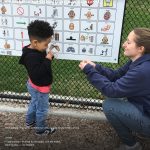
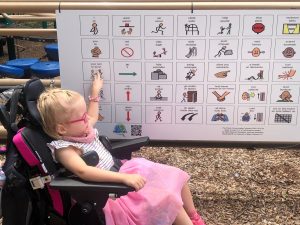
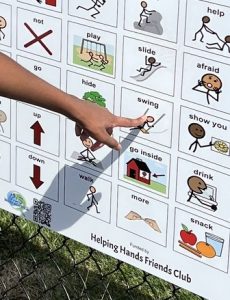
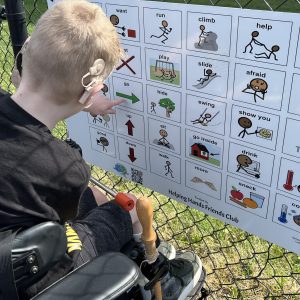
Yes, children who are non-verbal or who use Augmentative and Alternative Communication (AAC) are the most obvious beneficiaries. Well-designed inclusive playground boards gives them a consistent, familiar visual system outside the classroom — one that doesn’t require a charged device, a Wi-Fi connection, or a teacher nearby. They can point to an icon and tell a friend they want to swing, that something hurts, or that they need a break. We explored why this matters so much in outdoor settings specifically in our post on why communication boards are ideal for playgrounds and pools.
But the population that benefits from inclusive playground boards extends far beyond this group.
English Language Learners Need a Bridge Too
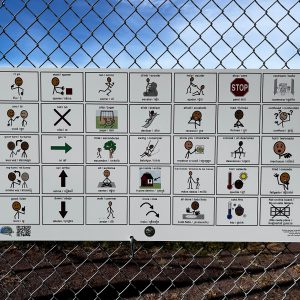
In many of the communities we serve, recreation departments and schools support children who speak little or no English at home. On the playground, these children face a communication barrier that has nothing to do with a diagnosis. Multilingual inclusive playground boards — our coummunication boards can include up to three additional languages beyond English, with a one-time setup fee per language — gives these children a shared vocabulary with their peers and their counselors from day one.
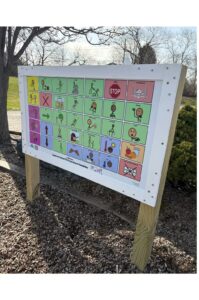
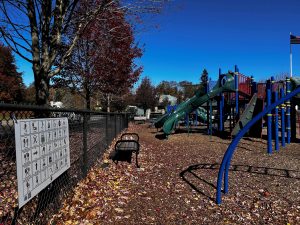
This is exactly what emerged when we began working with the City of North Olmsted Recreation Department. As conversations developed around their new playground and retrofitting their existing ones, it became clear that their summer camp population included a significant number of multilingual children alongside children with communication differences. The solution was a dual-sided camp board: one side designed for campers to express themselves, the other side designed for counselors to give directions and communicate with the group. Inclusive playground boards served everyone.
The Emergency Communication Problem Nobody Talks About
Here is the piece that stops administrators in their tracks when we discuss it, and it should.
When a child who has difficulty processing verbal information is in an emergency or distress situation, their response to spoken commands can appear to be refusal or defiance. A counselor shouts “Stop!” or “Come here!” and the child does not respond as expected. In a high-stress moment, that can be misread as willful non-compliance. In reality, the child’s brain cannot efficiently process rapid verbal directives under pressure.
Accessible playground inclusive signage in a high-traffic, easy-to-reach location gives that child and the adult working with them a visual anchor. It is not a replacement for emergency protocols. It is a critical supplement that can reduce confusion, prevent escalation, and in some situations, contribute directly to a child’s safety. This same visual-anchor principle is part of why we also build emotional balance boards for children who need a calmer, more structured way to communicate big feelings before they escalate.
Toddlers Who Are Just Beginning to Talk
Young children who are still developing functional language use pictures and symbols naturally. Inclusive playground boards mounted at the right height, we recommend the top of the board be no more than 36 inches from the ground so it is accessible to all users, becomes an intuitive tool for toddlers who are not yet reading but can point to what they want or need.
Children Who Shut Down Under Stress
Some children, including those with anxiety, sensory processing differences, or trauma histories, lose access to spoken language when they are overwhelmed. This is not a communication disorder in the traditional sense. It is a stress response. Having a visual option available on the playground means these children are not left without any way to express a need at the exact moment they need it most.
Grandparents, Caregivers, and Adults with Hearing Loss
Playgrounds are not only used by children. Grandparents and caregivers who experience hearing loss, cognitive changes, or who speak a different language than the child they are supervising can also benefit from clear, visual, inclusive playground boards.
Why This Matters When You Are Seeking Funding
When you walk into a meeting with a superintendent, a parks and recreation director, or a city council member and you present a communication board as a tool for non-verbal children only, you are presenting a narrow case. When you walk in and explain that one piece of signage serves children with autism, English language learners, children with anxiety, toddlers, children in emergency situations, and community members with hearing loss , you are presenting a civil rights and public safety case, one supported by the ASHA Communication Bill of Rights, which affirms that every person has the right to communicate regardless of the form that communication takes.
That is a much harder argument to say no to.
At Resources at Lakeshore Speech, we help our customers build that full case before they ever walk into that meeting. The science behind our layouts, the breadth of the populations served, and the evidence base behind AAC and visual supports are part of every conversation we have with a new client.
What to Do Next
If you are a teacher, SLP, PTA member, or camp director who has been thinking about bringing inclusive play signage to your playground, the first step is understanding and being able to articulate who it serves. Then you are ready to advocate. Our community engagement guide walks you through how to build that case for your specific community.
And if you want to talk through what a board could look like for your space, request a free quote and we will walk you through every detail.
Every child deserves a voice on the playground. More children than you realize are waiting for one.