
The Call That Changes Everything
Most people who contact Resources at Lakeshore Speech for the first time are not starting from zero. They have already decided they want signage for their playground. What they do not know is what happens next — what our design consultation actually looks like.
The process is simpler than most people expect. Here is exactly what the conversation looks like, from first contact to finished board.
Step One: Understanding Your Space and Your Community
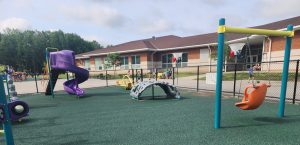
The first thing we want to know in any design consultation is where the board is going and who is going to use it. What kind of space is it — a school, a public park, a pool or splash park, a clinic? What does the surrounding community look like? What languages are spoken by the families who use this space?
These questions matter because our communication boards arenot one-size-fits-all. It is designed around the community it serves.
Step Two: The Science Behind the Layout
One of the first things we tell every new customer during their design consultation is this: you do not need to worry about which icons go where.
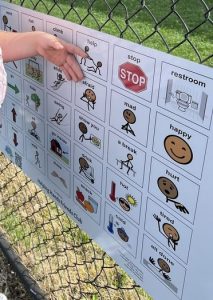
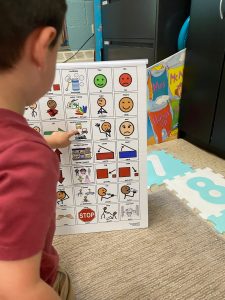
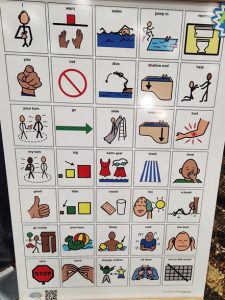
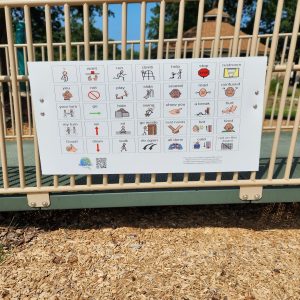
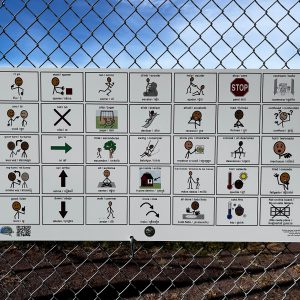
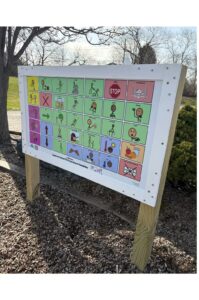
The layout of our boards is built on a scientific, evidence-based foundation developed by licensed Speech-Language Pathologists with deep expertise in AAC. Our standard board contains 35 cells, each holding an icon paired with a word or phrase covering the most functional concepts for a playground or recreational environment.
Step Three: Custom Icons for Your Specific Space
Every playground, pool, clinic or public space has something unique about it. We create custom icons for any element that is not covered by our standard vocabulary set, as part of our standard design consultation process.
This is also where the conversation about languages happens. Our boards can include up to three additional languages beyond English, each with a one-time setup fee per language. Every cell on the board can carry up to four languages simultaneously.
Step Four: Sponsor Logos at No Additional Cost
Here is something that surprises almost every customer: we can include up to four sponsor logos across the bottom of the board at no additional cost. For a Rotary Club, a Lions Club, or a local business with a genuine commitment to community inclusion, that is a meaningful offer — and one we discuss in depth in our community engagement guide.
Step Five: The Aha Moment
There is almost always a moment in a design consultation where something shifts — where the person on the other side of the table stops thinking about the board as an accommodation for a specific child and starts seeing it as something the whole community has been missing. Sometimes it happens when we talk about cost. Our boards are priced at approximately 50 percent less than comparable products on the market.
Step Six: Installation Guidance Without the Contractor Bill
We do not install the boards ourselves, and we are transparent about that from the start. What we do provide is detailed installation guidance for your building manager, grounds crew, or facilities department, including two non-negotiables: the top of the board should be no more than 36 inches from the ground, and it should be placed in a high-traffic area where it is easy to see and easy to reach. The U.S. Access Board’s accessibility guidelines for play areas support both of these recommendations.
What You Walk Away With
By the end of your design consultation, you will have a clear picture of what your board will look like, what it will cost, who it will serve, and how to get it funded and installed.
If you are ready to see what a board could look like for your space, request a free quote today.