
Beyond Requesting: Empowering Peer Connection with Playground Communication Boards & an AAC Social Script
Moving from “Requesting” to “Playing”
At Resources at Lakeshore Speech, we believe that communication is the heartbeat of human connection. For too long, the conversation around Augmentative and Alternative Communication (AAC) has been centered on “functional requesting”—teaching a child to ask for a juice box or a bathroom break. While these are vital life skills, they aren’t the things that make childhood magical. The magic happens on the playground.
When a child stands before a towering slide or a bustling sandbox, they don’t just want to “request” an object; they want to negotiate roles, crack jokes, and engage in the thrill of the chase. This transition from basic needs to social gymnastics requires a specific tool: the AAC social script.
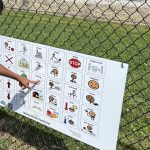
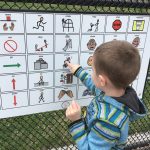
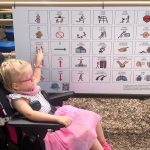
An AAC social script is a pre-planned sequence of words or symbols that helps a user navigate a specific social interaction. By using these scripts on large-scale communication boards—those durable, weather-proof signs you see in inclusive parks—we bridge the gap between “having a voice” and “having a friend.” In this definitive guide, we will explore how to use these scripts to turn every playground into a hub of inclusivity.
Why the AAC Social Script Matters for Playground Success
The playground is a high-speed environment. Decisions are made in split seconds, and social hierarchy is often determined by who can keep up with the “rules” of the game. For children with complex communication needs, the cognitive load of searching through hundreds of buttons on a personal device can sometimes lead to missing the moment.
By integrating a dedicated AAC social script into the physical environment via communication boards, we provide a visual anchor. It tells the child—and their neurotypical peers—exactly how to jump into the action. It normalizes AAC as a natural part of play, rather than a “special” tool used only in therapy.
People Also Ask: Common Questions About Playground AAC
1. What is the difference between a personal AAC device and a playground communication board?
A personal device is the user’s “voice” and contains their unique vocabulary. A playground communication board is a “universal design” tool. It provides a common language for everyone on the playground, allowing peers to model language and facilitating quick, context-specific interactions without the user needing to lug around expensive technology in a sandbox.
2. How do I encourage other children to use the board?
Modeling is key! When neurotypical children see adults and other kids pointing to symbols like “My turn” or “Run!” while playing, they realize it’s a tool for everyone. It breaks down the “us vs. them” barrier and fosters true inclusivity.
3. Are social scripts “stilted” or “unnatural”?
Initially, a script might feel structured, but it serves as a scaffold. Just as a child learns to ride a bike with training wheels, the AAC social script provides the stability needed to eventually engage in spontaneous, flexible conversation.
Evidence-Based Practice: Why We Use Scripts
Our approach at Resources at Lakeshore Speech is grounded in evidence-based practice. The American Speech-Language-Hearing Association (ASHA) emphasizes that communication is a social act. Research in the field of “Social Scripts” (Goldstein & Cisar, 1992) has long shown that providing linguistic frameworks helps children with developmental delays engage in more frequent and prolonged social interactions with peers.
Furthermore, the “Participation Model” of AAC assessment emphasizes removing barriers to participation. By installing communication boards and teaching specific AAC social scripts, we are actively dismantling the environmental and social barriers that keep children on the sidelines.
5 Essential Social Scripts for the Playground
To make the playground truly accessible, we need to look at the most common types of play. Here are five scripts designed to be used with communication boards to facilitate real-time engagement.
Script 1: The Classic Game of Tag and Hide-and-Seek
Tag is the quintessential playground game, but it’s incredibly fast-paced. A child using AAC needs to be able to claim their role immediately.
- The Script:
- “Let’s play Tag!” [model touching the pictures ‘PLAY’ ‘TAG/RUN’]
- “I’m IT!” [model touching the pictures ‘I’ or ‘MY TURN’]
- “You’re IT!” [model touching the pictures ‘YOU’ or ‘YOUR TURN’]
- “Run, run, run!” [model touching the pictures ‘GO’ or ‘RUN’]
- “Found you!” (for Hide-and-Seek) [model touching the pictures ‘FIND YOU’’]
The Goal: To establish roles and provide the “narrative” of the chase. Using an AAC social script here prevents the child from being left out of the “Who is it?” debate.
Script 2: Collaborative Play in the Sandbox
The sandbox is where early engineering and sensory play collide. Communication here is about shared goals.
- The Script:
- “Can I dig?” [model touching the pictures ‘I’ ‘PLAY’]
- “Pour the sand.” [model touching the picture ‘I’ or ‘MY TURN’]
- “Look! I built a [castle/mountain].” [model touching the picture SHOW YOU’]
- “My turn with the shovel.” [model touching the pictures ‘I’ or ‘MY TURN’]
- The Goal: Transitioning from parallel play (playing next to someone) to associative play (playing with someone). This script focuses on the exchange of materials and joint attention.
Script 3: Sensory Thrills on the Slides and Swings
This area is often about intensity and regulation. Communication boards in this zone help children advocate for their physical needs.
- The Script:
- “Go higher!”[model touching the pictures ‘GO’ ‘UP’]]
- “Push me, please.” [model touching the pictures ‘YOU’ ‘HELP’ ‘SWING’’]
- “Stop. I’m done.” [model touching the pictures ‘STOP’ ‘ALL DONE’]
- “Wait your turn.” [model touching the pictures ‘STOP’ ‘YOUR TURN’]
- “One, two, three… GO!” [model touching the picture ‘GO’]
- The Goal: Directing action and setting boundaries. The “Stop” and “Wait” functions are critical for safety and self-regulation in high-stimulation areas.
Script 4: The World of Make-Believe and Dramatic Play
Whether it’s a playhouse or a “ship” on the jungle gym, dramatic play requires the highest level of linguistic negotiation.’
- The Script:
- “Let’s pretend.” [model touching the pictures ‘I’, ‘YOU’ ‘PLAY’]
- “I’ll be the [Monster/Doctor/Chef].” [model touching the pictures ‘I’, ‘SHOW YOU’’]
- “Call the superhero for help” [model touching the pictures ‘YOU’ ‘GO’ ‘FIND’ ‘HELP’]
- “What do you want to eat?” [model touching the pictures ‘YOU’ ‘WANT’ ‘EAT’]
- The Goal: To define the “reality” of the game. Using an AAC social script for make-believe allows a child to be the director of the play, not just a bystander.
Script 5: Navigating Conflict and Resolution
Conflict is a natural part of childhood. Giving a child the words to stand up for themselves is the ultimate form of empowerment.
- The Script:
- “I don’t like that.” [model touching the pictures ‘NO’ ‘WANT’’]
- “It’s not your turn.” [model touching the pictures ‘NO’ ‘YOUR TURN’]
- “Please stop.” [model touching the pictures ‘YOU’ ‘STOP’]
- “Let’s play together.” [model touching the pictures ‘I’, ‘YOU’ ‘PLAY’]
- “I’m sorry.” [model touching the pictures ‘YOU’ ‘GOOD’]
- The Goal: Self-advocacy. When a child can use a communication board to say “I don’t like that,” they are gaining agency over their environment and their body.
Implementing Communication Boards: A Guide for Community Leaders
If you are a park director, school principal, or a motivated parent, you might be wondering how to bring these tools to your local space. Implementing communication boards is more than just hanging a sign; it’s about creating a culture of inclusivity.
Step 1: Strategic Placement
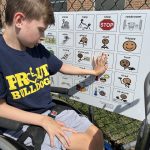
Boards should be placed at the eye level of the users (pictures considering those in wheelchairs) and located near high-tep 2: Vocabulary Selection
At Resources at Lakeshore Speech, we specialize in selecting “core vocabulary”—the 20-50 words that make up 80% of what we say. Words like “Go,” “Help,” “Stop,” and “More” are essential, alongside “fringe” words specific to the playground (e.g., “Slide,” “Swing”).
Step 3: Community Education
Host a “Play Date” where an SLP demonstrates how to use the AAC social script. Provide QR codes on the boards that link to instructional videos or downloadable versions of the board for home use.
Feature | Impact on Inclusivity |
High-Contrast Symbols | Assists users with visual impairments or CVI. |
Core Vocabulary | Allows for the widest range of expression with the fewest symbols. |
Weather-Proof Material | Ensures the “voice” of the community is always available, rain or shine. |
The Path to Empowerment: Conclusion
The playground is the first place children learn about democracy, negotiation, and friendship. By providing an AAC social script on permanent communication boards, we aren’t just helping children talk; we are helping them belong.
We move away from the clinical setting and into the sunlight, where every child—regardless of their verbal ability—can shout “Let’s PLAY!” and feel the rush of being part of the pack. This is the heart of inclusivity. It is the belief that every voice deserves to be heard, especially when that voice is playing.
Ready to Build an Inclusive Playground?
At Resources at Lakeshore Speech, we are dedicated to bringing these tools to every community. Whether you are a parent looking for a home-based AAC social script or a city official ready to install communication boards in your local parks, we are here to guide you.
Contact us today at www.lakeshorespeech.com to begin the process of ordering your custom communication boards and training your staff on the power of inclusive play. Together, we can make sure no child is left on the sidelines.
The goal of an AAC social script is not perfection; it is participation. When we prioritize connection over correction, we open up a world of possibilities for our children. Let’s get outside and play traffic areas like the entrance, the sandbox, or the swing set.
Final Takeaway:
The goal of an AAC social script is not perfection; it is participation. When we prioritize connection over correction, we open up a world of possibilities for our children. Let’s get outside and play!