
At Resources at Lakeshore Speech, we believe that every child deserves a voice, regardless of their location. Whether they are at the local playground, in the school cafeteria, or navigating a public park, the ability to connect with others is a fundamental human right. However, for non-speaking individuals or those who use Augmentative and Alternative Communication (AAC), the world can often feel silent and exclusionary.
One of the most effective ways to bridge this gap is through the installation of large-scale, weather-proof communication boards. These tools provide a visual language system that allows everyone to interact. Yet, the most common hurdle we hear from dedicated parents and educators is: “How do we pay for this?”
The truth is that funding communication boards is not as daunting as it seems. While you might not see a specific line item in a budget labeled “communication board,” the funds are hidden in plain sight under categories like accessibility, civil rights, and educational equity. This guide will walk you through the evidence-based strategies to secure these funds and transform your community into an inclusive haven.
Why Funding Communication Boards is a Community Priority
Before diving into the “how,” we must understand “the why.” In the world of Speech-Language Pathology, we often refer to the Communication Bill of Rights. This document, supported by the American Association of Speech-Language-Hearing Association (ASHA), asserts that all people have the right to request objects, actions, events, and people, and to express personal feelings or beliefs.
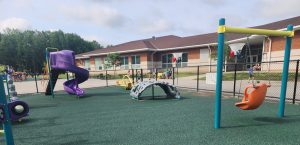
When a park or school lacks an AAC board, a child who uses a high-tech device or non-verbal cues is effectively silenced the moment they step outside. By funding communication boards, you are not just buying a sign; you are:
- Promoting Universal Design: Making spaces usable by all people to the greatest extent possible without the need for adaptation.
- Enhancing Safety: Allowing a child to quickly communicate pain, fear, or a need for help in a crowded public space.
- Fostering Social Inclusion: Giving neurotypical children the tools to initiate play with their neurodivergent peers.
Understanding the Primary Pathways for Funding Communication Boards
To successfully navigate the financial landscape, you have to speak the language of the funders. Most organizations don’t realize that an AAC board qualifies as “Assistive Technology” or “Environmental Modification.” Here are the heavy hitters in the funding world:
1.IDEA Part B(Special Education Funds)
For schools, the Individuals with Disabilities Education Act (IDEA) is the gold standard. Under Part B, funds are allocated to ensure a Free Appropriate Public Education (FAPE).
- Assistive Technology: If a student requires a communication board to access their playground or common areas as part of their IEP (Individualized Education Program), these funds can be utilized.
- Supplementary Aids and Services: This category covers the extra support needed to help a child participate in regular education environments.
2. ADA Compliance and Civil Rights
The Americans with Disabilities Act (ADA) mandates that public entities provide equal access.
- Barrier Removal: If a park is undergoing a renovation, adding an AAC board can be classified as a “communication access improvement.”
- Transition Grants: Many local governments have specific funds set aside for ADA transition plans to make their public spaces more compliant.
3. Community Development Block Grants (CDBG)
Administered by HUD (Housing and Urban Development), these grants are designed to develop viable communities by providing decent housing and a suitable living environment—particularly for persons of low and moderate income. Disability access is a major pillar of this funding.
Key Secondary Keywords: Using an AAC Board to Leverage Local Grants
When searching for local money, using the term communication boards is helpful, but focusing on the impact of the AAC board is what wins the grant. Local organizations love projects with tangible, visual results.
The Power of Local Service Clubs
Groups like Rotary International, Kiwanis, and the Lions Club have long histories of supporting children’s health and community accessibility.
- The Strategy: Present these groups with a “turnkey” project. Show them the design of the communication boards, explain the cost of installation, and offer to put their logo on the board as a “sponsored by” recognition.
- The Result: Many communities have found that a single presentation to a local Rotary Club results in the full funding of a board within weeks.
PTAs and Local Education Foundations
Parent-Teacher Associations are often looking for legacy projects—something that will stay at the school for years. A communication board on the school playground is a perfect candidate because it serves every grade level and creates a culture of kindness from day one.
Frequently Asked Questions About Funding Communication Boards
How much does a professional communication board typically cost?
While prices vary based on size and material, a high-quality, durable outdoor AAC board typically ranges from $550 to $3,500. This includes the design, heavy-duty weatherproofing, and mounting hardware. While this may seem high, when compared to the cost of a single piece of playground equipment (which can exceed $10,000), it is one of the most cost-effective ways to increase playground utility.
Can we use “Mental Health” or “Public Health” funds?
Absolutely. Lack of communication leads to frustration, behavioral outbursts, and social isolation—all of which are public health concerns. Many Health and Human Services (HHS) grants for “Community Wellness” or “Mental Health Support” are applicable because these boards reduce the stressors associated with communication barriers.
Who is responsible for the maintenance of the board?
When funding communication boards through a city or school district, maintenance usually falls under the Parks and Rec or Facilities department. Because the boards are made from high-grade aluminum or anti-graffiti laminate, maintenance is minimal—usually just a wipe-down during regular cleaning cycles.
Can we use more than one funding source?
The “Stacking” Strategy
The most successful projects don’t rely on one check. They “stack” their layers:
- Layer 1: A grant covers the physical AAC board cost.
- Layer 2: A local business or service club covers the professional installation.
- Layer 3: The existing staff budget covers a 1-hour training session for teachers or park rangers on how to model the board.
Mastering the Justification Language: What Funders Need to Hear
To secure funding communication boards, your application must be precise. Funders aren’t just looking for “a sign”; they are looking to solve a problem. Your justification language should focus on these four pillars:
- The Population: “This project serves non-speaking students, individuals with Autism, those with expressive language delays, and English Language Learners (ELL).”
- The Barrier: “Currently, there is a ‘communication gap’ on our playground that prevents 15% of our student body from safely and effectively interacting with peers.”
- The Outcome: “Expected outcomes include a 40% reduction in playground-related behavioral incidents and a measurable increase in peer-to-peer social engagement.”
- The Necessity: “This is a necessary step in meeting our ADA obligations for ‘effective communication’ and ensuring that our facilities are truly inclusive.”
Pro Tip: At Resources at Lakeshore Speech, we provide custom justification language for communities at no cost. You give us 10 minutes of your time to describe your space, and we provide the text you need to get your board funded.

Evidence-Based Practice: Why SLPs Advocate for Physical Boards
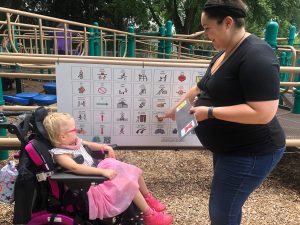
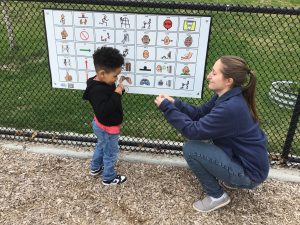
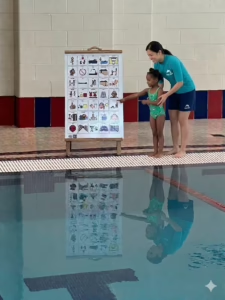
As Speech-Language Pathologists, we follow the evidence. Clinical observations and ASHA standards emphasize Modeling (also known as Aided Language Stimulation). This is the process where a communication partner points to symbols on a board while speaking.
Research shows that:
- Visual supports increase the speed of language acquisition.
- Providing a permanent visual display (like a large AAC board) reduces the cognitive load on a child who struggles to process spoken words.
- Augmentative communication does not stop a child from learning to speak; in fact, it often encourages vocalizations by reducing the pressure of communication.
By funding communication boards, you are applying these clinical gold standards to the “real world,” ensuring that the progress a child makes in a therapy room isn’t lost the moment they go outside to play.
Navigating the Challenges of Funding Communication Boards
While the path is clear, there are often minor hurdles. Here is how to leap over them:
“We don’t have enough space.”
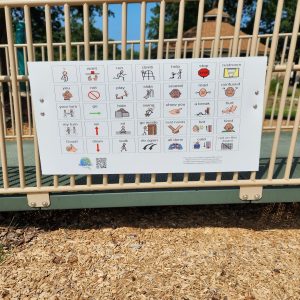
Communication boards come in various sizes. If a large freestanding kiosk isn’t an option, consider fence-mounted versions or smaller “communication stations” at key points (the swing set, the slide, the gate).
“What if it gets vandalized?”
High-quality communication boards are built with anti-graffiti coatings. Most markers and spray paints can be removed with simple solvents without damaging the icons. When presenting to a city council, emphasize the durability of the materials—this is a 10-year investment, not a temporary fix.
“Our staff doesn’t know how to use it.”
This is where Resources at Lakeshore Speech comes in. We don’t just provide the boards; we provide the roadmap for implementation. Funding can often include a small “professional development” line item to ensure that everyone from the gym teacher to the park gardener knows how to point to “Go,” “Stop,” and “Play.”
The Community Impact: A Legacy of Inclusion
When a community succeeds in funding communication boards, the atmosphere changes. It sends a silent but powerful message to families: “You belong here. We see you, and we have prepared a place for you.”
For a parent of a non-speaking child, seeing an AAC board at a local park is an invitation to exhale. It means they don’t have to carry a heavy device into a sandbox or worry that their child will be misunderstood by a new friend. It creates a “universal language” that transcends diagnoses and age groups.
Furthermore, these boards benefit more than just the disability community. They are used by:
- Toddlers who are just beginning to develop functional language.
- Grandparents who may have hearing loss or cognitive changes.
- Non-English speakers who can use the universal icons to communicate basic needs.
Conclusion: Start Your Journey Toward an Inclusive Community Today
Funding communication boards is not an expense—it is an investment in the social fabric of your neighborhood. Whether you leverage federal IDEA funds, tap into local Rotary clubs, or utilize ADA transition grants, the money is available. The key is to stop seeing the board as a “nice to have” and start seeing it as a civil rights necessity.
At Resources at Lakeshore Speech, we are more than just experts in communication; we are your partners in advocacy. We know the clinical benefits of communication boards, and we know the administrative hurdles of funding communication boards.
Are you ready to give your community a voice? Don’t let a lack of budget stand in the way of inclusion. Empowerment starts with a single conversation. Contact Resources at Lakeshore Speech today to receive your free justification language and start the process of ordering your communication boards. Together, we can ensure that no child is left out of the conversation.
Action Checklist for Successful Funding of Communication Boards:
- [ ] Identify your site: Where would a board have the most impact?
- [ ] Identify your “Stack”: Which two funding sources can you combine?
- [ ] Request Justification: Contact us for the specific wording for your grant.
- [ ] Present to Stakeholders: Use our evidence-based talking points to win approval.
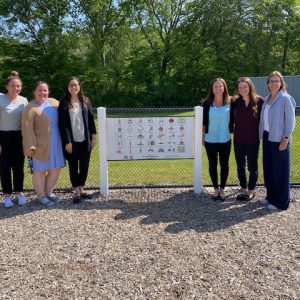
- [ ] Install and Celebrate: Hold a ribbon-cutting ceremony to show your community that everyone has a voice!


1 Comment
[…] Stories with concrete results help justify budgeting, grants, and district allocations. Explore options in our guide on funding communication boards. […]
Comments are closed for this article!