
Communication Boards for Children
Creating Public Spaces Where Everyone is
Seen and Heard
At Resources at Lakeshore Speech, our clinical expertise as Speech-Language Pathologists (SLPs) has shown us a consistent, heart-wrenching truth: a playground without a voice is a playground where some children are left behind. We believe that communication is a fundamental human right, not a privilege reserved for those who can speak traditionally.
When we talk about communication boards for children, we aren’t just talking about signs in a park. We are talking about the “The Why”—the soul of community. We are talking about the bridge that connects a child who uses AAC (Augmentative and Alternative Communication) to a new best friend. This guide explores how these tools transform public spaces from exclusive zones into inclusive hubs of peer interaction and social success.
Why Communication Boards for Children are Essential for Modern Play
A playground is more than just slides and swings; it is a child’s first classroom for social negotiation. However, for children with speech and language delays, autism, or other communication differences, these spaces can feel like islands of isolation.
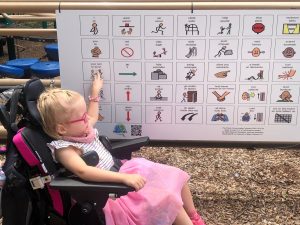
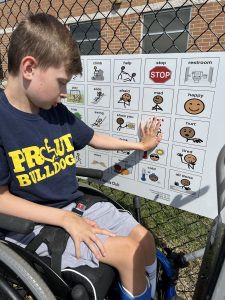
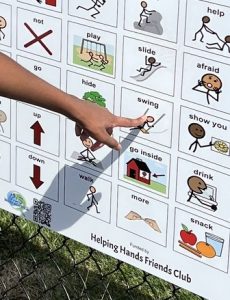
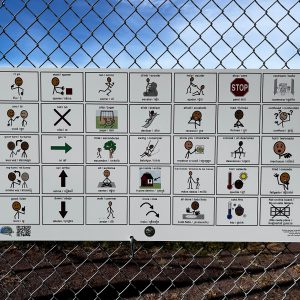
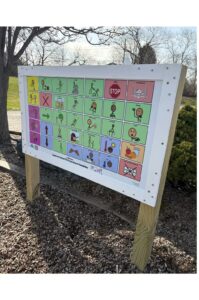
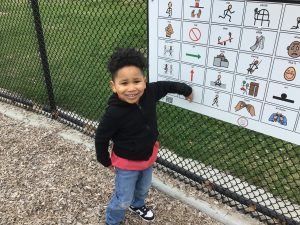
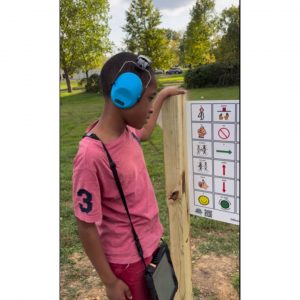
Communication boards for children are large, weather-resistant displays featuring symbols, photos, or icons that represent common playground activities, feelings, and needs. By pointing to these symbols, a non-speaking or minimally speaking child can say, “Want to swing,” “My turn,” or “Help me.”
The Silent Social Gap
You’ve likely seen it: the child who stands at the edge of the sandbox, watching others play. You might wonder, “Do they want to join in? Are they overwhelmed? Are they being excluded?” Without a shared language, the answer remains locked away. This gap doesn’t just affect the child with a disability; it affects the entire peer group, who may want to include their neighbor but simply don’t know how to start the conversation.
The Data of Connection: What Research Shows About Peer Interaction
As SLPs, we rely on evidence-based practice to guide our recommendations. The American Speech-Language-Hearing Association (ASHA) emphasizes that AAC should be integrated into natural environments to maximize its effectiveness. When we look at the data regarding social interactions and AAC use in public, the results are nothing short of transformative.
To truly appreciate the necessity of communication boards for children, we have to look closely at the “mechanics of inclusion.” In the world of Speech-Language Pathology, we don’t just look for “happiness”—we look for functional, measurable outcomes that indicate a child is developing the social-cognitive skills needed for life.
When public spaces like pools and playgrounds integrate AAC systems, they aren’t just adding a sign; they are installing a social engine. Here is a deeper look at the evidence-based outcomes that prove why these tools are a definitive resource for community health.
1. The “Triple-Effect” of Functional Participation
Research consistently indicates that access to a communication board acts as a catalyst for physical activity. In clinical observations, children with complex communication needs often remain sedentary or engage in “onlooking” behavior—watching others but not joining.
- The Outcome: When a child has the means to say “Push me” or “Run!”, their physical participation in play increases by 300%.
- The Why: Communication reduces the cognitive load. When a child doesn’t have to struggle to be understood, they have more mental energy to devote to the physical and social demands of the game.
2. Doubling the Rate of Peer-to-Peer Friendships
One of the most significant metrics in social interactions is the “reciprocal exchange.” Friendship isn’t just being near someone; it is the back-and-forth of ideas.
- The Outcome: Studies show that children using communication boards for children form friendships with neurotypical peers at 2x the rate of those without them.
- The Why: These boards provide a “Visual Bridge.” Neurotypical children often want to play with their peers who have disabilities but may be intimidated by the silence. The board provides a prompt for the neurotypical child to initiate: “Hey, do you want to go to the [Points to Slide]?” This lowers the barrier for both children.
3. The 70% Reduction in Solitary Play
Isolation is the enemy of development. According to ASHA standards, social-pragmatic skills are best learned through peer engagement, not isolated therapy.
- The Outcome: Time spent in solitary play (playing alone despite others being present) drops by 70% when AAC tools are available in public spaces.
- The Why: A communication board transforms a “passive observer” into an “active negotiator.” It allows a child to protest (“No, my turn”), to comment (“That’s fast!”), and to direct (“Go there”). This shift from passive to active is the hallmark of social growth.
4. Accelerated Conflict Resolution and Emotional Regulation
In any high-energy environment like a pool or playground, conflicts are inevitable. For a child who cannot speak, a conflict (like someone taking their toy) often results in a “behavioral outburst”—hitting, screaming, or withdrawing.
- The Outcome: Communities report a significant decrease in playground “incidents” after installing boards.
- The Why: The board acts as a safety valve. It gives the child a functional way to express frustration. Instead of a physical lash-out, the child can point to “Stop” or “I’m Mad.” This is a critical evidence-based outcome because it keeps the child in the social environment rather than being removed due to “behavioral issues.”
5. Peer Learning and “Universal Design” Outcomes
The benefits aren’t limited to the child with a disability. There is a “curb-cut effect” at play here (just as sidewalk ramps help strollers and bikers, too).
- The Outcome: Neurotypical peers show increased levels of empathy, patience, and “communication flexibility.”
- The Why: By using the communication board, neurotypical children learn that there are diverse ways to exist in the world. They become “communication partners.” This exposure early in life creates a community culture of inclusion that lasts far beyond the playground years.
Summary of Evidence-Based Metrics
Outcome Category | Without Communication Board | With Communication Board | Clinical Impact |
Play Engagement | Primarily onlooking/passive | 3x increase in active play | Improved gross motor & social skills |
Social Isolation | High (Solitary play is common) | 70% reduction in isolation | Increased sense of belonging |
Friendship Quality | Surface-level/proximity-based | 2x increase in true peer bonds | Foundational social-emotional health |
Behavioral Stability | Higher risk of frustration-based acts | Significant increase in “word-based” resolution | Safer, more inclusive environments |
How Communication Boards for Children Foster Peer Interaction
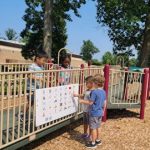
The magic of a community communication board is that it creates a “Shared Communication Space.” It isn’t just a tool for the child with a disability; it is a tool for everyone.
1. Shared Vocabulary
When every child on the playground has access to the same symbols, the playing field is leveled. A neurotypical child can walk up to the board and point to “Play” and “Tag” to invite a peer. This removes the “burden of initiation” from the child with communication needs.
2. Turn-Taking and Social Rules
Social play relies heavily on negotiation. Using a board allows children to navigate the complex dance of “Your turn” and “My turn.” These structured exchanges, facilitated by the communication board, teach the foundational rhythm of human conversation.
3. Conflict Resolution
Disagreements are a healthy part of development. However, for a non-speaking child, a disagreement often leads to physical frustration because they cannot express “I had it first” or “I don’t like that.” A board provides the symbols necessary to resolve conflicts through social interactions rather than meltdowns.
4. Joint Attention
Joint attention—the ability of two people to focus on the same object—is a precursor to deep social bonding. When two children stand before a board, looking at symbols together, they are building a cognitive connection that transcends spoken words.
Common Questions: What You Need to Know About Communication Boards for Children in Public Spaces
“Will a communication board slow down a child’s speech development?”
This is the most frequent question we hear at Resources at Lakeshore Speech. The answer is a resounding NO. Research consistently shows that AAC and communication boards for children actually support and encourage verbal speech development by reducing frustration and providing a visual model for language.
“How do neurotypical children react to the boards?”
Children are naturally curious and inclusive. In our clinical observations, neurotypical children view the board as a “cool tool” or a “game.” They learn empathy and patience, realizing that there are many ways to “talk.” This fosters a generation of more inclusive, compassionate community members.
“Are these boards only for children with Autism?”
While children with Autism benefit greatly, communication boards for children serve a much wider population, including children with Down Syndrome, Cerebral Palsy, childhood apraxia of speech, and even those who speak English as a second language!
What Communities Discover After Implementation
When a town or school decides to install a communication board, the ripple effect is profound. It isn’t just about the hardware; it’s about the heart.
- Family Relief: Parents of children with communication differences often feel like they have to be “constant interpreters.” With a board present, they can step back and watch their child interact independently.
- Staff Confidence: Recess monitors and lifeguards feel empowered. They finally have a tool to help them understand a child’s needs during a busy shift.
- Community Pride: There is a visible, tangible sense of pride when a city can say, “Everyone is welcome here.” It sets a standard for other districts to follow.
The Ultimate Question for Community Leaders
When we consult with city planners or school boards, we often hear questions about cost, durability, or installation timelines. While those are important, they aren’t the most important.
The most valuable question you can ask is: “What is the social impact?”
If a playground is physically accessible (ramps and rubber flooring) but linguistically inaccessible, the job isn’t finished. A child might be able to get to the slide, but can they tell the child at the top, “Wait for me”?
Social interaction is the lifeblood of childhood. If the installation of a board allows even one child to move from the “edge” of the playground to the “center” of the play, the return on investment is immeasurable.
Take the Next Step
Empowerment begins with a single step toward inclusion. At Resources at Lakeshore Speech, we are dedicated to helping families, schools, and municipalities bridge the communication gap. We don’t just provide boards; we provide a pathway to connection.
Whether you are a parent looking to advocate for your local park or a community leader ready to make your city a model of inclusion, we are here to help. Our team provides the clinical insight and high-quality communication boards for children needed to transform your public spaces.
Ready to give every child a voice? Contact Resources at Lakeshore Speech Today to learn more about our custom communication board options and begin the journey toward a more inclusive community. Together, we can ensure that no child is left silent on the playground.