
Why Every Park Needs Multi-Lingual Communication Boards
Communication Boards:
Quick Facts & Key Takeaways
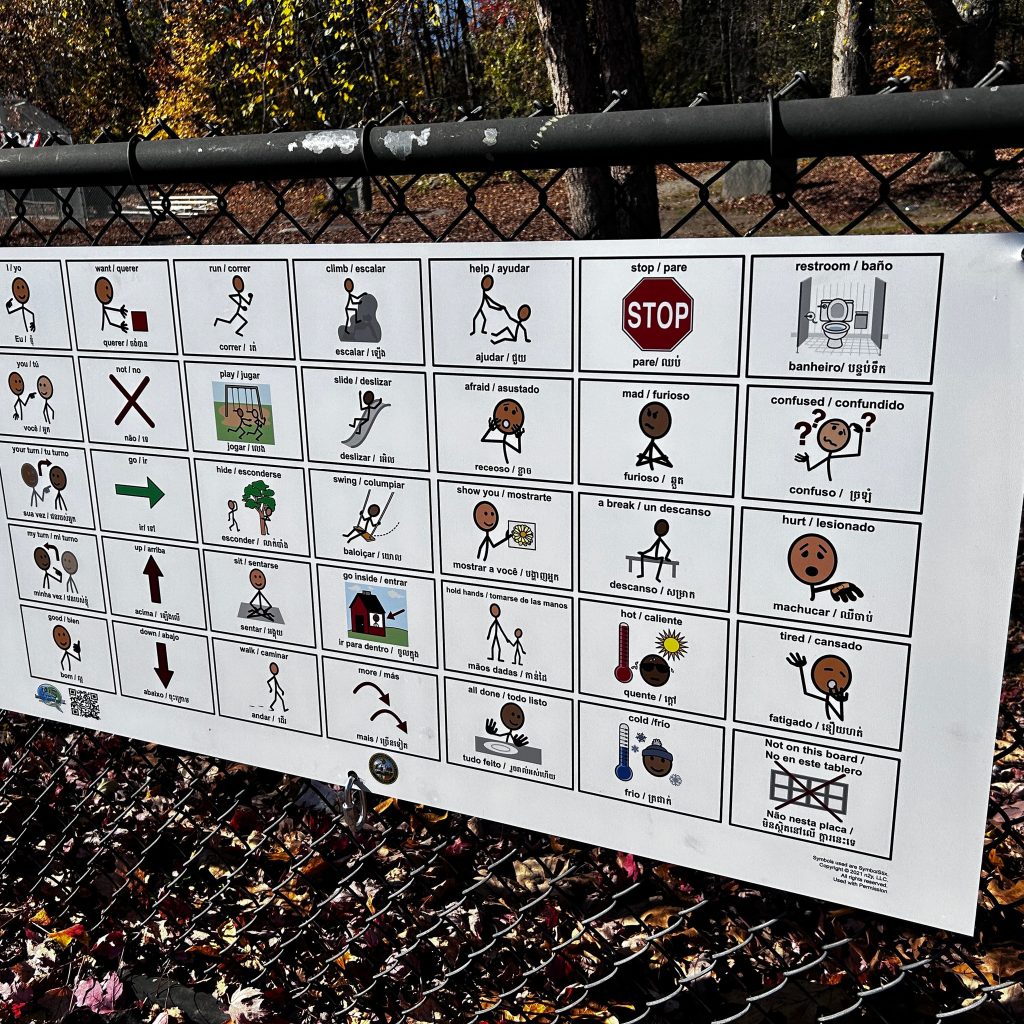
What they are: Large, weather-resistant signs featuring symbols and text (icons) that allow non-verbal or multi-lingual children to communicate.
The Goal: To ensure every child, regardless of their native language or physical ability, can ask to “swing,” “slide,” or “play together.”
Evidence-Based: Supported by ASHA standards for Augmentative and Alternative Communication (AAC).
Community Impact: Enhances social-emotional learning and fosters a sense of belonging for English Language Learners (ELL).
Breaking the Silence on the Playground
At Resources at Lakeshore Speech, we believe that communication is a fundamental human right, not a privilege. Yet, for many children, the playground—a place meant for joy and connection—can be a source of profound isolation. Imagine a child who has the perfect idea for a game but lacks the spoken words to invite a peer. Now, imagine that same child is also navigating a world where their home language isn’t the primary one spoken at the park.
This is where communication boards step in as a transformative tool for equity. In our rapidly diversifying communities, the need for inclusive signage has never been greater. By integrating bilingual and multi-lingual AAC (Augmentative and Alternative Communication) systems into public spaces, we are not just installing a sign; we are building a bridge. This guide serves as the definitive resource for families, educators, and community leaders on how “The Multi-Lingual Playground” can change the landscape of childhood forever.
What Are Communication Boards and Why Do They Matter?
To understand the impact of a communication board, one must first understand AAC. In the world of Speech-Language Pathology, AAC encompasses all the ways we share our ideas and feelings without talking.
The “Why” Behind the Board
For a child with Autism, a speech delay or a child who is an English Language Learner (ELL), the playground is a high-sensory environment. The noise, the movement, and the social pressure can make verbalizing thoughts difficult. A communication board provides a static, visual reference. It doesn’t move, it doesn’t disappear after it’s said, and it provides a “common language” for everyone on the mulch.
Furthermore, these communication boards act as a safety net. If a child is hurt or overwhelmed, they can point to “hurt” or “stop” even when their words fail them. By placing these tools in public view, we normalize different ways of communicating, reducing the stigma surrounding disabilities and language differences.
The Power of Multi-Lingual Communication Boards
While a standard English board is a great start, a truly inclusive community looks at its demographic data. In many neighborhoods, Spanish, Mandarin, Arabic, or Vietnamese are spoken just as frequently as English.
Supporting ELL and Bilingual Students Outdoors
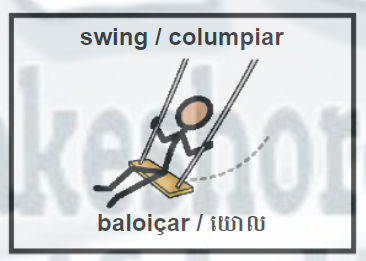
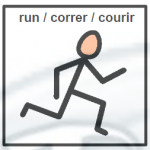
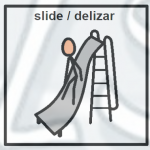
Dual-language communication boards provide a unique “scaffolding” effect. For a child learning English, seeing the word “Slide” paired with the Spanish word “Tobogán” and a clear icon of a slide provides immediate context. It honors their native language while supporting their acquisition of a second one.
Key Benefits of Dual-Language Boards:
Validation: It tells families, “You belong here, and your language is valued.”
Cognitive Development: Research shows that bilingualism enhances executive function; these communication boards encourage all children to engage with multiple languages.
Social Equity: It levels the playing field, ensuring that a language barrier doesn’t prevent a child from making a friend.
Layout Strategies: Designing for Clarity
A common concern among community leaders is: “Won’t adding a second language make the board too cluttered?” The answer lies in strategic design. As experts in visual communication, we follow specific layouts to ensure the board remains functional.
Stacking English and a Second Language
To maintain “scannability,” we often recommend a consistent hierarchy.
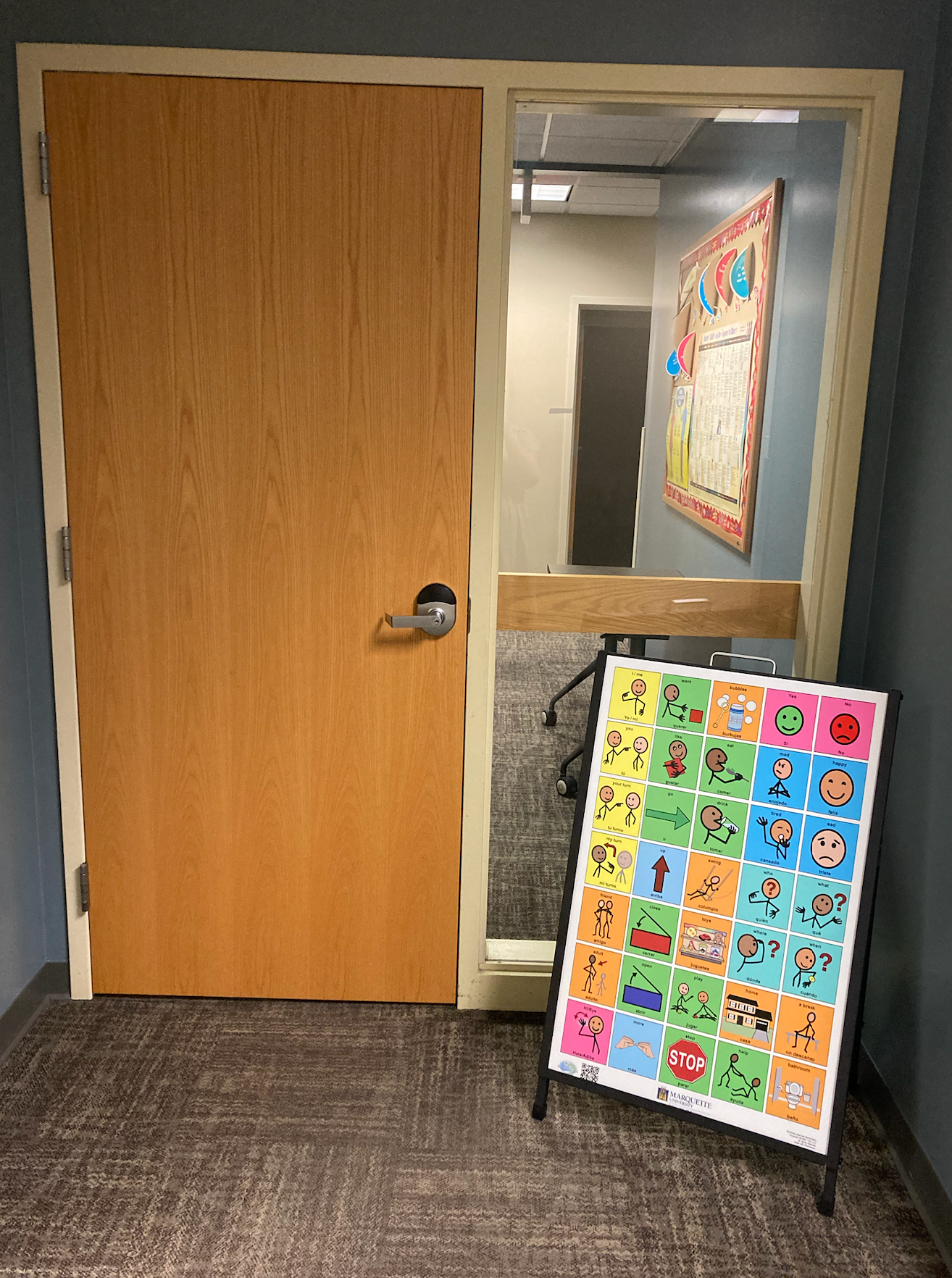
Symbol First: The icon (the picture) should be the largest element, as it is the universal language.
Color Coding: Using the Modified Fitzgerald Key—a system where different parts of speech (verbs, nouns, social words) are color-coded—helps the eye find what it needs quickly.
Language Placement: We typically place the English word at the top and the second language directly beneath it in a slightly different font or color. This consistency allows the brain to “filter” for the language it needs without losing the icon’s meaning.
Translation vs. Localization: Capturing the Spirit of Play
One of the biggest mistakes in creating multilingual boards is relying on “Literal Translation.” A dictionary might tell you one thing, but the “spirit” of the play-word is what matters.
Clinical Insight: In Speech-Language Pathology, we call this “localization.” For example, the English word “cool” might mean “chilly” or “awesome.” On a playground, we want the “awesome” version.
When we design these boards at Resources at Lakeshore Speech, we work with native speakers to ensure that the terms used are the ones children actually use in their culture. We aren’t just translating words; we are translating the experience of joy.
Evidence-Based Practice: What the Research Says
Our recommendations aren’t just based on “good feelings”—they are rooted in science. The American Speech-Language-Hearing Association (ASHA) emphasizes that AAC should be provided in a child’s primary language to support identity and family bonding.
The Robustness of Visual Supports
Studies in the Journal of Speech, Language, and Hearing Research indicate that visual supports significantly reduce “communication breakdowns.” On a playground, a breakdown often looks like a tantrum or a child withdrawing from play. When a communication board is present, the “success rate” of social interactions increases because both the speaker and the listener have a visual anchor.
Additionally, the “Modeling” method (where a parent or peer points to the icons while speaking) has been proven to accelerate language learning for both neurotypical and neurodivergent children.
Addressing “People Also Ask”
How do I choose which languages to include?
Start with your local school district’s data. Which languages are most represented in their ESL/ELL programs? Most communities opt for a bilingual board (e.g., English/Spanish), but tri-lingual communication boards are becoming increasingly popular in metropolitan hubs.
Where is the best place to install a communication board?
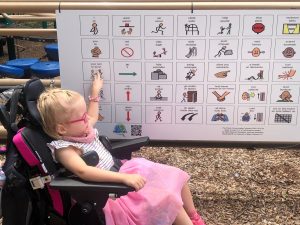
Visibility is key. We recommend placing communication boards near the entrance of the play area and at the “hub” (usually near the swings or the main play structure). It should be at a height accessible to children in wheelchairs and toddlers alike.
Will these boards get vandalized?
Our communication boards are manufactured using high-grade, UV-resistant, and graffiti-proof materials. While no public sign is 100% immune, we find that when a community understands the purpose of the board—helping children—there is a high level of respect for the installation.
Benefits for All: A Lesson in Empathy
Perhaps the most beautiful “side effect” of playground communication boards is how they affect neurotypical, English-speaking children. When a child sees a peer using a board, they don’t see a “disability”; they see a different way to talk.
Children are naturally curious. They will ask, “What is that sign?” This provides a perfect opening for parents and educators to talk about diversity, inclusion, and the many ways people experience the world. It teaches the next generation that if someone can’t speak your language, you find another way to listen.
Empowering Every Voice
The installation of a communication board is a declaration. It says that every child’s voice matters. It says that “inclusion” isn’t just a buzzword; it’s a physical reality built into the fabric of our parks.
At Resources at Lakeshore Speech, we are proud to be at the forefront of this movement. We provide the expertise needed to select the right vocabulary, the right layout, and the right languages to serve your specific community. By bringing multilingual AAC to your local playground, you aren’t just changing a park—you’re changing the life of every child who finally feels “heard” for the first time.
Ready to make your playground a truly inclusive space?
Don’t wait for another child to feel left out of the game. Contact us today to learn about our custom communication boards and how we can help you lead the way in community accessibility.
Frequently Asked Questions
Q: Are communication boards only for children with autism?
A: Not at all! They help children with Down syndrome, cerebral palsy, speech delays, ELL students, and even toddlers who haven’t found their words yet.
Q: Can these be used in schools?
A: Absolutely. Communication boards are perfect for recess areas, gyms, and cafeterias to support social interaction outside the classroom.
Q: How do we teach kids to use them?
A: It’s simple: Model, Model, Model. When you say, “Let’s go to the swing,” point to the “Swing” icon on the board. Kids will mimic what they see!
Q: Are the boards ADA compliant?
A: When installed at the correct height and on an accessible path, they are a major asset to ADA-compliant playground designs.
Q: How much do they cost?
A: Pricing varies based on size and customization. Reach out to our team for a quote tailored to your community’s needs!