The North Olmsted Story: A Full Grant Win

A Vision Without a Budget Is Still a Vision Worth Having

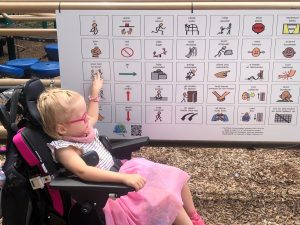
When the City of North Olmsted Recreation Department first reached out to Resources at Lakeshore Speech, they already knew what they wanted. They had a new playground going in, existing playgrounds that needed to be retrofitted, and a genuine commitment to making their spaces inclusive and accessible for every child in their community. What they did not have was a clear path to paying for it.

This is the most common place communities find themselves. The vision is there. The will is there. The budget is not — at least not yet. Our community engagement guide covers how to build that vision into a case for stakeholders, but North Olmsted‘s story shows what happens once that case is built.

The Conversation That Changed the Scope

When we sat down with the director of the North Olmsted Recreation Department, the conversation quickly expanded beyond a single board on a single playground sign installation. As we talked through the populations they served — the children with communication differences, the families who spoke languages other than English at home, the summer campers who came with a wide range of needs — it became clear that one board was not going to be enough.

It also became clear that their summer camp program had a specific and underserved need. Counselors were working with children who were multilingual, non-verbal, or both, and there was no consistent visual communication system in place to support either group.

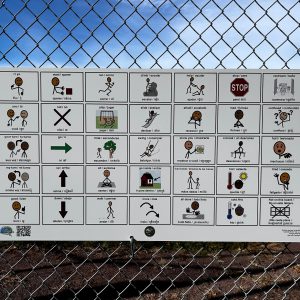
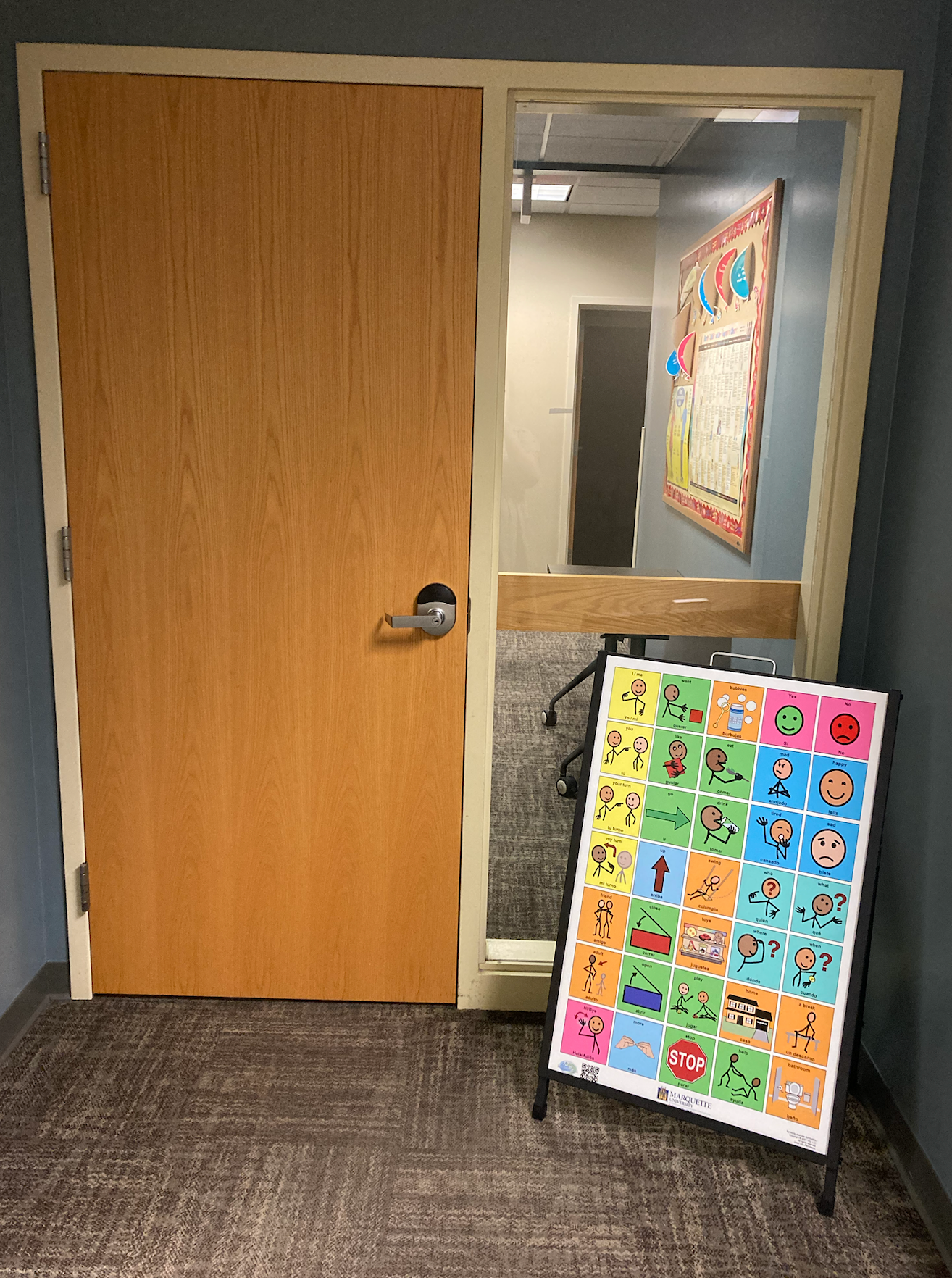
Out of that conversation came an idea we had not originally planned for: a dual-sided camp communication board. One side was designed for campers — giving children a way to express themselves, make requests, indicate needs, and interact with peers. The other side was designed for counselors — providing a visual system for giving directions, managing group transitions, and communicating clearly with children who could not reliably process rapid verbal instructions.

This is the kind of customization that comes from a real conversation, not a catalog order. And it is the kind of solution that funders find compelling, because it solves multiple problems with a single investment.

Where the Money Came From

The North Olmsted Recreation Department staff did the hard work of researching their funding options, and they found it in a place that surprises many of our customers: the Cuyahoga County Board of Developmental Disabilities.

County Boards of Developmental Disabilities exist in every county in Ohio, and similar agencies exist in some form in most states across the country. Their mission is to support individuals with developmental disabilities and to fund initiatives that improve access, inclusion, and quality of life in the community. The National Association of County Behavioral Health and Developmental Disability Directors is a useful starting point if you want to find your own county’s equivalent agency.

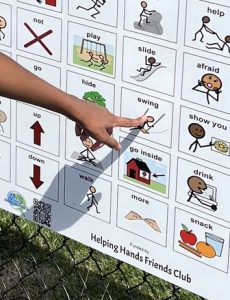
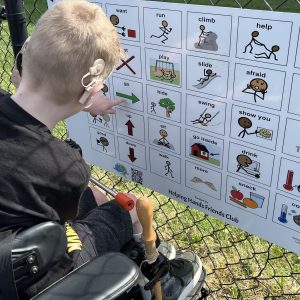
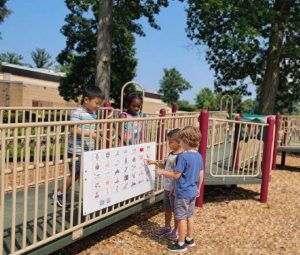
The grant covered the full cost of all the boards North Olmsted needed — the new playground installation, the retrofits on the existing playgrounds, and the camp boards. What began as a budget problem became a fully funded, multi-site project.

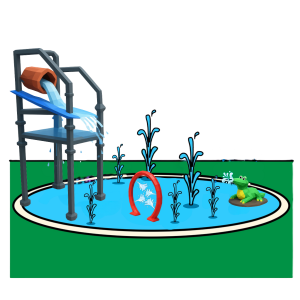
purchase process
North Olmsted

What North Olmsted Got Right

There are a few things the North Olmsted team did that made their funding effort successful, and they are worth noting for any community that wants to follow a similar path.

  • They started with a clear vision of what they wanted and where they wanted it, which made the scope of the project easy to communicate to a funder.
  • They expanded their thinking beyond a single board when the conversation revealed a broader need, which made the project more impactful and more fundable.
  • They identified a funding source that was specifically aligned with the population their project served, rather than applying broadly and hoping for a match.
  • They leaned on the expertise of the Resources at Lakeshore Speech team to provide the documentation, specifications, and justification language that grant applications require.

If your project also includes a pool, splash pad, or aquatic center, the same funder logic applies just as well — our pool communication boards have been funded through nearly identical county and foundation grants.

What Your Community Can Learn from This

The North Olmsted story is not unique to North Olmsted. It is repeatable. The elements that made it work — a clear need, an expanded vision, a well-matched funding source, and a committed staff — are available in communities across the country.

If you are a recreation director, a special education coordinator, or a parent advocate wondering how your community could fund inclusive playground boards, start by asking one question: who in our county or region has a mission that aligns with communication access for children with disabilities? We help our customers ask and answer exactly these questions, and our guide to boosting community engagement covers how to keep that momentum going once the boards go up.

The Board That Went Up

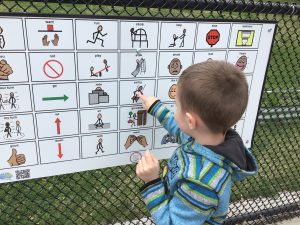
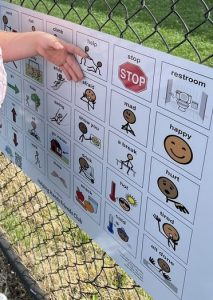
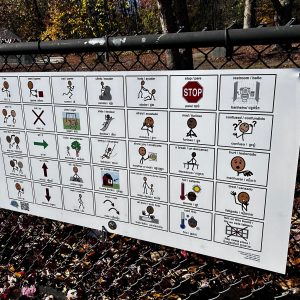
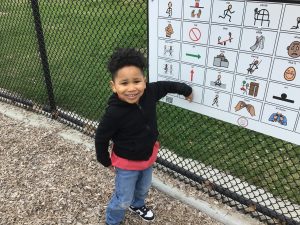
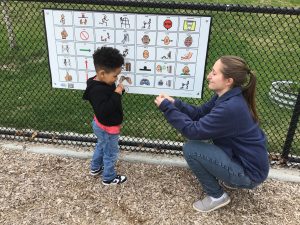
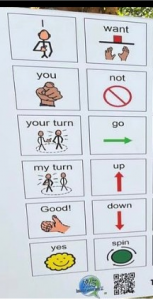
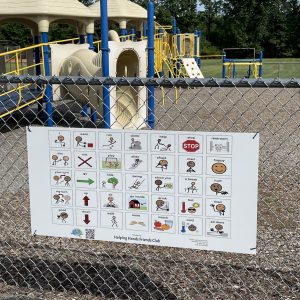
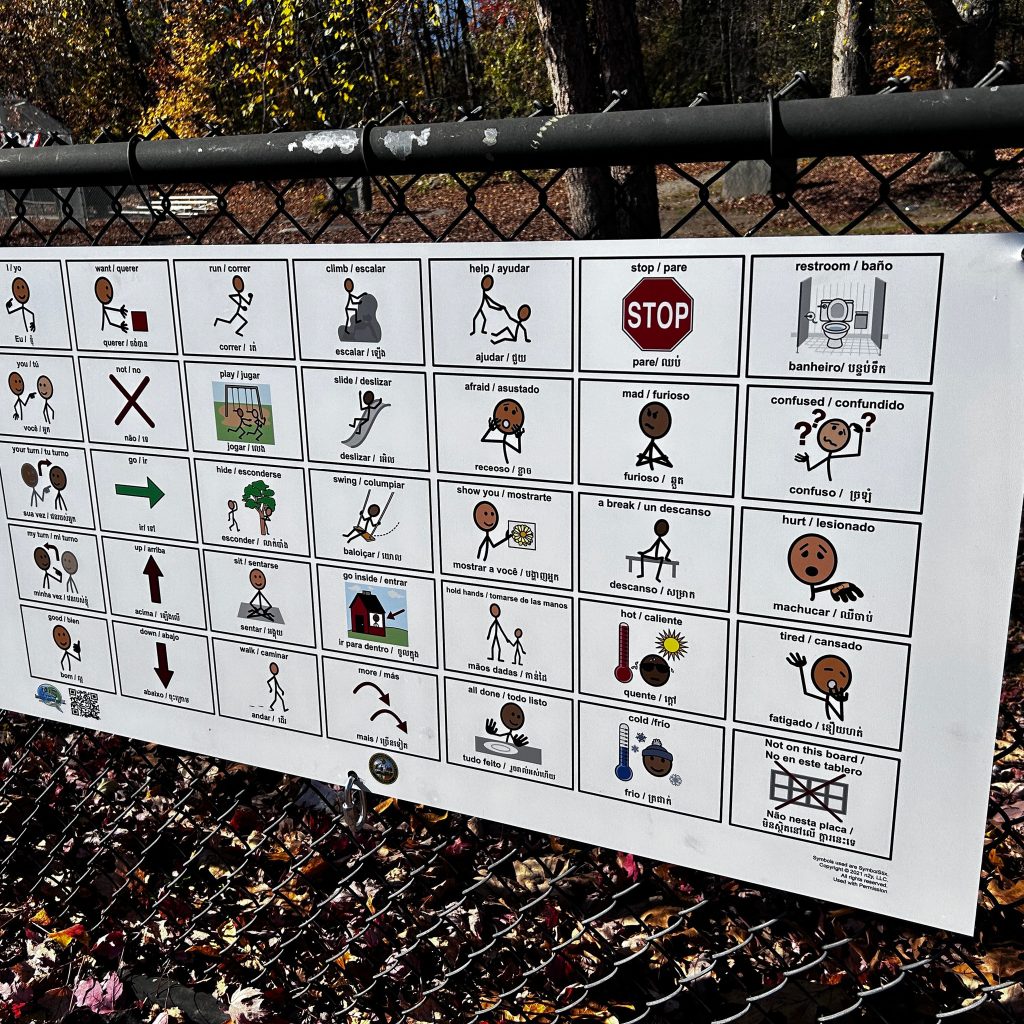
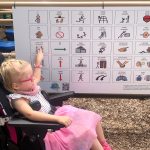
North Olmsted now has communication boards on their new playground, retrofitted onto their existing playgrounds, and a dual-sided camp board that serves both campers and counselors across languages and communication styles. Every child who comes to those spaces has a voice. Every counselor has a tool.

That is what a funded vision looks like.

If you are ready to start building yours, request a free quote and let’s talk about what your community needs.
communication board checklist

Who Truly Benefits From Inclusive Playground Boards?

communication boards

The Assumption That Limits Impact

When a school principal or recreation director first hears about inclusive playground boards they almost always picture the same child: a non-verbal child with autism who uses AAC in the classroom. That child absolutely deserves a voice on the playground. But if that’s the only child decision-makers are picturing, they are dramatically underestimating the impact a single piece of signage can have and they are leaving a powerful funding argument on the table.

As a licensed Speech-Language Pathologist with more than 30 years of experience, this is the single most common mistake I see when communities begin exploring inclusive playground boards. They know it’s important. They just don’t know how important, or for how many. Our guide to encouraging communication board use touches on this, but it deserves a much closer look here.

Children with Communication Differences Are Just the Beginning

Yes, children who are non-verbal or who use Augmentative and Alternative Communication (AAC) are the most obvious beneficiaries. Well-designed inclusive playground boards gives them a consistent, familiar visual system outside the classroom — one that doesn’t require a charged device, a Wi-Fi connection, or a teacher nearby. They can point to an icon and tell a friend they want to swing, that something hurts, or that they need a break. We explored why this matters so much in outdoor settings specifically in our post on why communication boards are ideal for playgrounds and pools.

But the population that benefits from inclusive playground boards extends far beyond this group.

communication boards for children
sponsor logo

English Language Learners Need a Bridge Too

In many of the communities we serve, recreation departments and schools support children who speak little or no English at home. On the playground, these children face a communication barrier that has nothing to do with a diagnosis. Multilingual inclusive playground boards — our coummunication boards can include up to three additional languages beyond English, with a one-time setup fee per language — gives these children a shared vocabulary with their peers and their counselors from day one.

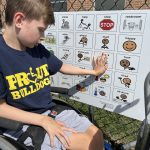
This is exactly what emerged when we began working with the City of North Olmsted Recreation Department. As conversations developed around their new playground and retrofitting their existing ones, it became clear that their summer camp population included a significant number of multilingual children alongside children with communication differences. The solution was a dual-sided camp board: one side designed for campers to express themselves, the other side designed for counselors to give directions and communicate with the group. Inclusive playground boards served everyone.

The Emergency Communication Problem Nobody Talks About

Here is the piece that stops administrators in their tracks when we discuss it, and it should.

When a child who has difficulty processing verbal information is in an emergency or distress situation, their response to spoken commands can appear to be refusal or defiance. A counselor shouts “Stop!” or “Come here!” and the child does not respond as expected. In a high-stress moment, that can be misread as willful non-compliance. In reality, the child’s brain cannot efficiently process rapid verbal directives under pressure.

Accessible playground inclusive signage in a high-traffic, easy-to-reach location gives that child and the adult working with them a visual anchor. It is not a replacement for emergency protocols. It is a critical supplement that can reduce confusion, prevent escalation, and in some situations, contribute directly to a child’s safety. This same visual-anchor principle is part of why we also build emotional balance boards for children who need a calmer, more structured way to communicate big feelings before they escalate.

Toddlers Who Are Just Beginning to Talk

Young children who are still developing functional language use pictures and symbols naturally. Inclusive playground boards mounted at the right height, we recommend the top of the board be no more than 36 inches from the ground so it is accessible to all users, becomes an intuitive tool for toddlers who are not yet reading but can point to what they want or need.

Children Who Shut Down Under Stress

Some children, including those with anxiety, sensory processing differences, or trauma histories, lose access to spoken language when they are overwhelmed. This is not a communication disorder in the traditional sense. It is a stress response. Having a visual option available on the playground means these children are not left without any way to express a need at the exact moment they need it most.

Grandparents, Caregivers, and Adults with Hearing Loss

Playgrounds are not only used by children. Grandparents and caregivers who experience hearing loss, cognitive changes, or who speak a different language than the child they are supervising can also benefit from clear, visual, inclusive playground boards.

young man with cochlear implant pointing to a message on a playground communication board.
communication boards

Why This Matters When You Are Seeking Funding

When you walk into a meeting with a superintendent, a parks and recreation director, or a city council member and you present a communication board as a tool for non-verbal children only, you are presenting a narrow case. When you walk in and explain that one piece of signage serves children with autism, English language learners, children with anxiety, toddlers, children in emergency situations, and community members with hearing loss , you are presenting a civil rights and public safety case, one supported by the ASHA Communication Bill of Rights, which affirms that every person has the right to communicate regardless of the form that communication takes.

That is a much harder argument to say no to.

At Resources at Lakeshore Speech, we help our customers build that full case before they ever walk into that meeting. The science behind our layouts, the breadth of the populations served, and the evidence base behind AAC and visual supports are part of every conversation we have with a new client.

What to Do Next

If you are a teacher, SLP, PTA member, or camp director who has been thinking about bringing inclusive play signage to your playground, the first step is understanding and being able to articulate who it serves. Then you are ready to advocate. Our community engagement guide walks you through how to build that case for your specific community.

And if you want to talk through what a board could look like for your space, request a free quote and we will walk you through every detail.

Every child deserves a voice on the playground. More children than you realize are waiting for one.

Can Communication Boards Help With Behavior?

can communication boards help behavior?

The tantrum didn’t come out of nowhere.

It started with a whimper. Then stomping feet. By the time the caregiver realized something was wrong, the child had thrown herself to the ground, the caregiver’s voice had risen several decibels, and what began as a perfectly good afternoon at the playground ended with everyone — child and adult alike — in tears.

Sound familiar?

Here’s what most people get wrong about that moment: the behavior was not the problem. The behavior was the message.

This is one of the most common questions we hear from parents, teachers, school administrators, and park and recreation directors: can communication boards help with behavior? After a combined 60+ years working as ASHA-certified Speech-Language Pathologists, our answer is an unequivocal yes — and in this post, we’ll show you exactly why, using a real before-and-after scenario, the clinical reasoning behind it, and what you can do about it starting today.

All Behavior Is Communication

As Speech-Language Pathologists, we hold one belief above all others: communication is a human right. And when that right is compromised — when a person cannot clearly express what they need, want, or feel — behavior fills the gap.

This is the most common misconception we encounter among parents, school administrators, and park and recreation directors: that a child’s difficult behavior is the result of bad parenting, poor discipline, or a behavioral problem that needs to be managed. In our clinical experience, the vast majority of challenging behaviors trace back to a single root cause — an unmet communication need.

The child who screams at the pool isn’t being difficult. She may be overwhelmed and have no way to say I need a break.

The child who kicks and throws objects in the classroom isn’t defiant. He may not be able to say I don’t understand what you’re asking me to do.

The child who has a full meltdown at the park? He may simply have been trying to say I want a snack — and had no tools to do it.

This isn’t just our clinical opinion — it’s backed by a growing body of research. According to ASHA’s own guidance on augmentative and alternative communication (AAC) in early intervention, AAC plays a crucial role in supporting early language development, and there are no prerequisites for considering or introducing it — including with very young children. In other words: you don’t have to wait for a behavior to become a crisis before giving a child a tool to communicate. The tool comes first. The behavior change follows.

ADA Compliant

What Happened When We Introduced a Communication Board

Let us walk you through a real scenario we see play out, before and after the introduction of a playground communication board.

Before:

A child on the playground begins to whimper and stomp her feet. The caregiver tries to figure out what’s wrong, but the child cannot explain. The behavior escalates — she throws her body to the ground in a full tantrum. The caregiver’s voice rises. Eventually, the child is scooped up and removed from the playground. Everyone leaves upset. The child’s need was never identified. The underlying cause was never addressed.

Notice what’s happening here from a clinical standpoint: this isn’t a “behavior problem” in the traditional sense. It’s a communication breakdown. The child has a need — and very likely knows what that need is — but has no reliable way to express it to the adult standing right next to her. The caregiver, doing the best she can, starts guessing. Guessing takes time. Time without resolution increases dysregulation. Dysregulation becomes a tantrum. By the time the meltdown is in full swing, the original need (a snack, a turn on the slide, relief from the heat) has been buried under a wave of frustration that has nothing to do with parenting skill and everything to do with access.

After:

The same early warning signs appear — the whimpering, the stomping feet. This time, the caregiver leads the child to a communication board nearby. The caregiver gently models the interaction, touching icons to form the message: “I want slide” or “I am hot” — and asks the child what she needs. The child scans the board. She points to the icon for snack. The caregiver models the full message: “I want snack.” The child imitates, touching the icons herself. The caregiver brings her to a bench, gives her a snack. The child eats, and returns to play without incident.
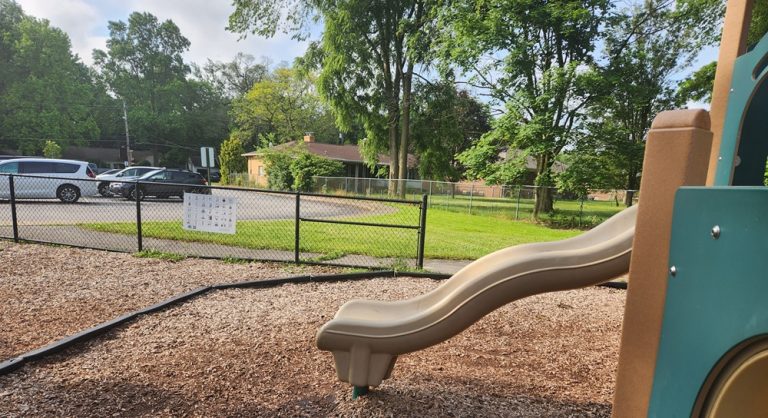
Same child. Same environment. Completely different outcome — because she had a way to communicate.

What changed wasn’t the child’s temperament, her parenting, or her “compliance.” What changed was access. The board gave her a visual, low-pressure way to scan options and land on the right one, instead of relying on speech she may not have had readily available in a moment of rising frustration. The caregiver’s modeling — physically touching the icons herself before prompting the child — is a core AAC strategy called aided language modeling, and it’s one of the simplest, most effective things any adult can do to teach a child how the board works.

This is the difference between managing a behavior after it happens and preventing it by meeting the need underneath it.

Who Benefits From Communication Boards?

This is where we want to challenge another common assumption: communication boards are not only for nonverbal children.

Communication supports benefit a wide range of individuals, including:

  • Children and adults with autism spectrum disorder
  • Individuals with cerebral palsy or Down syndrome
  • People who are recovering from a stroke or traumatic brain injury
  • Anyone who processes information more slowly under stress or in loud, stimulating environments
  • Individuals who speak a language different from their caregiver or service provider

In short: any person, in any environment, who may struggle to communicate their needs in the moment can benefit from a well-designed communication board. This is why we design boards for so many different settings — from pool and aquatic centers to therapy clinics and special education classrooms, from therapeutic riding stables to schools and recreation centers. Each environment carries its own communication demands, and the vocabulary on the board should reflect that.

We also want to highlight a specific tool that’s especially relevant to the behavior conversation: emotional balance boards. While a core vocabulary board helps a child express a want or need (“I want snack,” “I want slide”), an emotional balance board helps them identify and name a feeling — frustrated, overwhelmed, excited, tired. For many children, the inability to name an emotion is just as much a driver of challenging behavior as the inability to request an item. Giving a child the words for “I feel frustrated” before that frustration turns into a thrown object is one of the most proactive interventions we offer. We go deeper into this in our ultimate guide to emotional balance communication boards, including how speech production itself is affected during a meltdown.


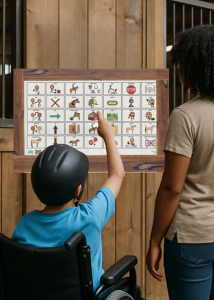
Therapeutic riding communication board installed in a therapeutic equine facility.

Why Environment Matters

Behavior does not happen in a vacuum. It happens on the playground. In the gym. At the pool. In the classroom. In the community.

That is exactly where communication tools need to be — not locked in a therapy room, but present and accessible in the spaces where real life happens. A communication board at the splash pad is a safety tool. A board in the park pavilion is a de-escalation tool. A board in the classroom is an academic and social tool.

When administrators and park directors make the decision to install communication boards in their spaces, they are not just accommodating individuals with disabilities. They are creating environments that are safer, more inclusive, and more functional for everyone who passes through.

Behavior and Safety Are Directly Linked

The behaviors that communication boards reduce are not minor inconveniences. They include tantrums, screaming, kicking, and throwing — and in more extreme cases, hitting, punching, flipping furniture, and physical aggression that puts both the individual and those around them at risk of injury. In each of these cases, the behavior is communicating something the person could not otherwise express. Give them a voice — and the behavior changes.

This is also why we think of communication access as a safety issue, not just a developmental one. Picture a child at a public pool who is overheated, overwhelmed by noise, or in mild distress and cannot say so. Picture a participant at a therapeutic riding center who cannot tell their instructor that they feel unsteady or unsafe on the horse. Picture a student in a gym class who cannot communicate that an activity is causing them pain. In every one of these situations, clear communication isn’t a “nice to have” — it’s the difference between a quick, calm resolution and an emergency.

This is precisely why we design boards for such a wide range of public and semi-public spaces: parks, playgrounds, pools, splash pads, gyms, recreation centers, schools, and therapeutic riding stables. Each of these environments brings people together — staff, caregivers, peers, and the individuals themselves — and every one of those interactions depends on the ability to communicate clearly, quickly, and without barriers.

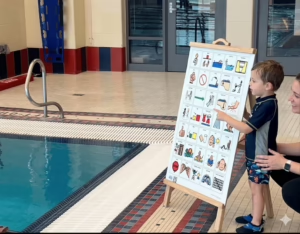
modeling pool communication boards
emotional regulation / balance communication boards

A Communication Board Is Not a Last Resort

We want to be clear: a communication board is not something you pull out after everything else has failed. It is a proactive, evidence-based tool that, when introduced early and used consistently, prevents the escalation that leads to those difficult moments in the first place.

The most effective communication boards share a few key qualities. They use core vocabulary — high-frequency, flexible words like want, more, stop, help, go — that can be combined to express a huge range of needs across settings. They’re paired with adult modeling, meaning the adults around the child use the board too, rather than only prompting the child to use it — a strategy we break down further in our guide to AAC training. And they’re placed where the need actually arises, not tucked away in an office or a binder.

If you’ve heard conflicting things about communication boards — that they’ll delay speech, that a child has to “earn” one, that only nonverbal children qualify — our post on 5 myths about alternative communication (AAC) addresses these misconceptions directly with the evidence behind why they’re false.

At Resources at Lakeshore Speech, our ASHA-certified speech-language pathologists design fully customized communication boards built around the specific needs of the individual, the environment, and the population being served. We use diverse symbol systems, incorporate QR-coded caregiver support resources, and provide free customization for donor-funded placements — because we believe access to communication tools should never be a barrier. If you’re a school district or parks department wondering how to fund a project like this, we’ve put together a guide to grant and local funding resources to help you get started, and we accept official purchase orders for institutional buyers.

If you still have questions about how communication boards work, who they’re designed for, or what makes ours different, our FAQ page covers the questions we hear most often from parents, educators, and administrators.

What You Can Do Today

If you are a parent, a teacher, a school administrator, or a park or recreation director reading this — here is the most important thing we want you to walk away with:

The next time you see a behavior, ask yourself: what is this person trying to tell me?

And then ask whether they have the tools to tell you more clearly.

If you’re ready to explore custom communication boards for your home, school, or public space, we’d love to help.

👉 Request a free quote at www.lakeshorespeech.com

Resources at Lakeshore Speech is a team of ASHA-certified Speech-Language Pathologists with 60+ years of combined clinical experience. We believe communication is a human right and we build the tools to make that right accessible to everyone.

Are Communication Boards Easy to Customize?

AAC Awareness Month

The Dangerous Misconception of the DIY Communication Board

If you are a parks department director, a school administrator, a camp coordinator, or a community leader looking to make your local spaces more inclusive, the word easy is likely at the very top of your project checklist. You want a solution that is easy to understand, easy to order, easy to install, and easy for the public to navigate. When you begin searching for inclusive communication tools, you will find countless vendors and articles online promising that creating a custom communication board is as simple as clicking a few buttons, picking a handful of pictures, and printing them onto a piece of plastic.

This has led to a widespread, well-intentioned, but highly damaging misconception in the community space. The prevailing myth is that anyone with a computer and a design program can put together an effective communication board by simply arranging a grid of random icons and images anywhere on a board. People look at a finished augmentative and alternative communication (AAC) board and see a collection of colorful illustrations, assuming that the arrangement is merely aesthetic or arbitrary. They believe that customizing a board simply means picking words that match the local scenery and scattering them across a grid.

The reality of communication board development is vastly different. True ease refers to the ability of the purchaser to understand, navigate, and utilize the clinical information embedded within the tool to create a successful, functional custom setup. The development of a communication board is not a graphic design project, it is a clinical process backed by decades of language science.

A certified speech-language pathologist is the individual with the true credentials and expertise required to complete this type of task. Without a clinical foundation, a customized board risks becoming a decorative piece of plastic that looks inclusive on the surface but fails to provide a functional voice to the individuals who rely on it. When we treat communication board customization as a simple matching game, we inadvertently silences the very people we are trying to empower.

static communication boards
funding

Understanding the Clinical Science of Augmentative Communication

To understand why customization requires a speech-language pathologist, you have to look closely at how non-verbal individuals, or individuals with limited speech, actually process visual language. When a certified speech-language pathologist designs or alters a communication board, they are balancing complex cognitive, neurological, and linguistic factors. There are three specific, science-backed pillars that must guide every single customization decision, ensuring that the final product remains highly functional no matter what local elements are added.

The Power of Core Vocabulary Over Fringe Vocabulary

The first and most critical pillar of an effective communication board is a heavy reliance on core vocabulary. Core vocabulary consists of the high-frequency words that make up approximately eighty percent of the words we use in daily communication across all settings. These are words like go, stop, more, detailed, help, like, you, me, up, and down.

The first and most critical pillar of an effective communication board is a heavy reliance on core vocabulary. Core vocabulary consists of the high-frequency words that make up approximately eighty percent of the words we use in daily communication across all settings. These are words like go, stop, more, detailed, help, like, you, me, up, and down. Understanding how to choose vocabulary for augmentative communication tools requires looking past standard word lists and focusing on true functional language.

The incredible power of core vocabulary lies in its flexibility and its vital importance to overall language development. Core words allow a user to create flexible, spontaneous messages without needing highly specific or literal visual references. For example, if a child wants to use a slide at a playground, a board focused on core vocabulary allows them to point to the icons for go and there. This simple combination communicates the exact same intent as pointing to a specific picture of a slide.

The magic of this approach is that go there can also be used to ask to visit the swings, the picnic pavilion, the parking lot, or a friend across the field. If your customization process involves removing core vocabulary to make room for dozens of specific nouns, also known as fringe vocabulary, you are severely limiting the user. If a board only features specific nouns like slide, swing, and sandbox, the child can only talk about those exact objects. They cannot use those words to express an action, a feeling, or a complex thought. Our approach always focuses on preserving a robust core vocabulary layout first, ensuring that the non-verbal individual has a functional framework for actual language generation rather than just a menu of local objects.

Motor Planning and Spatial Consistency Across Boards

The second pillar that cannot be compromised during customization is motor planning. When neurotypical, verbal individuals speak, they do not consciously think about how to move their tongue, lips, and vocal cords for every single syllable. Muscle memory takes over, allowing speech to flow seamlessly. For an individual using an AAC device or a physical communication board, the exact same principle applies to motor planning and muscle memory. They learn the location of a word based on where it lives spatially on the grid.

Motor planning depends entirely on the absolute consistency of the placement of the icons moving from location to location, and from board to board. If you are installing multiple communication boards across a large park system, a school campus, or a town center, you must maintain a fixed spatial architecture. If a user learns that the icon for the restroom is located in the upper right-hand corner of the board at the main playground, they must be able to walk down to the baseball fields or into the community center and find the restroom icon in that exact same upper right-hand corner.

When well-meaning individuals attempt to customize boards without clinical oversight, they often scramble the grid to make room for new images. They might move the restroom icon to the bottom left on one board because they wanted to put a picture of a tree in the top right. This completely disrupts the user’s motor planning. It forces a non-verbal individual to completely re-scan, re-learn, and search the board every time they move to a new area. This significantly increases their cognitive load and can lead to immense frustration, causing them to abandon using the board entirely.

Protecting Symbol System Consistency

The third pillar is maintaining strict consistency within the symbol system itself. Non-verbal individuals who use high-tech speech-generating devices or low-tech communication books at school spend years learning a specific visual language dialect. Different software programs and clinical frameworks use distinct symbol sets, such as SymbolStix or PCS, which represent concepts in specific visual styles.

When customizing a public communication board, it is vital that the symbol system used on the sign matches or closely mirrors the actual icons that the users see daily at school and on their personal AAC devices. If a child uses a specific symbol for want or help in their classroom, seeing a completely different, randomized clip-art icon on a park board can cause massive confusion. True customization means understanding the local demographic, working with the local school districts to see what symbol systems are prevalent, and ensuring the public boards align with those existing tools.

communication boards in schools
pool communication boards

The Real World of Collaborative Customization

When working with clients who purchase our communication boards for public spaces, we always begin from a scientifically verified, standard layout that honors core vocabulary, motor planning, and symbol consistency. We do not start with a blank canvas, because a blank canvas encourages the random placement of icons. Instead, we use our clinical framework as the foundation, and then we sit down with the purchaser to discuss what specific items they may need to add, where those items should go, and, most importantly, the clinical reasons why those additions are being made.

This collaborative approach transforms the customization process into an educational experience for the purchaser. The biggest logistical and design challenge we face in this line of work is not necessarily knowing what the specific playground, facility, or location looks like, or where the board will ultimately be installed. We are creating physical, durable signs that must live in a real environment, and the layout of that environment dictates how people interact with the sign.

To overcome this lack of physical context, we work closely with city planners, park directors, and school administrators to gather blueprints, site maps, and photographs of the exact location where the board will stand. Once we understand the spatial realities of the environment, we develop a custom draft. We then enter an iterative phase with the client, continuing to work closely with them to tweak the customized elements until they are completely satisfied. This process ensures that the client fully understands why the boards are designed the way they are, giving them ownership over the clinical rationale behind their new community tool.

The North Olmsted Case Study and the Camp Board Breakthrough

A perfect example of this deep, environmental customization occurred recently during a project with the city of North Olmsted. The city was actively retrofitting and fitting their beautiful new playground equipment with accessible communication boards to ensure that their spaces were welcoming to all children.

During the design process, we worked closely with the director of the parks department. As we analyzed the blueprints and discussed how the space would be utilized throughout the year, the director mentioned a specific demographic and operational need that a standard playground sign could not completely address. She highlighted their extensive summer camp programs.

During the summer, dozens of campers, including individuals with diverse communication needs, gather in the parks. The camp counselors needed a tool that allowed students to better express themselves during camp activities, but they also desperately needed a way for the counselors themselves to give directions more clearly and model language in real-time as they moved around the property.

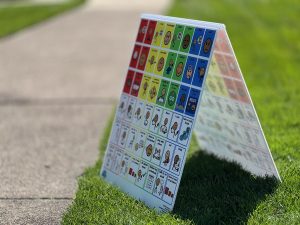
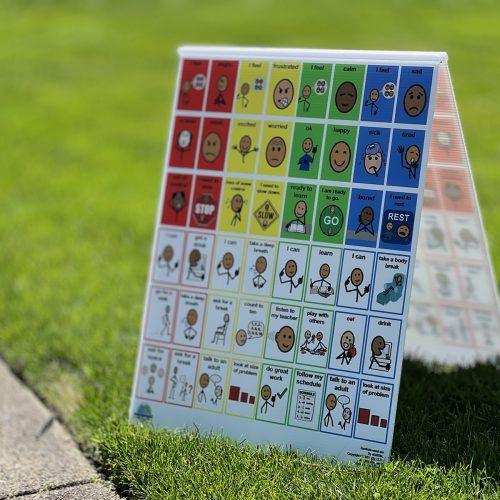
At that exact moment, we had an incredible breakthrough. We realized that a static, post-mounted sign next to a swing set was not enough for a dynamic, mobile summer camp environment. To solve this problem, we designed a completely custom, portable camp board built into a heavy-duty sandwich sign structure.

We utilized both sides of the sandwich sign to create a multi-functional communication hub:

  • One side of the sandwich board was carefully customized and intended for the campers to express their personal feelings, immediate physical needs, choices, and social interactions with peers.
  • The opposite side of the sandwich board was custom-designed specifically for the camp counselors and staff to use to give directions, clarify schedules, model expectations, and visually reinforce instructions out in the field.

Because this sign was a portable sandwich board, counselors could easily carry it from the main pavilion over to the grassy fields, or down to the shade trees depending on where the camp activities were taking place.

In tandem with this mobile camp board, we fully customized their permanent, post-mounted playground signs to include specific local amenities, including their brand-new splash pad, the nearby ballpark, and the soccer fields. We seamlessly integrated these local fringe vocabulary terms into the existing clinical layout without disrupting the core vocabulary framework or ruining the motor planning architecture. This project successfully provided clear, accessible communication for everyone in the park, matching the physical layout of North Olmsted with the clinical needs of its residents.

emotional balance board
playground communication boards

The Ultimate Litmus Test for Your Communication Board

If you are a reader who is currently preparing to purchase, design, or customize a communication board for your local school, public park, non-profit organization, or community space, it is easy to get overwhelmed by the graphics, the colors, and the logistics of sign procurement. Before you approve a final proof, send a design to a printer, or sign off on a customization project, you need a way to ensure that your tool is genuinely effective. You need to verify that your board is a legitimate, powerful gateway to language, and not just a collection of random, well-meaning icons.

To do this, you must apply the ultimate clinical litmus test. Step away from your role as an administrator, a designer, or a purchaser. Put yourself completely and entirely into the shoes of an individual who cannot communicate verbally. Look at the draft of your custom board through their eyes, imagine standing in front of it in the middle of your park or facility, and ask yourself the following deeply important questions:

  • If I am feeling overwhelmed, tired, or hurt, can I easily look at this board and communicate exactly how I feel to an adult, or am I limited to just pointing at equipment?
  • If I need a basic, critical human necessity, can I instantly look at this board and request to go to the restroom, or find a drink of water, without having to hunt through a randomized jumble of icons?
  • If I want to interact with the children around me, does this board give me a specific way to comment on what I see, share a joke, or ask to join a game, allowing me to truly be an active part of the community or space I am standing in?

When you evaluate your custom communication board using these questions, you will quickly see whether your design provides true autonomy. If an individual looks at your board and can only answer simple yes or no questions, or if they can only point to a picture of a swing to indicate they want to swing, your board is not truly customized for communication. It is severely limited.

A non-verbal person has complex thoughts, deep emotions, specific needs, and a desire for social connection just like anyone else. They are not thinking in one-word noun labels. They want to tell you that a game is fun, that they want to go faster, that they are finished, or that they want to go somewhere else.

A truly effective custom communication board does not simply display a handful of local icons. It respects the science of language development, protects the spatial consistency that muscle memory requires, and provides a rich framework of core vocabulary. By partnering with certified speech-language pathologists and committing to a clinical customization process, you can ensure that your community investment does something truly life-changing. It will give a profound, enduring voice to those who need it most, creating an environment where everyone can truly communicate how they feel, what they want, and where they would like to go.

Bring true inclusivity to your community. Avoid the pitfalls of a DIY setup and invest in signs designed by clinical experts. Explore our scientifically backed, durable communication boards for public spaces and start your collaborative customization project today.

Benefits of AAC in Public Spaces

playground communication boards

Low-Tech vs. High-Tech AAC: Why Physical Communication Boards Are Essential for Truly Inclusive Public Spaces

 Quick Facts & Key Takeaways

  • What is AAC? Augmentative and Alternative Communication (AAC) includes any method used to express thoughts, needs, and ideas without reliance on spoken words.
  • The Power of Low-Tech: While digital apps are powerful, the benefits of AAC  in public spaces include being weatherproof, immune to dead batteries, and instantly accessible to everyone.
  • Community-Wide Impact: Installing communication boards benefits not just non-speaking individuals, but also toddlers, individuals with temporary speech loss, and non-native English speakers.
  • The Bottom Line: True community inclusion requires physical, permanent low-tech AAC options alongside high-tech personal devices.
playground communication boards

Quick Links

Every individual deserves the right to share their voice, express their needs, and connect with the world around them. Yet, for millions of individuals with communication challenges, a trip to the local park, library, or community center can feel deeply isolating.

At Resources at Lakeshore Speech, our clinical team works daily with families, educators, and community advocates to dismantle these barriers. One of the most transformative shifts we are witnessing today is the widespread installation of physical communication tools in parks and playgrounds.

When we explore the benefits of AAC in public spaces, it becomes clear that while digital communication apps are incredible tools for personal use, they cannot replace the permanent, equitable access provided by physical, low-tech communication boards. In this comprehensive guide, we will dive deep into why  your community needs physical AAC boards to foster genuine inclusion and belonging.

Understanding AAC: The Foundation of Inclusion

To fully appreciate why public spaces require low-tech solutions, we must first establish what AAC is and how it functions. Augmentative and Alternative Communication (AAC) is an umbrella term that encompasses all forms of communication other than oral speech.

The AAC Spectrum: High-Tech vs. Low-Tech

Speech-Language Pathologists (SLPs) generally categorize AAC systems into three distinct tiers:

  1. No-Tech: Relying entirely on the body, such as sign language, gestures, facial expressions, and body language.
  2. Low-Tech / Light-Tech: Physical tools that do not require electricity or batteries. This includes printed picture books, laminated communication flipcharts, and large, weather-resistant AAC boards mounted on playground posts.
  3. High-Tech: Electronic devices that require power, such as dedicated speech-generating computers or specialized communication apps (e.g., Proloquo2Go, TouchChat, or TD Snap) running on iPads and tablets.

While high-tech systems offer customized vocabulary and robust voice output, they are inherently tied to an individual owner. Physical AAC boards installed in public areas, on the other hand, democratize communication. They ensure that anyone who steps into a public space has an instant, uncompromised means of expression.

Why Public Spaces Need Low-Tech: Physical Boards vs. Digital Apps

It is tempting for city planners or school boards to assume that because “there is an app for that,” public spaces do not need physical infrastructure. However, relying solely on personal digital apps creates massive equity gaps.

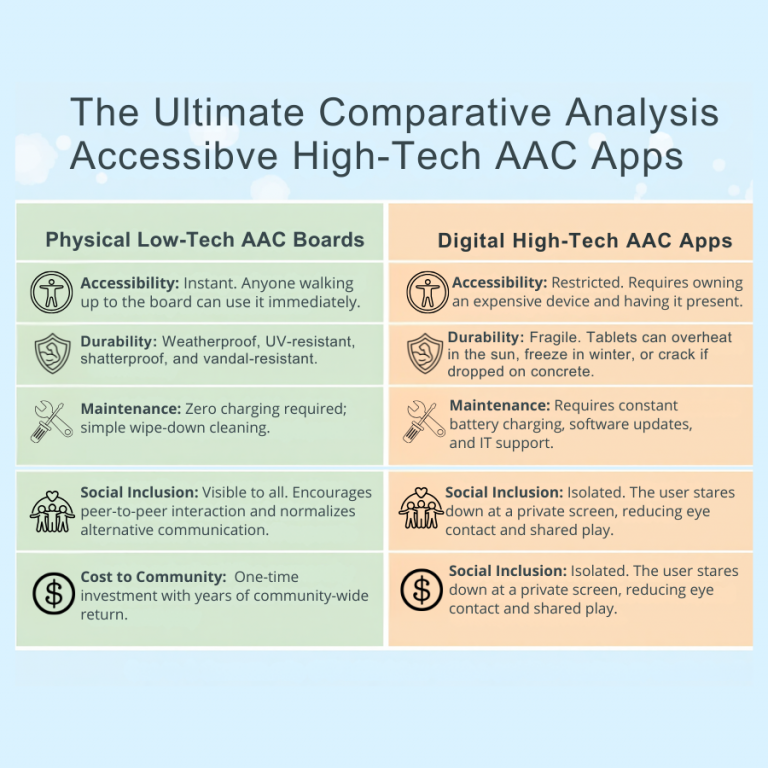
Let’s look at a head-to-head comparative analysis of the benefits of AAC in public spaces match up against digital applications in shared, public environments.

Benefits of AAC in Public Spaces - Comparative Analysis
Comparison of the benefits of AAC in public spaces vs High-tech AAC

Environmental Vulnerabilities of Digital Tools

Imagine a hot July afternoon at a local inclusive playground. A child using a personal iPad app wants to ask a peer to swing with them. Suddenly, the iPad flashes a warning symbol: “Device temperature too high. iPad needs to cool down before you can use it.” In an instant, that child’s voice is stripped away.

Furthermore, water features, splash pads, sandboxes, and mud kitchens are staples of enriching childhood play. They are also absolute death sentences for expensive electronic tablets. Physical AAC boards, constructed from heavy-duty, marine-grade plastics or aluminum, stand resilient against torrential rain, baking sun, and muddy hands. Consequently, they provide an uninterrupted guarantee of expression that digital apps simply cannot match.

Deep Dive: The Tangible Benefits of AAC in Public Spaces

When a community invests in low-tech communication infrastructure, the societal return on investment is monumental. Let’s explore the core benefits of AAC in public spaces and how they reshape community dynamics.

Eliminating Communication Barriers in Real Time

When a non-speaking individual visits a park without a physical board, they must rely on their own device (if they own one) or interpretative assistance from a caregiver. If the caregiver steps away for a moment, or if the device is left in the car to prevent theft, the individual is left without a functional voice.

By installing permanent AAC boards, municipal leaders create an environment where a child can run straight from the slide to the board, point to the symbol for “more,” and immediately run back to play. It bridges the gap between thought and action without requiring a third-party mediator.

Promoting Peer-to-Peer Social Inclusion

One of the most beautiful outcomes of installing low-tech boards is how they foster natural, neurodiverse friendships. Children are inherently curious. When they see a colorful board filled with icons at eye level, they gravitate toward it.

Neurotypical children quickly learn how to use the board to communicate with their non-speaking peers. For instance, a child might walk up to the board, point to the icon for “ball,” and look at a peer with autism, inviting them into a game. This direct interaction reduces social stigma, builds empathy, and creates a culture of deep-seated inclusion from an early age.

Normalizing Alternative Communication for the Public

Stigma thrives in the absence of exposure. When AAC boards are absent from public squares, the general public remains unaware of how non-verbal individuals interact.

Conversely, when these boards are prominently displayed alongside traditional park signage, alternative communication is normalized. Passersby, city workers, and other parents see AAC as a valid, everyday form of language. This raises community awareness and reshapes public spaces into environments that celebrate diversity rather than merely tolerating it.

People Also Ask: Common Questions About Public AAC Systems

As specialists in speech and language development, we frequently consult with city councils and parks departments. Here are the most common questions we encounter regarding the benefits of AAC in public spaces and the  deployment of low-tech communication tools.

How do children know how to use an AAC board without training?

This is where the magic of aided language stimulation (or modeling) comes into play. Children learn language by hearing it spoken around them for thousands of hours before they utter their first word. Similarly, individuals learn AAC by seeing others point to symbols while speaking.

When an AAC board is placed in a public space, parents, educators, and peers naturally begin modeling – another examples of the benefits of AAC in public spaces. A mother might say, “Let’s go fast on the slide,” while pointing to the icons for “fast” and “slide” on the board. Non-speaking children observe this and rapidly learn that pressing or pointing to those pictures yields real-world results.

Are public AAC boards only meant for individuals with severe autism?

Absolutely not. This is a common misconception that limits the perceived value of these installations. While individuals with autism are frequent users of AAC, these boards serve a massive, diverse demographic, including:

  • Children with Down syndrome, Cerebral Palsy, or childhood apraxia of speech.
  • Toddlers who are late talkers and experience profound frustration when trying to express their needs at the park.
  • Individuals with temporary speech loss due to medical conditions, dental procedures, or vocal strain.
  • Selective mutism, where individuals experience severe anxiety that physically prevents speech in public situations.
  • Non-native English speakers: By utilizing universal picture communication symbols (like PCS or SymbolStix), an AAC board can bridge language barriers, allowing a child who only speaks Spanish or Ukrainian to seamlessly play with an English-speaking peer.

What vocabulary should be included on a public space AAC board?

An effective public communication board must balance core vocabulary and fringe vocabulary.

  • Core Vocabulary: These are high-frequency words that make up about 80% of what we say across all contexts (e.g., want, help, stop, go, more, look, me, you, happy, sad).
  • Fringe Vocabulary: These are context-specific nouns and verbs. For a playground board, fringe words would include swing, slide, sandbox, water, park, run, and climb.

A well-designed board places core vocabulary in a structured, easy-to-navigate layout (often following a left-to-right grammatical order) while dedicating a specific section to the unique features of that specific public space.

Evidence-Based Practice: What the Research Says About AAC and Inclusion

As clinical practitioners, everything we do at Resources at Lakeshore Speech is anchored in evidence-based practice and guidelines established by national bodies like the American Speech-Language-Hearing Association (ASHA).

The ASHA Position on Communication Access

According to ASHA, communication is a fundamental human right. ASHA explicitly states that AAC use does not stunt natural speech development; in fact, research consistently demonstrates that AAC supports and accelerates verbal speech production by reducing communication anxiety and providing a clear auditory and visual model of language.

Scientific Studies on Public-Space Modeling

A landmark body of research in the field of developmental disabilities highlights that environmental engineering—changing the physical environment to support the user—is the single most effective way to promote independent functional communication. According to a comprehensive meta-analysis by Sennott, Light, and McNaughton (2016), individuals with complex communication needs demonstrate a monumental increase in spontaneous peer interactions when visual supports are permanently embedded into natural play spaces. Their findings confirm that these engineered environments yield significantly higher rates of social initiation compared to scenarios where users are forced to rely solely on personal electronic devices.

When we apply this science to municipal planning, it becomes clear that relying on a family to bring a personal device to a park is a clinical failure of environmental design. The park itself must be accessible. Therefore, implementing physical boards aligns directly with established therapeutic protocols for generalization—the ability to use communication skills outside of a clinical therapy room and in the real world.

How to Implement Low-Tech AAC in Your Community: A Step-by-Step Guide

If you are a parent, educator, or forward-thinking community leader, you might be wondering how to translate this knowledge into concrete action. Transforming your local park into an inclusive haven requires intentional planning.

Step 1: Identify the Right Location

Look for areas with high foot traffic and shared play zones. Ideal spots include:

  • Directly adjacent to the primary playground structure.
  • Near entry gates or benches where parents congregate.
  • Beside inclusive play pieces like wheelchair-accessible merry-go-rounds or adaptive swings.

Step 2: Select High-Quality, Accessible Materials

Do not cut corners on manufacturing. A cheap, laminated poster taped to a signpost will degrade within weeks. Invest in heavy-duty, UV-printed, non-glare aluminum or high-density polyethylene (HDPE) panels. Ensure the board is mounted at an accessible height for both standing children and individuals utilizing wheelchairs or mobility devices.

Step 3: Ensure Inclusive Vocabulary Design

Work with certified Speech-Language Pathologists to ensure the symbols chosen are universally recognized and structured logically. Avoid clutter; too many icons can cause visual fatigue and cognitive overload, defeating the purpose of quick, accessible communication.

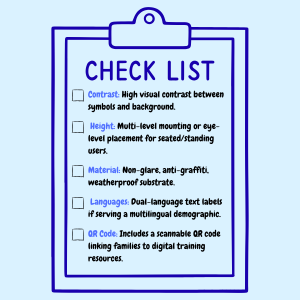
Designing for Success: A Quick Implementation Checklist

Before purchasing or printing any public communication sign, verify that your project meets these accessibility standards:

communication board checklist
Checklist - Benefits of AAC in Public Spaces

Conclusion: Empowering Every Voice Through Community Infrastructure

The true measure of a community’s compassion and forward-thinking nature is found in how it treats its most vulnerable and marginalized members. True accessibility goes far beyond concrete wheelchair ramps and paved walkways; it must encompass cognitive and linguistic accessibility.

Recognizing the immense benefits of AAC in public spaces is the first step toward building a society where no child is left standing silently on the sidelines of a playground, unable to ask a peer to play. By installing robust, low-tech AAC boards, we can give the gift of an immediate, unshakeable voice to everyone who gathers in our shared spaces.

This investment builds an enduring culture of inclusion, empathy, and mutual understanding that echoes far beyond the boundaries of the park.

Take Action Today with Resources at Lakeshore Speech

Are you ready to champion accessibility and bring a high-quality, clinically verified communication board to your local park, school, or community center? Don’t navigate the design and vocabulary selection process alone.

Contact our dedicated team at https://www.lakeshorespeech.com/ today to consult with our AAC specialists and begin the seamless process of ordering custom, durable communication boards for your community. Together, we can ensure that every voice is heard, valued, and celebrated. Ensuring that everyone benefits from AAC in public spaces. 

Benefits of AAC in public spaces

Master Emotional Regulation: Heavy-Duty AAC Visual Boards

emotional regulation balance communication board

Key Takeaways

  • Speech Fails Under Stress: During a meltdown or sensory crisis, the brain’s speech production center (Broca’s area) experiences a drop in activity. Emotional regulation / balance boards act as a permanent anchor when spoken words fail.

  • Action-Oriented Design: True emotional regulation occurs when a child can identify a feeling and instantly select an SLP-curated coping mechanism (e.g., taking a break, deep breathing) from the same visual panel.

  • Predictability Builds Safety: Using a fixed, standardized layout across multiple environments (home, classroom, playground) reduces cognitive strain and helps individuals locate tools quickly during crises.

  • Material Matters for Longevity: Choosing the right build—weatherproof Aluminum Alloy for public parks/sensory rooms or interactive Magnetic or Coroplast for desks—ensures the tool survives high-impact use.

  • Proactive over Reactive: Emotional regulation / balance communication boards should be used for daily check-ins and modeling during calm routines (Aided Language Input) so individuals are fluent with the tool before dysregulation happens.

  • Fosters Lifelong Autonomy: Rather than compliance-driven behavior management, these emotional regulation / balance boards support genuine social-emotional learning and protect the user’s personal agency.

Quick Links

Empowering Non-Verbal Expression in Moments of Crisis

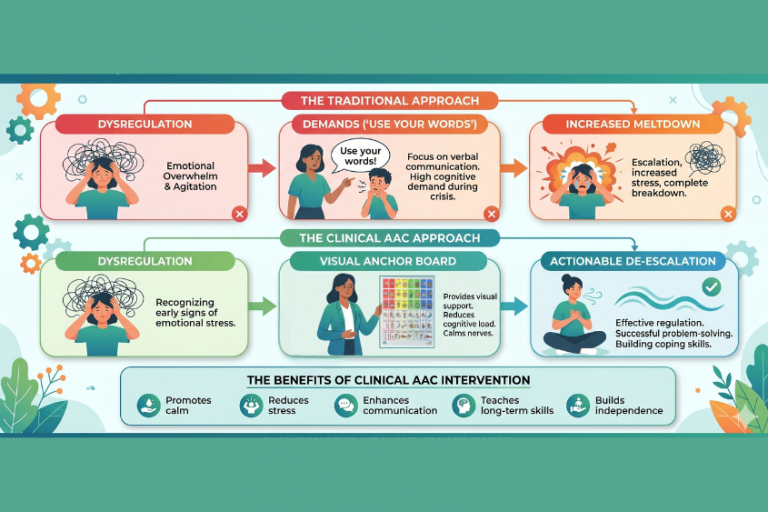
Every parent, educator, and therapist knows the profound feeling of helplessness that arises when a child or adult slips into a state of total emotional dysregulation. When big feelings swell into an intense, overwhelming meltdown, verbal communication often vanishes completely. In these high-stress moments, demanding that an individual “use their words” is not simply ineffective; it is neurologically impossible.

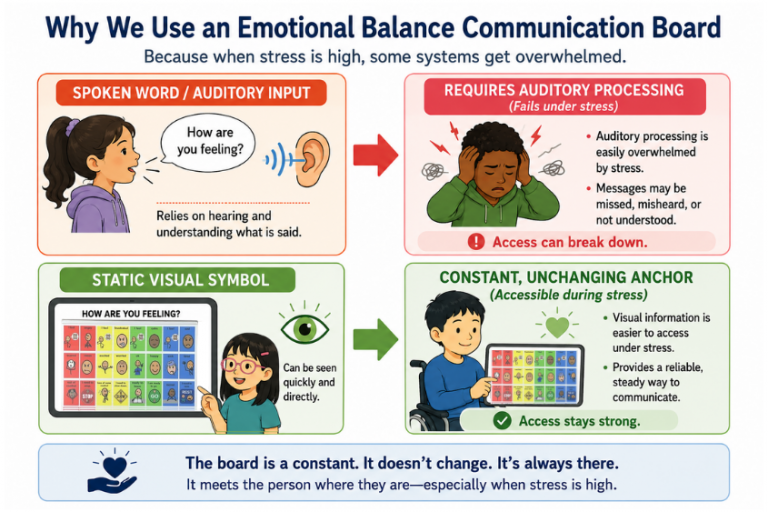
When the brain enters a fight-or-flight state, the Broca’s area—the neurological engine responsible for speech production—experiences a significant drop in activity. This is where the practice of emotional regulation or balance must shift from verbal demands to visual support. At Resources at Lakeshore Speech, we develop clinical, heavy-duty visual tools designed specifically to bridge this exact communication gap.

By implementing an emotional regulation / balance communication board, families, schools, and community leaders can provide a reliable, non-verbal roadmap for emotional navigation. These boards give individuals a clear, stress-free path to identify their feelings and select an actionable coping mechanism without requiring verbal expression. This foundational tool shifts caregiving approaches from reactive management to proactive empowerment.

What is an Emotional Regulation / Balance Communication Board?

An emotional regulation / balance communication board is a specialized, augmentative and alternative communication (AAC) tool engineered to help neurodivergent and neurotypical individuals recognize, organize, and express their internal states. Unlike a standard “feelings chart” that merely lists emotions, these advanced communication boards are dual-purpose engines. They establish structural connections between what an individual is feeling and what they can do to safely process that feeling.

The Anatomy of an Emotional Balance Design

At Resources at Lakeshore Speech, our SLP-designed layouts utilize industry-standard symbol systems, including Boardmaker© and SymbolStix©. These symbols are organized using validated linguistic frameworks, such as the Modified Fitzgerald or Gossens’ color-coding configurations. By structuring vocabulary into explicit, predictable color bands, users can rapidly scan and pinpoint their internal status under intense cognitive strain.

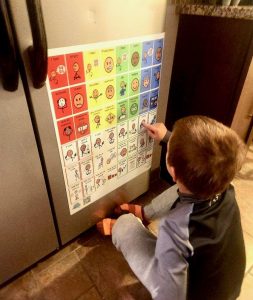
To maximize functional use, these layouts categorize emotional states into clear, color-coded tiers of alertness:

  • Low States of Alertness (Blue): Depicts feelings such as sad, tired, sick, or bored. The paired strategies focus on safe, low-energy reactivation (e.g., getting a drink of water, asking for a break, or speaking to a trusted person).
  • Optimal Learning States (Green): Depicts feelings such as happy, calm, or focused. This zone represents ideal emotional balance, where an individual is mentally prepared to follow instructions, collaborate, and socialize.
  • Elevated States of Alertness (Yellow): Depicts feelings such as frustrated, anxious, or nervous. Strategies focus on immediate, mid-level de-escalation tactics (e.g., counting to 10, deep breathing exercises, or using a sensory tool).
  • Highly Heightened States of Alertness (Red): Depicts feelings such as angry, terrified, or jealous. Actionable options emphasize safety and protective containment (e.g., requesting immediate physical space, taking a structured walk, or relocating to a designated sensory zone).

The Science of Visual Anchors in Social-Emotional Learning

The integration of visual communication boards is deeply rooted in evidence-based practice (EBP) and backed by guidelines from the American Speech-Language-Hearing Association (ASHA). Research within cognitive science demonstrates that visual supports markedly reduce cognitive load during periods of physiological dysregulation.

Alleviating Cognitive Load Through AAC

When an individual is calm, their prefrontal cortex processes language seamlessly. However, sensory overload or emotional distress floods the nervous system with cortisol and adrenaline, making temporary auditory processing deficits common.

Emotaional regulation communication board

Furthermore, spoken language is transient—once a word is said, it vanishes. For a dysregulated student, tracking fleeting speech can worsen their anxiety. In contrast, an emotional regulation / balance board serves as a permanent, static visual anchor. The symbol remains constant, giving the individual’s brain the necessary time to look, process, and make a functional selection at their own pace.

Advancing Social-Emotional Learning (SEL)

True social-emotional learning involves more than behaving quietly; it requires developing genuine emotional literacy. When children regularly use a dedicated communication board, they are not merely signaling distress; they are actively mapping abstract internal sensations to concrete, 2D visual icons.

Consequently, this system directly supports the development of executive functioning skills. Over time, consistent use teaches individuals that internal emotional tension can be named, externalized, and managed with structured strategies, protecting their personal autonomy.

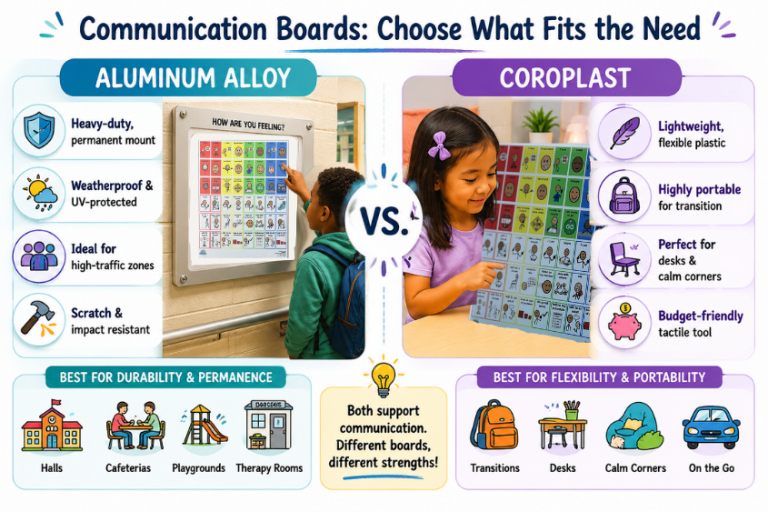
Material Engineering: Coroplast vs. Aluminum Alloy

A tool can only provide effective clinical support if it remains accessible in the environments where dysregulation actually occurs. At Resources at Lakeshore Speech, we fabricate our boards in multiple physical formats to ensure they survive the unique demands of homes, schools, clinics, and community spaces.


emotaional regulation / balance boards material comparison

1. Heavy-Duty Aluminum Alloy Boards

For public spaces, outdoor therapeutic playgrounds, inclusive school hallways, and high-traffic clinic rooms, our Aluminum Alloy (Alumalite) boards provide maximum longevity. These commercial-grade boards are scratch-resistant, impact-resistant, and entirely weatherproof. They are engineered to endure intense environmental demands—such as heavy rain, snow, direct summer sunlight, and pool chemicals—without warping, fading, or peeling.

2. Lightweight Coroplast Boards

When portability and flexibility are prioritized, our high-quality Coroplast (corrugated plastic) boards offer an excellent, lightweight alternative. These boards are ideal for inside classroom doors, individual student desks, or dedicated indoor calm-down corners.

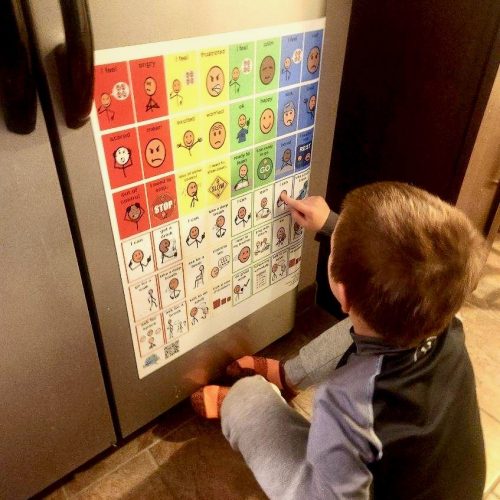
In addition to our standard flat layouts, we offer specialized magnet-print formats (18″x24″). These allow for an interactive, tactile experience where individuals can physically move magnetic indicators to declare their current emotional state and choose their corresponding coping strategy.

Strategic Placement: Where Do You Install Emotional Regulation Boards?

To maximize the therapeutic benefit of an emotional regulation / balance system, boards should be positioned preemptively. Placing them strategically allows individuals to access vital visual supports before reaching a state of total emotional exhaustion or behavioral crisis.

The Sensory Room or Dedicated “Reset Space”

This is the most common and effective interior placement. By mounting an aluminum or interactive magnetic board at eye level within a sensory room or quiet corner, you establish an explicit sanctuary for co-regulation / balance. The moment a dysregulated individual enters the space, the visual board provides immediate direction, helping them transition out of distress without requiring overwhelming verbal interactions.

The Classroom or Facility Doorway

Transitions between different environments—such as moving from a loud, chaotic hallway into a quiet classroom—frequently trigger stress for neurodivergent individuals. Placing an emotional regulation / balance board near major entryways allows for quick emotional check-ins. Students can naturally point to their current state as they cross the threshold, giving teachers immediate, actionable insight into each student’s readiness to learn before instruction even begins.

Public Parks, Playgrounds, and Recreational Complexes

Inclusive communities recognize that emotional dysregulation  can happen anywhere, particularly in sensory-heavy environments like public parks. Installing our weatherproof, UV-resistant aluminum alloy boards next to swings, splash pads, or sports courts ensures that children have constant access to functional communication when physical fatigue or social frustration runs high.

Clinical FAQs: Deep Dive into Emotional Literacy


How do emotional regulation / balance boards differ from standard feelings charts?

Most standard classroom feelings charts only focus on identification, prompting a user to indicate if they are “happy,” “sad,” or “mad.” Our clinical emotional regulation / balance boards are structured to focus heavily on the critical question: “What’s next?” Instead of leaving an individual stuck in a heightened emotional state, our boards pair each feeling icon directly with actionable, SLP-curated coping strategies. This layout shifts the tool’s focus from mere emotional observation to functional, active behavior modification and self-soothing.

Can these boards be used for neurotypical individuals?

Yes. Intense emotional overstimulation, physical exhaustion, and environmental stress affect all human brains, regardless of neurotype. While these boards provide critical access for non-verbal or minimally verbal individuals, neurotypical children and adults also benefit from visual supports during high-stress moments. Reducing the need for verbal expression helps anyone navigate intense emotional waves with greater ease and lower anxiety.

Why is a fixed layout preferred over a completely custom board?

To provide the highest quality and fastest delivery times, our boards feature a standardized, SLP-curated layout and core vocabulary set. In clinical practice, consistency builds safety.

When an individual encounters the exact same symbols, color schemes, and structural layout across multiple environments—such as their speech therapy room, their general education classroom, and their local public park—it reduces their cognitive processing demands. This structural predictability helps them quickly locate and use the communication tools they need during times of crisis.

Implementation Strategies for Caregivers and Educators

Simply mounting an emotional regulation / balance board on a wall is not enough to ensure its success; it must be actively integrated into daily routines through supportive modeling.

1. The Power of Proactive Modeling

The most reliable way to teach visual communication skills is a technique known as Aided Language Input or modeling. Caregivers and educators should frequently point to symbols on the communication board during daily, low-stress routines while speaking out loud.

For example, during a regular conversation, a teacher might say, “I am feeling so focused today, so I am ready to learn,” while physically pointing to the corresponding icons on the board. This practice demonstrates to users how the board works during calm moments, ensuring they know how to navigate it when an emotional crisis occurs.

2. Conducting Daily Check-Ins

Incorporate the communication board into structured, predictable parts of the day, such as morning meetings, dinner table conversations, or bedtime routines. Asking an individual to share their current state during calm periods builds their baseline emotional literacy and reinforces the habit of emotional self-reflection.

3. Integrating the Board into Positive Reinforcement

When an individual successfully uses the board during a challenging moment—such as pointing to the frustrated icon and selecting take deep breaths—it is vital to validate and reinforce that choice.

Acknowledge their effort by saying, “I see you are feeling frustrated, and I love that you showed me on your board. Let’s take those deep breaths together.” This positive response reinforces the effectiveness of the board, showing the user that visual communication directly results in their needs being understood and respected.

Cultivating Long-Term Inclusion and Autonomy

Integrating an emotional regulation / balance communication board into a home, school, or community center is a powerful step toward creating a truly inclusive, neurodiversity-affirming environment. These tools do not simply manage behavior; they fundamentally change how we support individuals through emotional vulnerability.

emo static infograph 2

By providing a reliable, non-verbal outlet for complex feelings, you protect an individual’s personal autonomy and foster lasting self-worth. Users learn that their emotional needs are valid, their voice is always accessible, and they have the power to actively navigate toward emotional balance.

Secure Your SLP-Designed Communication Board Today

Are you ready to transform your classroom, clinical practice, home, or community space into a supportive environment for emotional development? The specialized visual tools from Resources at Lakeshore Speech provide the clinical structure, durability, and clarity needed to support lasting emotional growth.

Our team of Speech-Language Pathologists is ready to help you select the ideal layout, symbol system (Boardmaker© or SymbolStix©), and durable materials for your specific environment.

  • For Schools & Districts: Create consistent, supportive environments across classrooms, reset spaces, and playgrounds.
  • For Private Clinics & Hospitals: Enhance your therapeutic space with heavy-duty, clinically validated visual supports.
  • For Families & Advocates: Bring structured, stress-free communication tools directly into your daily home routines.

Take action today. Contact Resources at Lakeshore Speech to request your free quote and begin the process of ordering your specialized communication boards. Let’s build a world where every individual has the tools they need to feel safe, understood, and emotionally balanced.

emotional regulation balance communication board
emotional regulation / balance communication boards

The Monumental Benefits of Communication Boards for Children

Design consultation with certified SLP

Quick Facts & Key Takeaways – Benefits of Communication Boards

  • Total Inclusivity: Outdoor communication boards bridge the gap between physical accessibility and social inclusion on public playgrounds, pools, and splash parks.
  • The “Device Burdens” Solution: Traditional high-tech speech tablets (AAC systems) risk overheating in the sun, experiencing water damage at splash pads, or getting lost during active play. Large-scale, permanent weather-proof boards completely remove this obstacle.
  • Peer-to-Peer Bridges: By using a shared symbol space, neurotypical and neurodivergent children interact directly, dropping social barriers and mitigating the loneliness often felt by kids with limited speech.
  • Universal Learning Tool: In addition to assisting children with neurodivergent needs, these community installations support toddlers developing language, late talkers, and multilingual families navigating new languages.

What's Inside

How Outdoor Communication Boards Give Every Child a Voice

Imagine a vibrant local park on a sunny Saturday. Children are sprinting toward the swings, climbing up the slide, and playing a noisy game of tag. But for a child who is non-verbal, has autism, or experiences a significant language delay, this bustling environment can present unique challenges. They may want to ask for a turn or tell a peer “That’s cool!”, but the verbal words might not be accessible in that high-energy moment.

Now, imagine you want to join that game of tag. You know exactly what you want to say: “Can I play too?” But your vocal muscles or neurological pathways refuse to coordinate. You try to catch a peer’s eye, but they run past, caught up in the fast-paced auditory world around them. You have a personal speech-generating device, but it is safely tucked away in your parent’s backpack across the park because it is too heavy to carry while climbing, or because your family is terrified it will get wet near the pool.

For millions of minimally verbal or non-speaking children, this heartbreaking sense of isolation is a daily reality.

This is where playground communication boards serve as a vital tool. At Resources at Lakeshore Speech, we view these boards not just as equipment, but as an essential component of a truly inclusive environment. By providing a visual language system, we can ensure that “play for all” includes every child’s voice. When we look at how communities can foster truly accessible environments, understanding how communication boards benefit children is the first step toward transforming public recreation spaces into hubs of unconditional belonging.

What Are Playground Communication Boards?

At their core, playground communication boards are large, durable signs installed in public play areas. They feature a grid of symbols, pictures, and words that represent common playground activities, needs, and social interactions. These boards are a functional form of Augmentative and Alternative Communication (AAC).

By pointing to a symbol for “swing” or “stop,” a child can communicate effectively without needing to rely on verbal speech. These AAC playground boards act as a bridge for children who are non-verbal, minimally verbal, or even those who simply find the sensory environment of a park too overwhelming to speak clearly. They are a reliable, permanent “voice” available to anyone in the play area, providing a low-tech backup for when a child might not have their personal speech device handy.

At Resources at Lakeshore Speech, we view these boards not just as equipment, but as an essential component of a truly inclusive environment. By providing a visual language system, we can ensure that “play for all” includes every child’s voice.

Why Public Spaces Require a Shift in How We View Accessibility 

For years, community accessibility discussions centered almost entirely on physical infrastructure. Cities built poured-in-place rubber surfacing, installed wheelchair-accessible ramps, and integrated adaptive swing sets. While these engineering steps are vital, true play requires more than just getting a child’s body onto a playground structure—it requires connecting their mind and voice to the children around them.

Research indicates that children who experience complex communication challenges encounter deep social barriers on public playgrounds that go far beyond basic physical access (Therrien et al., 2022). Unstructured environments like neighborhood parks, community pools, and public splash pads are incredibly high-stimulation, fast-paced environments. In these settings, verbal speech moves quickly. If a child cannot rapidly express a need, share an idea, or establish a boundary, they are frequently excluded from cooperative play groups.

Furthermore, traditional Augmentative and Alternative Communication (AAC) systems—such as high-tech dedicated speech tablets or personal communication binders—are highly vulnerable to the elements (Derse, 2008). A family spending an afternoon at a neighborhood splash park cannot easily risk exposing an expensive electronic device to water, sand, heat, or heavy impacts. Consequently, many children are left entirely “voiceless” during the exact hours of the day when they should be experiencing absolute freedom and play. Large, permanently anchored AAC communication boards solve this exact problem by embedding functional, universal language directly into the recreational environment.

benefits of Communication boards for children
benefits of communication boards

What Are the Benefits of Communication Boards for Children?

When looking at child development, we must address a core question: What are the benefits of communication boards for children? From a speech-language pathology perspective, these tools do far more than replace spoken words. They fundamentally alter how a child interacts with their environment, processes information, and builds relationships with the world around them.

1.  Reducing Communicative Frustration and Cognitive Load

When a child cannot express their thoughts, anxiety and frustration skyrocket. This often leads to behavioral meltdowns. One of the primary benefits of communication boards for children is that they lower the cognitive load required to speak. In high-energy public spaces, coming up with the motor plans for speech can be exhausting. Visual boards give children an instant, stress-free path to express exactly what they need without the pressure of vocalization.

2.  Supporting Receptive and Expressive Language Growth

Many individuals mistakenly believe these tools slow down speech development. However, clinical evidence shows the exact opposite. Visual aids provide a stable, permanent anchor for spoken language. While a spoken word disappears the moment it is muttered, a picture symbol remains static. This gives the child crucial time to process the word’s meaning. By pairing visual icons with spoken words, children build stronger vocabulary connections, boosting both their receptive understanding and their expressive output.

3.  Fostering Autonomy and Self-Advocacy

True independence means having control over your own choices. Public communication boards allow children to choose their own activities, direct their own play, and set personal boundaries. Instead of relying on a parent or caregiver to guess what they want, a child can confidently walk up to a board and state their mind. This early experience with self-advocacy builds lifelong confidence.

4.  Supporting Visual Learners

Many children with complex communication needs are visual learners. In a clinical setting, we often see that visual supports reduce frustration and lower cognitive load. Communication boards for parks provide a static reference point. Unlike spoken words, which are fleeting, a symbol on a board remains visible, allowing a child the time they need to process information and express a thought at their own pace.

5.  Encouraging Peer Connections

These boards are not exclusively for children with disabilities. They serve as a universal language for the entire playground. When neurotypical children see a peer using the board, it often sparks curiosity and social modeling. This naturally facilitates interaction, teaching children from a young age that there are many valid ways to communicate and connect with others.

communication boards for playgrounds
communication board design at Fairview Park Ohio

The Core Benefits of Communication Boards for Children in Public Parks

When cities and community leaders install permanent communication panels in recreational spaces, they change the entire dynamic of public play. Let’s break down the distinct clinical, emotional, and social advantages of these incredible community tools.

1. Eliminating the “Device Burden” and Protecting Speech Tools

As early intervention and school-based speech-language pathologists have long noted, carrying an external communication book or a dedicated electronic tablet during vigorous physical play is highly burdensome for a child (Derse, 2008). If a child has to hold a heavy device while climbing a ladder or traversing monkey bars, their safety is compromised. If they leave the device with a caregiver on a park bench, they lose their voice the moment they step onto the play equipment.

Permanent outdoor panels ensure that language is permanently present, accessible, and impervious to the elements. Whether a child is dripping wet at a municipal pool or covered in woodchips at a playground, they can simply walk up to the panel and point to “Go,” “Stop,” “More,” or “Water” to make their desires instantly known.

2. Equalizing the Social Playing Field

The magic of an outdoor communication panel lies in its status as a shared tool. It is not an isolated piece of medical equipment attached to a single child; it is an interactive fixture of the park available to everyone.

When neurotypical children see the board, they naturally become curious. They begin using the symbols to communicate with one another or to model language for their peers. This common visual interface reduces the “burden of initiation” on the neurodivergent child. Instead of trying to force a verbal greeting or figure out how to bridge a social gap, a child can walk up to the board, point to the symbol for “Play,” and point to the image of the slides. The communication barrier evaporates, paving the way for organic peer-to-peer relationships.

3. Immediate Access to Safety and Boundary Language

High-stimulation environments like splash pads and busy parks require rapid self-regulation and safety communication. If a child is feeling overwhelmed, hot, or frightened, they need to communicate that state instantly to prevent a sensory meltdown or a dangerous situation. Outdoor boards feature clearly visible, highly intuitive core vocabulary symbols for concepts like “Stop,” “Help,” “Hot,” “Cold,” “Hurt,” or “All Done.” This grants children the immediate power to advocate for their physical needs and personal boundaries in real-time, giving caregivers peace of mind.

Who Benefits from Outdoor AAC Boards?

The impact of outdoor AAC boards extends across a diverse range of park visitors. Based on our clinical experience at Resources at Lakeshore Speech, we see these tools benefiting a wide variety of users:

  • Children with Autism Spectrum Disorder (ASD): Visual symbols help navigate social transitions and reduce the stress of environmental changes.
  • Late Talkers and Toddlers: Even typically developing toddlers who are still building their vocabulary can use the board to express needs, often reducing the frustration common in early childhood.
  • Children with Childhood Apraxia of Speech: For those who struggle with the motor planning required for speech, the board provides an immediate functional outlet.
  • English Language Learners (ELL): Symbols are a universal bridge. A child who does not yet speak the local language can still engage with peers through visual icons.
  • The “Device-Free” Moment: Personal high-tech AAC devices can be fragile or hard to see in the sun. A board allows a child to leave their expensive tech with a caregiver while they climb and play freely.

Design and Functionality: A Speech-Language Perspective

Effective playground communication boards require a thoughtful design rooted in linguistic principles. It isn’t just about putting pictures on a sign; it’s about how those symbols facilitate genuine language development.

Symbol System Consistency

Consistency is one of the most important factors in language learning. To support this, Resources at Lakeshore Speech offers both SymbolStix and Boardmaker/PCS (Picture Communication Symbols) sets. These are the two most common systems used in schools and on personal speech devices. Providing this choice allows communities to align their park signage with what local students are already learning in the classroom, making the tool much more intuitive.

Core vs. Fringe Vocabulary

A functional board balances “Core Vocabulary”—high-frequency words like go, help, stop, more, and me—with “Fringe Vocabulary”—specific nouns like slide, ball, or sandbox. This allows a child to move beyond simple labeling and begin constructing functional phrases like “more swing” or “I go.”

Durability and Customization

Because these are communication boards for parks, they must withstand heavy use and the elements. We utilize high-grade aluminum composite materials that do not rust or warp. Furthermore, we believe these boards should reflect the community. Unlike many providers, Resources at Lakeshore Speech provides 100% customization, including adding agency or donor logos at no additional cost. This helps foster a sense of community ownership and acknowledges the sponsors who make these projects possible.

Improving Accessibility with Integrated Technology

Even the best tool is only effective if people feel confident using it. To support parents and caregivers, every board provided by Resources at Lakeshore Speech includes a specialized QR code.

When scanned, this code links directly to an educational video. This resource demonstrates how to “model” language on the board in real-time. This immediate support helps adults feel more comfortable with AAC, ensuring the board becomes an active part of the playground experience rather than a static fixture.

Frequently Asked Questions About Outdoor Communication Boards

As public interest in universal design grows, parents, town council members, and park directors frequently reach out to us with questions. Below are the most common inquiries we address regarding the implementation and benefits of communication boards for children.

Do communication boards stop a child from learning how to talk?

This is the single most common concern we hear from families, and the scientific answer is an absolute, definitive NO. Decades of speech-language pathology research and official statements from the American Speech-Language-Hearing Association (ASHA) demonstrate that augmentative and alternative communication tools support and encourage verbal language development rather than hindering it.

Visual symbols provide a concrete cognitive anchor for fleeting acoustic spoken words. When a child points to a symbol while an adult says the word aloud, it reinforces language comprehension and reduces the immense cognitive pressure of speech production. Often, as comprehension increases through visual aids, verbal attempts follow close behind.

How do cities select the right vocabulary symbols for an outdoor park board?

Selecting vocabulary is a careful clinical science. To build true topical authority and clinical effectiveness, boards must balance Core Vocabulary and Fringe Vocabulary.

  • Core Vocabulary (80% of what we say): High-frequency words that can be used across multiple contexts (e.g., more, stop, go, look, want, help, I, you, it). These are typically placed in a consistent grid layout on the left and center of the board to assist with motor planning.
  • Fringe Vocabulary (20% of what we say): Specific nouns and context-dependent words unique to that environment (e.g., swing, water, slide, towel, ladder, splash). These are generally grouped by category along the edges or right-hand side.

At Resources at Lakeshore Speech, our specialists collaborate directly with city planners and manufacturers to ensure that symbol selection meets ASHA’s highest standards of cultural responsiveness and clinical validity.

Successful Implementations Nationwide

The move toward more accessible play is a national movement. Resources at Lakeshore Speech has been proud to assist various communities in implementing these tools. Successful installations have already taken place in:

    • Lowell, MA
    • Rocky River, OH
    • Fairview, OH
    • Middletown, RI
    • Jackson County, AL
    • Lackawanna, NY
  • North Olmsted, OH

Feedback from these communities often highlights how the boards have opened up new social opportunities for children who previously felt like observers rather than participants.

Conclusion: Empowering Every Child to Have a Voice in the Community

At Resources at Lakeshore Speech, our work is grounded in over six decades of combined clinical experience. We understand that a playground is more than just a place to run; it is a place to connect, to learn, and to belong.

Every single child deserves to experience the absolute joy, physical development, and social bonding that comes from unstructured public play. Playground equipment can challenge a child’s muscles, but a shared communication environment stretches their mind, builds empathy, and nurtures lasting peer friendships.

By investing in permanent outdoor communication boards, civic leaders, parent-teacher associations, and parks departments do more than just install a sign—they make a profound statement. They signal to every family that enters the park that their child is seen, valued, and welcome exactly as they are. These installations effectively eliminate the fear of damaged personal electronics, dismantle social isolation, and provide a vibrant, visual bridge that unites children of all abilities.

By integrating AAC playground boards into our public spaces, we are making a statement that every child’s voice is valued. We are proud to serve as a resource for communities looking to make their parks a little more welcoming, one symbol at a time.

Are you ready to spearhead a movement for true communication accessibility in your neighborhood, school district, or city park? Our dedicated team at Resources at Lakeshore Speech is here to guide you through every stage of the journey. From initial symbol mapping and custom vocabulary selection to sourcing ultra-durable, weather-proof manufacturing partners, we provide the expert clinical oversight needed to bring your vision to life.

Contact Resources at Lakeshore Speech today

Multi-Lingual Communication Boards: The Ultimate Guide to Inclusive Play

multi-lingual communication boards

Why Every Park Needs Multi-Lingual Communication Boards

Communication Boards:

Quick Facts & Key Takeaways

  • What they are: Large, weather-resistant signs featuring symbols and text (icons) that allow non-verbal or multi-lingual children to communicate.

  • The Goal: To ensure every child, regardless of their native language or physical ability, can ask to “swing,” “slide,” or “play together.”

  • Evidence-Based: Supported by ASHA standards for Augmentative and Alternative Communication (AAC).

  • Community Impact: Enhances social-emotional learning and fosters a sense of belonging for English Language Learners (ELL).

funding

Breaking the Silence on the Playground

At Resources at Lakeshore Speech, we believe that communication is a fundamental human right, not a privilege. Yet, for many children, the playground—a place meant for joy and connection—can be a source of profound isolation. Imagine a child who has the perfect idea for a game but lacks the spoken words to invite a peer. Now, imagine that same child is also navigating a world where their home language isn’t the primary one spoken at the park.

This is where communication boards step in as a transformative tool for equity. In our rapidly diversifying communities, the need for inclusive signage has never been greater. By integrating bilingual and multi-lingual AAC (Augmentative and Alternative Communication) systems into public spaces, we are not just installing a sign; we are building a bridge. This guide serves as the definitive resource for families, educators, and community leaders on how “The Multi-Lingual Playground” can change the landscape of childhood forever.


What Are Communication Boards and Why Do They Matter?

To understand the impact of a communication board, one must first understand AAC. In the world of Speech-Language Pathology, AAC encompasses all the ways we share our ideas and feelings without talking.

The “Why” Behind the Board

For a child with Autism, a speech delay or a child who is an English Language Learner (ELL), the playground is a high-sensory environment. The noise, the movement, and the social pressure can make verbalizing thoughts difficult. A communication board provides a static, visual reference. It doesn’t move, it doesn’t disappear after it’s said, and it provides a “common language” for everyone on the mulch.

Furthermore, these communication boards act as a safety net. If a child is hurt or overwhelmed, they can point to “hurt” or “stop” even when their words fail them. By placing these tools in public view, we normalize different ways of communicating, reducing the stigma surrounding disabilities and language differences.

The Power of Multi-Lingual Communication Boards

While a standard English board is a great start, a truly inclusive community looks at its demographic data. In many neighborhoods, Spanish, Mandarin, Arabic, or Vietnamese are spoken just as frequently as English.

Supporting ELL and Bilingual Students Outdoors

Dual-language communication boards provide a unique “scaffolding” effect. For a child learning English, seeing the word “Slide” paired with the Spanish word “Tobogán” and a clear icon of a slide provides immediate context. It honors their native language while supporting their acquisition of a second one.

Key Benefits of Dual-Language Boards:

  • Validation: It tells families, “You belong here, and your language is valued.”

  • Cognitive Development: Research shows that bilingualism enhances executive function; these communication boards encourage all children to engage with multiple languages.

  • Social Equity: It levels the playing field, ensuring that a language barrier doesn’t prevent a child from making a friend.


Layout Strategies: Designing for Clarity

A common concern among community leaders is: “Won’t adding a second language make the board too cluttered?” The answer lies in strategic design. As experts in visual communication, we follow specific layouts to ensure the board remains functional.

Stacking English and a Second Language

To maintain “scannability,” we often recommend a consistent hierarchy.

  1. Symbol First: The icon (the picture) should be the largest element, as it is the universal language.

  2. Color Coding: Using the Modified Fitzgerald Key—a system where different parts of speech (verbs, nouns, social words) are color-coded—helps the eye find what it needs quickly.

  3. Language Placement: We typically place the English word at the top and the second language directly beneath it in a slightly different font or color. This consistency allows the brain to “filter” for the language it needs without losing the icon’s meaning.


Translation vs. Localization: Capturing the Spirit of Play

One of the biggest mistakes in creating multilingual boards is relying on “Literal Translation.” A dictionary might tell you one thing, but the “spirit” of the play-word is what matters.

Clinical Insight: In Speech-Language Pathology, we call this “localization.” For example, the English word “cool” might mean “chilly” or “awesome.” On a playground, we want the “awesome” version.

When we design these boards at Resources at Lakeshore Speech, we work with native speakers to ensure that the terms used are the ones children actually use in their culture. We aren’t just translating words; we are translating the experience of joy.


Evidence-Based Practice: What the Research Says

Our recommendations aren’t just based on “good feelings”—they are rooted in science. The American Speech-Language-Hearing Association (ASHA) emphasizes that AAC should be provided in a child’s primary language to support identity and family bonding.

The Robustness of Visual Supports

Studies in the Journal of Speech, Language, and Hearing Research indicate that visual supports significantly reduce “communication breakdowns.” On a playground, a breakdown often looks like a tantrum or a child withdrawing from play. When a communication board is present, the “success rate” of social interactions increases because both the speaker and the listener have a visual anchor.

Additionally, the “Modeling” method (where a parent or peer points to the icons while speaking) has been proven to accelerate language learning for both neurotypical and neurodivergent children.

communication boards
create sentences

Addressing “People Also Ask” 

How do I choose which languages to include?

Start with your local school district’s data. Which languages are most represented in their ESL/ELL programs? Most communities opt for a bilingual board (e.g., English/Spanish), but tri-lingual communication boards are becoming increasingly popular in metropolitan hubs.

Where is the best place to install a communication board?

Visibility is key. We recommend placing communication boards near the entrance of the play area and at the “hub” (usually near the swings or the main play structure). It should be at a height accessible to children in wheelchairs and toddlers alike.

Will these boards get vandalized?

Our communication boards are manufactured using high-grade, UV-resistant, and graffiti-proof materials. While no public sign is 100% immune, we find that when a community understands the purpose of the board—helping children—there is a high level of respect for the installation.


Benefits for All: A Lesson in Empathy

Perhaps the most beautiful “side effect” of playground communication boards is how they affect neurotypical, English-speaking children. When a child sees a peer using a board, they don’t see a “disability”; they see a different way to talk.

Children are naturally curious. They will ask, “What is that sign?” This provides a perfect opening for parents and educators to talk about diversity, inclusion, and the many ways people experience the world. It teaches the next generation that if someone can’t speak your language, you find another way to listen.

Empowering Every Voice

The installation of a communication board is a declaration. It says that every child’s voice matters. It says that “inclusion” isn’t just a buzzword; it’s a physical reality built into the fabric of our parks.

At Resources at Lakeshore Speech, we are proud to be at the forefront of this movement. We provide the expertise needed to select the right vocabulary, the right layout, and the right languages to serve your specific community. By bringing multilingual AAC to your local playground, you aren’t just changing a park—you’re changing the life of every child who finally feels “heard” for the first time.

Ready to make your playground a truly inclusive space?

Don’t wait for another child to feel left out of the game. Contact us today to learn about our custom communication boards and how we can help you lead the way in community accessibility.

[Contact Resources at Lakeshore Speech Today]

Frequently Asked Questions 

Q: Are communication boards only for children with autism?

A: Not at all! They help children with Down syndrome, cerebral palsy, speech delays, ELL students, and even toddlers who haven’t found their words yet.

Q: Can these be used in schools?

A: Absolutely. Communication boards are perfect for recess areas, gyms, and cafeterias to support social interaction outside the classroom.

Q: How do we teach kids to use them?

A: It’s simple: Model, Model, Model. When you say, “Let’s go to the swing,” point to the “Swing” icon on the board. Kids will mimic what they see!

Q: Are the boards ADA compliant?

A: When installed at the correct height and on an accessible path, they are a major asset to ADA-compliant playground designs.

Q: How much do they cost?

A: Pricing varies based on size and customization. Reach out to our team for a quote tailored to your community’s needs!

communication board

Empowerment Through Fun: Customizing Communication Boards

communication boards

Breaking the "One-Size-Fits-All" Mold: A Comprehensive Guide to Customizing Communication Boards

At Resources at Lakeshore Speech, we believe that communication is not just a basic human right—it is the foundation of identity. For children and adults who rely on Augmentative and Alternative Communication (AAC), the symbols on their screens or boards are more than just tools; they are their voice. However, for too long, the world of AAC has been dominated by generic, “one-size-fits-all” imagery.

When a child looks at their talker or AAC board, they shouldn’t just see a way to ask for a snack; they should see a reflection of themselves, their family, and their culture. This is why customizing communication boards is not just a technical task—it is an act of advocacy. In this definitive resource, we will explore how to weave diversity and inclusivity into the fabric of AAC, ensuring that every user feels seen, heard, and valued.

Why Representation Matters in AAC Communication

Representation isn’t a “luxury” feature in speech therapy; it is a clinical necessity. When we talk about AAC communication, we are talking about a person’s primary means of interacting with the world. If the icons on a board only feature light-skinned, able-bodied “yellow stick figures,” we inadvertently send a message to marginalized users that they are an afterthought.

The Impact of “The Why”

  • Validation of Identity: Seeing icons that match one’s skin tone or hair texture fosters a sense of belonging.
  • Reduced Cognitive Load: It is easier for a child to associate a symbol with a real-life concept when that symbol looks like their actual environment.
  • Increased Engagement: Users are more likely to take ownership of their device when it feels personalized to their life.

Furthermore, inclusivity in design reduces the “othering” of disability. By including diverse representations of ability—such as icons featuring wheelchairs, hearing aids, or service animals—we normalize the lived experiences of the people using these tools.

The Deep Dive: Customizing Communication Boards for Cultural Competence

Creating a truly diverse communication tool requires moving beyond the default settings. To achieve diversity in design, we must look at several key areas: skin tone, ability representation, and culturally relevant symbols.

1. Moving Beyond the “Yellow Stick Figure”

For decades, the standard in the industry was a generic, colorless figure. While intended to be “neutral,” neutrality often defaults to a Western, Eurocentric standard. When customizing communication boards, one of the first steps should be adjusting the skin tone settings. Most modern AAC software (like Proloquo2Go or TouchChat) and symbol systems (like PCS and SymbolStix) now allow for global skin tone shifts or individual icon edits.

2. Ability Representation

True inclusivity means showing that people of all abilities participate in all types of activities. Does the icon for “run” have to be a person on two legs? Could it be someone in a racing wheelchair? Does the icon for “listen” include a cochlear implant? These small details tell the user that their way of moving through the world is valid.

3. Culturally Relevant Symbols

Food, clothing, and holidays are the cornerstones of culture. If a family eats congee for breakfast, a “cereal bowl” icon isn’t helpful. If a child wears a hijab or a patka, their “clothing” icons should reflect that.

  • Food: Include staples like tamales, naan, or fufu.
  • Community: Ensure icons for places of worship include mosques, synagogues, and temples, not just churches.
  • Family: Represent diverse family structures, including multi-generational households or LGBTQ+ parents.

People Also Ask: Common Questions on Designing for Diversity

How do I start customizing communication boards for my classroom?

The best way to start is with an audit of your current materials. Look at your “core boards” and ask: “Who is missing?” Start by changing the default skin tones to reflect the demographics of your students. In addition to visual changes, ensure that vocabulary reflects the students’ home languages and slang, which is vital for social-emotional growth.

Does changing icons affect “Motor Planning” in AAC?

This is a common concern among SLPs. Motor planning is the ability to find a button based on its location rather than just its image. While you should avoid moving the location of a button, changing the visual of the icon usually does not disrupt the user’s ability to communicate, provided the change is made thoughtfully and the user is involved in the process.

Where can I find diverse icon sets for AAC communication?

Many companies are catching up. Global Symbols is an excellent external resource that provides free, culturally diverse pictograms. Additionally, you can upload real photos to most AAC platforms to provide the ultimate level of personalization.

Evidence-Based Practice: What the Research Says

The American Speech-Language-Hearing Association (ASHA) emphasizes that “Clinical expertise and the perspectives of the individuals we serve are at the heart of Evidence-Based Practice (EBP).” This includes cultural humility.

Studies in the field of sociolinguistics suggest that language is inseparable from culture. Consequently, when we provide a child with a communication system that ignores their culture, we are providing an incomplete language. Research shows that AAC communication is most effective when it is “socially valid”—meaning it fits the social context of the user’s life. By customizing communication boards, we are adhering to the highest standards of ASHA’s Code of Ethics by providing competent, culturally responsive care.

“To provide services that are truly person-centered, we must recognize that the user is the expert on their own life. Our job as specialists is to provide the canvas that allows their true self to emerge.”

The Design Process: A Collaborative Approach

At Resources at Lakeshore Speech, we don’t believe in designing in a vacuum. The process of customizing communication boards must involve the “experts”—the parents, caregivers, and community leaders who know the child best.

Step-by-Step Collaborative Design

  1. The Discovery Phase: We meet with the family to discuss their daily routines, traditions, and the specific “vocabulary of home.”
  2. Icon Selection: We present options for symbols. Does the family prefer realistic photos or stylized icons? Which skin tones and features best represent the child?
  3. Community Feedback: For community-based boards (like those in parks or libraries), we consult with local leaders to ensure the icons reflect the specific neighborhood’s demographics.
  4. Implementation and Iteration: We trial the board and make adjustments. Inclusivity is an ongoing journey, not a destination.

Internal and External Resources for Growth

To further your journey in inclusivity and AAC communication, we recommend exploring the following resources:

The Technical Side: How to Customize Communication Boards

If you are a parent or educator ready to take the leap, here is a quick guide to the technical side of customizing communication boards.

For Digital AAC Apps:

  • Search for “Styles”: Most apps have a “Style” or “User” setting where you can change the “Default Skin Tone.”
  • Use the Camera Tool: Don’t be afraid to take a photo of the child’s actual favorite toy or their actual “Abuela.” Real photos are the gold standard for personalized nouns.
  • Labeling: Ensure the text label matches the word used at home. If the family says “dinner,” don’t label the icon “supper.”

For High-Contrast/Visual Impairment:

Inclusivity also means designing for different visual needs. For users with CVI (Cortical Visual Impairment), customizing communication boards involves using high-contrast colors (like yellow or red on a black background) and reducing visual clutter.

Conclusion: Empowerment Through Personalization

Designing for diversity is more than just a trend; it is a commitment to the dignity of every individual who uses AAC. When we put in the work of customizing communication boards, we are telling our children that they belong in every space—on the playground, in the classroom, and in the heart of their communities.
Inclusivity in AAC communication breaks down barriers and builds bridges. It allows a child to say “This is me” before they ever say “I want.” At Resources at Lakeshore Speech, we are dedicated to helping families and educators navigate this process with empathy and expertise.
Ready to give your child a voice that truly represents who they are? Contact Resources at Lakeshore Speech today to learn more about our custom communication board services and how we can support your journey toward a more inclusive future. Let’s build a world where every voice is seen.

Summary Checklist for Customizing Communication Boards and Inclusive Design

  • [ ] Have you adjusted the default skin tones?
  • [ ] Are there icons representing different types of mobility and medical equipment?
  • [ ] Does the food and clothing vocabulary reflect the user’s culture?
  • [ ] Have you consulted with the family about specific religious or community symbols?

By following these steps, you aren’t just creating a board; you are opening a door. Customizing communication boards is the key to unlocking a child’s full potential in a world that finally looks back at them.

customizing communication boards
symbol systems
How to Use and Model Social Skill Filters
customizing communication boards