The after-school hours are a crucial time for reinforcing what your child has learned in school, but they’re also an opportunity for growth in other areas. We’ll share some practical tips to help you and your child navigate these busy hours.
Continue readingNew School Year: A Guide for a Smooth Start
Preparing for a new school year can be both exciting and overwhelming. With a bit of planning and some practical tips, we can make this transition smoother and more enjoyable for both you and your child.
Continue readingSweet Dreams
Preparation for the start of a new school year is well under way for many. As you may have noticed, the sun is setting a little earlier as we inch our way from summer into fall. Late nights chasing fireflies and roasting s’mores gives way to sports practices, music lessons, and therapy sessions. There are many ways to begin to prepare you and your family for the inevitable change of schedule, none as important as remembering the critical role SLEEP plays in our lives. Young and old, sleep is one of the more overlooked aspects of healthy living.
Please take a moment and read through these two articles not only to understand the role sleep plays for children learning, but some techniques that make help increase your loved ones sleep (as well as your own).
12 Sleep Tips for Kids with Special Needs
Sweet dreams!
Yours in Speech,
Lakeshore Speech Therapy, LLC.
Tax Free Weekend
There are still plenty of SUMMER fun days left before the 2019-20 school year kicks off. Alas, Ohio state’s Tax Free weekend turns our attention to the new school year earlier than we might want. If you are taking advantage of the financial savings this weekend you want to make sure you are prepared with the facts so your aren’t caught paying more than what you anticipated.
School supplies are tax exempt this weekend (up to $20 per item). Get a copy of your child’s supply list before heading off to the store. Make your game plan for the near and far future. Creating a ‘school supplies collection’ in your home could save hours of frustration, melt-downs, and your overall sanity later in the school year. Yes, your child will need to bring the suggested number of glue sticks, but it’s a known fact that glue sticks dissolve upon entry into any school building. Purchase extras (lots of extras) to store in your ‘school supplies collection’ site. Other items to consider purchasing extras include but are never limited to paper, notebooks, pencils, erasers, scissors, highlighters, markers, markers and markers. Throw in a few extra pencil pouches or pencil boxes and maybe some construction paper for good measure.
Clothing (up to $75 per item) is tax exempt this weekend. All clothing … for all ages…. Including DIAPERS. While the children need to be looking their best with in the new school year so do Y.O.U. Make your game plan for the near and far future. Attempting to try on clothes for yourself when shopping with little ones is a kin to attempting to juggle jello spheres in the sun … a hot mess … just a hot mess. Take inventory of what the children need to make your time shopping most effective and then take a look at what YOU need! Consider going shopping for yourself without the company of the children – your time will be spent on someone equally important – Y.O.U.
A few more money saving tips for this weekend…..coupons can be used…get to clipping. You can redeem ‘store bucks’ toward purchases this weekend as well. Tax free clothing applies at second-hand stores, consignment shops and outlets.
Happy shopping!
Yours in Speech,
Lakeshore Speech Therapy, LLC.
It’s All Routine
This month we’ve focused on schedules and free activities to fill those schedules. This week we are discussing routines and the importance of routines related to speech-language development. Personal, familial, classroom, or therapy routines provide a framework of certainty. Within these routines are the skills and expectations that help to introduce and maintain speech-language skills, social pragmatic skills and increased independence with executive functioning skills.
Take a moment and replay your morning routine back in your head. Do you brush your teeth before you wash your face? Do you take a medication right away or do you take it with your first cup of coffee? It’s easy to picture yourself completing your morning routine and if something is off, you know it immediately.
Routines for infants and toddlers provide a number of opportunities to practice important speech-language and social skills. Anticipating the steps, sequencing steps, learning the vocabulary associated with the steps are all skills infants and toddlers need to develop meaningful associations with language and action. Daily routines provide the repetition of vocabulary and actions leading to independent participation in these routines.
Routine for school aged children can provide a calming environment for anticipating activities as well as expectations throughout the day. Similar to infants and toddlers, sequencing steps, learning vocabulary and making associations provides the foundation for increasing successful independence throughout the day. Routines also give the child the opportunity to learn the expected behaviors and unwritten social rules in a repeat practice setting. Daily routines facilitate conversations between child and adult to specifically explain and model appropriate social and behavioral expectations.
Routines for older children and young adults create a setting where focus can be more on new skills and independence versus the actual steps. These routines are not only part of the day, but provide the opportunity to increase independence and demonstrate expected behaviors and social skills which should be the focus of mastery for young adults. Routines at this age also provide opportunities for increased independence imperative for vocational and secondary education settings.
Individuals who have tendencies to become rigid regarding implementation and execution of routines, such that any variation creates adverse behaviors need to have their routines continuously changed. This does not mean the target task or activity needs to change, however change when the task or activity occurs. For example, night time routine might go tv time -change in pjs – brush teeth – book time – lights out. Consider changing to book time – brush teeth – change in pjs – tv time – lights out or some variation. You know your loved one best and will be able to determine how often the change needs to occur.
If you have any questions or need a sounding board regarding routines, please reach out to your speech-language pathologist.
Yours in Speech,
Lakeshore Speech Therapy, LLC

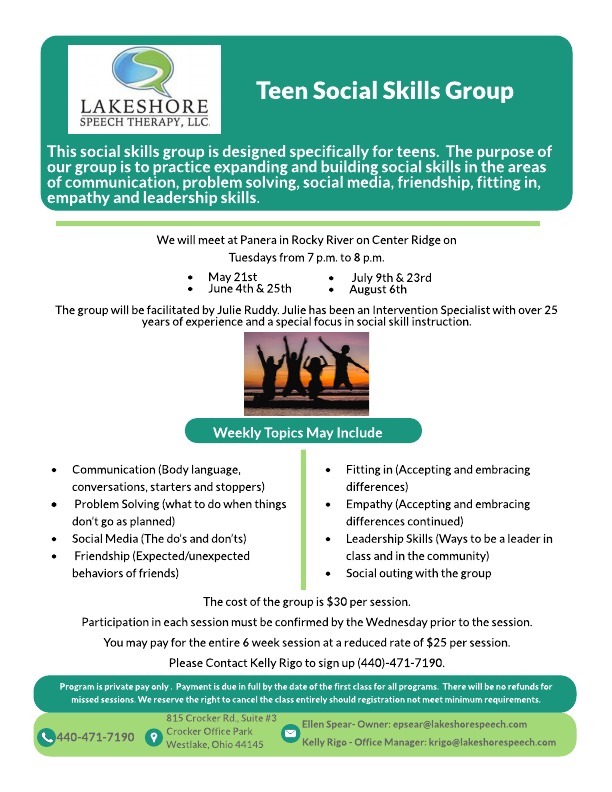
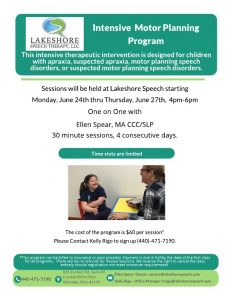
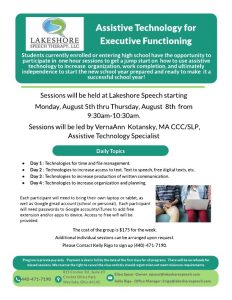
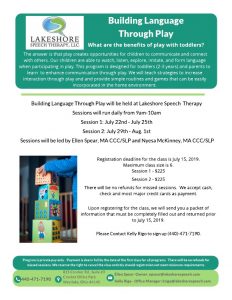
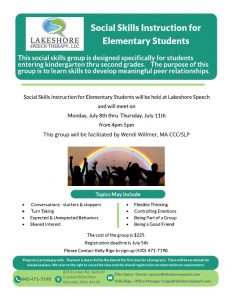
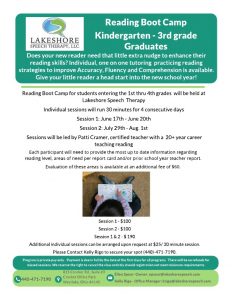
Lakeshore Speech Therapy Summer 2019 Programming
Every summer, we at Lakeshore Speech Therapy work to provide our clients and families with programming that meets everyone’s needs. This year we are excited to offer programs for everyone from toddlers to teens. Please take a moment to see all that we have to offer. Share this information with friends and family that may benefit from these amazing programs. As always, please share your ideas for future programs.
Yours in Speech,
Lakeshore Speech Therapy, LLC

Friday Night Lights
Friday night lights! High school traditions! Go Team!
Fall is the time of year to grab your favorite sweatshirt and enjoy an evening of high school football. “Enjoy” – that’s the difficult part especially for some. The many sounds and smells as well as the number of people all in one place can cause loved ones with integration issues difficulty in large crowds. There are a number of proactive steps families can take to help loved ones adjust to these situations.
Paint a picture of what the individual will experience during their time at the game. For example:
- We are going to park the car in the parking lot (or, in some instances, the – field, street, etc.)
- We will walk to the gate or entrance of the field.
- We will have to stand in line to get our tickets.
- Note: if available, please consider purchasing tickets ahead of time. Less time anxiously waiting, the better.
- There will be a lot of people around us; you will hear them talking and shouting.
- We will walk to our seats
- We will walk up or down the stadium steps
- Note: if the stadium steps are open (meaning you can see the ground below) you may want to consider sitting in an area closer to the ground or where the steps are solid.
- We will sit in our seats
- Note: if the individual is sensitive to pressure – consider bringing a blanket or stadium chair to decrease the sensation of the ‘hard’ stadium bleachers.
- Etcetera
- Don’t forget to include what will be
- heard (band, horns, cheering, etc.)
- seen
- smelled
- Don’t forget to include what will be
Carry an ‘important tools’ bag. This bag should contain items that calm the individual, items that may distract attention from an unpleasant sensation and items that will help to diminish non-preferred sensations. The bag may include noise canceling headphones, headphones and a music source,ear plugs, fidget toys, extra blankets, weighted blankets, etc.
Plan your arrival and departure around preferred events. If the individual loves watching the marching band, but is bothered by all the whistles during the game, arrive at the game 15-25 minutes late. If the individual does not appreciate the marching band, make arrangements for an activity or get special permission to leave and re-enter the the stadium during halftime. If the individual does or does not like the mascot, plan your seats in the location accordingly.
Give your loved one a voice during the game. Pre-record a cheer or a special message on a voice recorded switch. No need to get too high tech, this is a high energy exciting time, it’s more important to get the message out! If a device is not an option, make a sign that shares the message or use a horn or bell for the individual to be part of the roaring crowd. If you need more information or ideas, please do not hesitate to ask any speech therapist at Lakeshore Speech.
Friday night lights shine brighter when everyone is involved. Go Team!
Yours in Speech,
Lakeshore Speech Therapy, LLC.
Getting out the door in one piece: Ideas for Every Family
Build strong executive functioning skills this school year with simple speech therapist tips for stress-free routines, organization, and family success.
Continue readingHelp with Stuttering. You’re NOT alone!
We have all experienced a moment when what you are trying to say just won’t come out. Those episodes of stuttering are typically a blip in time occurring far and few between. Stuttering is a natural part of development for children between the ages of 2 and 5. When a young child stutters, she/he may repeat certain syllables, words or phrases, prolong them, or making no sound for certain sounds and syllables. These ‘episodes’ can be attributed to the child having so much to say, but can’t get the information out quickly and don’t want to lose her/his audience or turn to talk. Developmental stuttering my last for a few weeks or several months, and it may be sporadic. Most children stop stuttering by age 5 without speech-language therapy intervention. However, if these episodes are accompanied with facial or body movements, become worse and more frequent, a speech-language evaluation is suggested for children as young as 3 years of age.
While there is no cure for stuttering, there are effective treatments that can help an individual control his/her speech. As fluency therapy is a complex marriage of clinical and psychological intervention, It is recommended these treatments and therapies be administered by a speech-language pathologist who has experience or specializes in the area of fluency therapy. As a child matures, intervention/therapy techniques adjust from learning the techniques for fluent or smooth speech to learning how to best manage dysfluencies given specific situations in the home, peer, work and academic settings.
Middle and high school years are filled with uncertainty and the constant feeling of trying to ‘fit in’. Anything that makes you ‘different’ isn’t necessarily considered a ‘positive’. For teens who have a fluency disorder or stutter, these years can be a time of significant social struggle and self-doubt. We take for granted the number of times in any one given day we are required to answer, comment, question or defend ourselves with clarity and ease.
Lakeshore Speech Therapy is fortunate to have Wendi Willmer as part of our staff. As a Board Certified Specialist in Fluency, Wendi possesses in-depth knowledge on how to treat stuttering in people of all ages. Sensitive to the struggles teens and young adults experience with stuttering, she is offering two six-week small group sessions to help students.. One group is specifically designed for the needs of students in grades 6th thru 8th and another for students in grades 9th thru 12th. While working in a group setting, not only will the students learn new techniques to control stuttering, but practice those skills they do have; all the while creating a network of friends that truly understand what they are going through. Class sizes are limited and registration is open until Wednesday, September 12, 2018. Find more information at https://www.lakeshorespeech.com/events/.
Yours in Speech,
Lakeshore Speech Therapy, LLC