Communication Boards = Inclusive Public Spaces: 5 Questions

Inclusive Public Spaces

Inclusive Playground Communication Boards: What They Are and Why They Matter in Public Spaces

The Shift Toward Inclusive Play

At Resources at Lakeshore Speech, our team of speech-language pathologists works every day with children who communicate in diverse ways. Across the country, we collaborate with families, schools, community leaders and parks and recreation teams who share one common goal: to create environments where every child can play, connect and feel included.

As inclusive design becomes the standard—not the exception—communities are increasingly turning their attention to tools that support meaningful social participation. One tool is rising to the top of playground equipment trends: playground communication boards.

Communication boards have existed for decades in clinical and educational settings, but their expansion into public play areas represents a powerful step toward equity. When paired with evolving ADA-compliant playground standards, sensory-friendly features and universal design principles, they help ensure that every child—regardless of communication ability—can participate in play.

In this blog, we’ll answer the questions:

  • What is a communication board?
  • Why are playground communication boards so important in public spaces?
  • How do they support neurodivergent children and those who use AAC (augmentative and alternative communication)?
  • How do boards fit into broader playground equipment trends?
  • How does one stay informed as inclusive playground solutions continue to evolve?

As SLPs, we are thrilled to see communities asking not just “Is this playground fun?” but “Is this playground accessible, welcoming and communicatively inclusive?”

What Is a Communication Board?

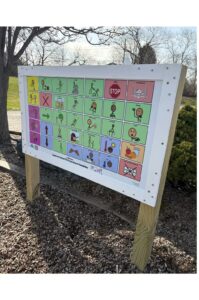
A communication board is a visual tool containing a selection of symbols, illustrations, or words that represent commonly used vocabulary. Individuals point to or touch these symbols to express needs, ideas, and emotions. Communication boards are one of the simplest and most widely used forms of AAC (augmentative and alternative communication).

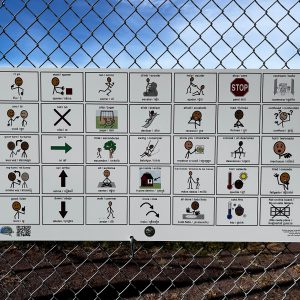
On playgrounds, communication boards typically include core vocabulary such as:

  • “Help”

  • “Stop”

  • “Go”

  • “Want”

And fringe vocabulary such as: 

  • ”Slide”

  • “Swing”

  • “My turn”

  • “Let’s play”

  • “Friend”

  • Emotion symbols for happy, scared, tired, excited

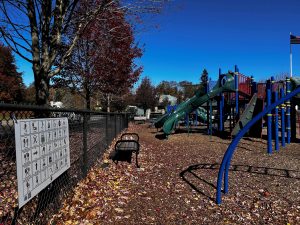
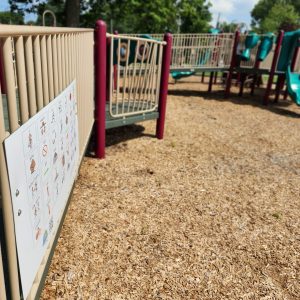
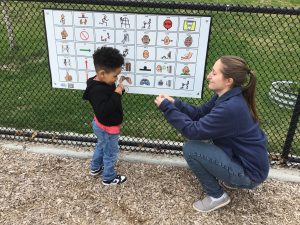
Though often mounted near entrances, next to high-traffic activities like slides or swings or even installed directly on the playground equipment.

Why Do Communication Boards Work?

Communication boards allow children to:

  • Interact with peers even without spoken language

  • Clarify their wants and needs during play

  • Build functional vocabulary in real-world environments

  • Increase social participation

  • Reduce frustration, meltdowns and misunderstandings

For children with autism, developmental delays, apraxia, down syndrome, ADHD, sensory processing differences or selective mutism, the presence of a board can be the difference between accessing play and watching play happen around them.

But communication boards don’t just support children—they support adults, too: teachers, paraeducators, SLPs, playground staff and caregivers who may need a quick, low-tech tool to model language or support a child in a moment of need.

How do boards fit into broader playground equipment trends?

Latest Equipment Innovations in Inclusive Playgrounds

The rise of playground communication boards fits into a broader movement toward inclusive play spaces that support children of all abilities. These projects are driven by evolving standards for ADA compliance playground design, updated research on sensory-rich environments, and global conversations about the importance of universal design.

Below are some of the biggest equipment and design trends shaping today’s playgrounds.

1. Sensory-Friendly Features

Sensory-friendly playground equipment is becoming a non-negotiable element in inclusive design. Communities and manufacturers are integrating sensory play to support children with autism, sensory processing disorders, ADHD, developmental disabilities and motor challenges.

Common sensory-friendly features include:

Visual

  • Calming color palettes

  • High-contrast pathways for safe navigation

  • Visual schedules mounted near entry points

Auditory

  • Musical elements like chimes or drums

  • Noise-buffering materials to reduce overwhelming echoes

Tactile

  • Textured climbing features

  • Sand, water and sensory tables

  • Smooth and rough sensory borders

Proprioceptive & Vestibular

  • Cozy nooks and quiet zones

  • Swings that support varied body positioning

  • Spinning elements with safety modifications

Playground communication boards naturally complement these features by helping children label sensory experiences, request breaks or communicate discomfort—critical tools for self-regulation.

2. Universal Design Principles

Universal design principles ensure that built environments can be accessed and used by the greatest number of people without the need for adaptation.

When applied to playgrounds, universal design encourages:

  • Equipment that is multilevel and approachable from multiple angles

  • Wide, clearly delineated pathways

  • Ramp access to elevated play structures

  • Equipment usable by children with and without mobility devices

  • Clear signage and visual supports

  • Social-communication tools like playground communication boards

By incorporating boards directly into playground pathways, communities send a powerful message: communication access is as essential as physical access.

3. Growth of Special Needs Playground Equipment

Demand for special needs playground equipment has surged. Not because children with disabilities require separate areas, but because appropriately designed equipment can elevate participation for all children.

These adaptations include:

  • High-back, harnessed swings

  • Spinner bowls with supportive seating

  • Ground-level merry-go-rounds accessible to wheelchairs

  • Safe-entry slides with guardrails

  • Motion-controlled interactive panels

  • Social-emotional learning panels

  • Play structures designed for lower sensory load

Adding communication boards alongside this inclusive equipment promotes collaborative, accessible, language-rich play.

Why are playground communication boards so important in public spaces?

The Role of Playground Communication Boards in Public Spaces

Playgrounds are more than recreational zones—they are learning labs for social communication.

Below are the key reasons these boards are becoming essential across the United States.

1. Promoting Social Inclusion

Children who struggle to communicate often withdraw during play. A communication board levels the playing field by giving access to shared vocabulary. Children who are minimally verbal, emerging communicators, or new to English can all participate more fully.

Boards also help typically developing children initiate communication with peers who communicate differently—leading to friendships that may not have formed otherwise.

2. Supporting AAC Users

Many children rely on digital AAC devices such as tablets with speech-generating apps. However:

  • Devices may not be allowed in sand or water areas

  • Families may worry about damage

  • The device may not be available at the moment

  • Devices can glitch, freeze or lose power

Playground communication boards provide a reliable low-tech backup, recommended by SLPs and AAC guidelines.

This ensures that communication doesn’t disappear when a device is inaccessible.

3. Increasing ADA and Accessibility Compliance

While ADA regulations do not yet explicitly require communication boards, they strongly encourage inclusive, accessible communication options in public spaces.

Boards support:

  • Functional communication

  • Emotional regulation

  • Safety and emergency communication

  • Equal participation

Communities striving for an inclusive ADA compliance playground often adopt communication boards proactively, recognizing that communication access is a fundamental right.

4. Supporting Children With Autism and Other Developmental Disabilities

For many autistic children or others with language-based disabilities, play can be overwhelming. Communication boards help them:

  • Request space or breaks

  • Communicate emotions

  • Ask for specific sensory experiences (“swing,” “spin,” “quiet”)

  • Navigate turn-taking and social rules

  • Reduce frustration and dysregulation

Boards also serve as visual anchors—helping children anticipate what’s available and what to expect next.

5. Encouraging Language Modeling by Adults

Boards create instant opportunities for adults to model language. An SLP, parent, paraeducator, or even a peer can point to symbols to demonstrate:

  • Requesting

  • Commenting

  • Greeting

  • Problem-solving

  • Emotional expression

This is especially valuable because children learn language through experience—not drills.
inclusive
inclusion - how to choose a playground communication board

How do they support neurodivergent children and those who use AAC?

Below are composite but realistic examples our SLPs encounter across the country.

Example #1: A Child With Autism Finds His Voice at the Playground

“Evan,” age 5, visited his neighborhood playground weekly. His parents worried because he typically paced the perimeter rather than joining other children. He often became frustrated and melted down when approached or redirected.

After the city installed playground communication boards, Evan’s mom showed him how to point to “swing” and “my turn.”

Within two weeks, Evan began initiating play for the first time. He pointed to “go,” looked at another child, and climbed onto the swings—smiling.

Today, Evan uses 15–20 playground vocabulary symbols independently. His parents credit the board for giving him social confidence and reducing meltdowns.

Example #2: A Parks and Recreation Team Improves Safety and Communication

A mid-size parks department wanted more inclusive features but had limited funds. After consulting with SLPs and community disability advocates, they chose communication boards as a cost-effective first step.

The results were immediate.

Staff members noticed that communication breakdowns—especially among toddlers and neurodivergent children—decreased dramatically.

Common phrases children used:

  • “I’m hurt.”

  • “I need help.”

  • “Bathroom.”

  • “I’m sad.”

This is the smallest investment with the biggest impact.

Example #3: Integrating Boards Into Special Needs Playground Equipment

A school district upgraded several playgrounds with sensory-friendly equipment. However, teachers noticed children struggled to communicate during group play activities.

SLPs collaborated with the district to install:

  • A large main communication board at the entrance

  • Smaller boards near the swings and slides

Students communicate more effectively across settings—from recess to therapy to the classroom.

How does one stay informed as inclusive playground solutions continue to evolve?

Staying Current With Playground Communication Trends

The landscape of inclusive design is evolving quickly. Here’s how parks departments, educators, SLPs, and families can stay informed.

1. Follow Industry Research and Standards

Key organizations include:

These groups frequently issue updates on safety, accessibility and inclusive design best practices.

2. Collaborate With SLPs and AAC Specialists

SLPs bring expertise in:

  • Vocabulary selection

  • Symbol organization

  • Cultural and linguistic inclusivity

  • Evidence-based AAC strategies

Partnerships between SLPs and parks & recreation departments ensure boards are functional, accessible and impactful. As practicing SLPs, we at Resources at Lakeshore Speech encourage a meeting with parks and recreation departments to discuss customizing communication boards specific to the community. 

3. Explore Emerging Playground Equipment Trends

Manufacturers are increasingly integrating:

  • QR-code-linked digital boards

  • Multilingual symbol sets

  • Weather-resistant materials

  • ADA-friendly layouts

  • Integrated communication boards on equipment

  • Sensory zones supported by communication guides

Staying informed helps communities choose equipment that meets both immediate needs and future accessibility goals.

4. Gather Community Feedback

Ask families, teachers, and children:

  • What vocabulary is missing?

  • Is the board easy to understand?

  • Should more boards be installed in different zones?

  • Do caregivers want training on how to use them?

Co-designing with the community ensures communication boards truly reflect local needs.

Investing in the Future of Play

Playgrounds are not simply places to climb, swing, and slide. They are places where children learn to negotiate, cooperate, express themselves, and build relationships.

By incorporating playground communication boards, communities promote:

  • Inclusive play

  • Language development

  • Social-emotional learning

  • Safety and accessibility

  • Equal participation for all children

At Resources at Lakeshore Speech, we believe communication access is a foundational part of inclusive design. Boards are simple, cost-effective, and profoundly transformative.

Whether you are a parks and recreation leader planning renovations, an SLP advocating for your school district, or a parent seeking support for your child—we are here to help.

Partner with Resources at Lakeshore Speech to bring communication boards to your school, park or community space.

We would love to support your team, help choose vocabulary or consult on the design of your next inclusive play project.
playground Communication boards
communication board with 4 languages

Empowering Playground Communication Boards: Enhancing Inclusion for All

playground Communication boards

Playground communication boards promote inclusion, social interaction and engagement for all children.

As speech-language pathologists at Resources at Lakeshore Speech, we work every day with children who communicate in diverse and meaningful ways. Our work is guided by evidence, grounded in compassion, and driven by a deep belief that every child deserves equitable access to communication—especially in play. One of the most powerful inclusive tools we support and design is playground communication boards, which are transforming parks, schools, and community spaces into environments where all children feel seen, heard, and welcomed. 

In this blog, we’ll explore what playground communication boards are, why they matter, and how they support autistic children, neurodiverse children, and all learners. We’ll also outline how families, educators, and community leaders can work together to create inclusive, accessible play spaces. 

What Is a Playground Communication Board? 

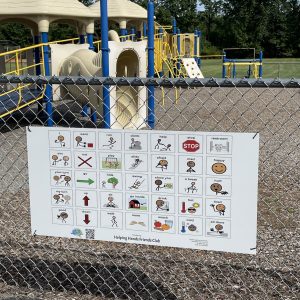
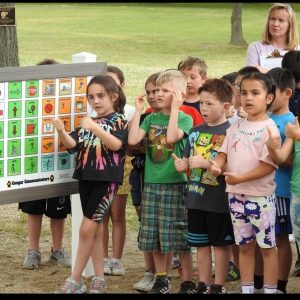
A playground communication board is a large, durable outdoor display featuring picture symbols paired with words that represent essential vocabulary children use during play. These are similar to AAC (augmentative and alternative communication) boards used in therapy sessions or classrooms, but designed specifically for open outdoor spaces. 

Most playground communication boards include:

  • Core vocabulary words used across activities (e.g., go, stop, want, help, play, more) 
  • Fringe vocabulary tailored to outdoor, social, and physical play (e.g., swing, slide, climb, friend) 
  • Clear, easy-to-recognize symbols 
  • Multilingual options, based on community needs 
  • High-contrast layouts for visual accessibility 
  • Durable, weather-resistant materials 

At Resources at Lakeshore Speech, we design and support boards created specifically for parks, playgrounds, pools, waterparks, therapeutic riding centers and a variety of community spaces. 

The purpose is simple but profound: 

To give every child access to communication—no matter their speech abilities, language background  or learning style. 
playground communication board at a playground for children to access to communicate
communication boards for playgrounds

Communication Boards: Benefits for Children, Students and Families 

While playground communication boards support children who use AAC, their impact is far broader. They encourage communication, collaboration, and community building among all children and families

Key benefits of access and use to AAC we see in our daily practice:

Accessibility for Nonverbal, Autistic, and Neurodiverse Children 

For many autistic children, non-speaking children, and neurodiverse peers, playgrounds can be overwhelming or difficult to navigate socially. A communication board becomes a visual support—a tool that reduces anxiety by supporting functional communicative interactions.

How communication boards support neurodiverse learners: 

  • Offer concrete visuals that reduce the cognitive load of processing language in loud environments 
  • Promote emotional regulation by giving children a way to ask for a turn, request help, or express needs 
  • Encourage independence by allowing children to initiate communication without relying solely on an adult 
  • Reduce frustration and prevent misunderstandings 
  • Facilitate successful participation in group play 

When children have reliable, accessible tools, they gain confidence and a sense of belonging. This is the heart of inclusive play. 

Social Inclusion and Peer Interaction 

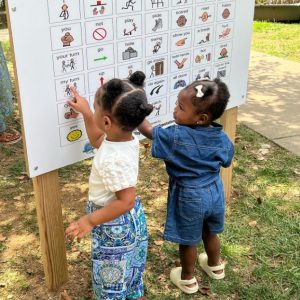
Play can be the great equalizer—if children have a shared way to communicate. Playground communication boards empower all kids to: 

  • Invite others to play 
  • Share ideas 
  • Request turns 
  • Comment on actions 
  • Problem-solve together 

These interactions encourage social interaction and create a community where every child feels valued. 

Neurotypical peers and siblings often use the board, too. When everyone participates, it normalizes AAC and eliminates stigma. We love seeing a group of children point to the board together while deciding what to play next—it’s a beautiful reminder that inclusion benefits everyone.

Support for Siblings, Peers and Educators 

Children learn from each other long before they learn from adults. That’s why visual communication tools are so important in natural settings. 

Playground communication boards support: 

  • Siblings, who want to help their brother or sister communicate, but aren’t always sure how 
  • Peers, who can model communication or follow a visual to include someone new 
  • Teachers and camp counselors, who need simple supports for groups with mixed communication needs 
  • Paraprofessionals and aides, who assist children with AAC devices
  • Families, who may not yet be familiar with AAC vocabulary and strategies 

We consistently hear from educators that the boards help reduce the pressure to verbally direct play. Instead of continually prompting, adults can gesture toward the board to support natural communication. 

This shift strengthens children’s autonomy and empowers adults to facilitate rather than direct.

weatherproof communication boards

Case Studies: Success Stories from Parks, Schools and Communities 

We see real-world impact every day. Here are a few examples—based on common outcomes we observe—of how playground communication boards change lives. 

1. A Community Park Welcomes More Families

One of our partner community parks saw an increase in families visiting after installing a playground communication board. Parents of autistic children told us they felt more comfortable staying longer because their children were more engaged and less frustrated. 

A mom shared that her son used the board to “tell” another child he wanted to swing. It was the first time she’d seen him initiate play with a peer without adult prompting. 

The board provided a bridge that allowed him to connect in a new way. 

2. A School Creates More Inclusive Recess 

A local school district installed boards across multiple playgrounds to support their inclusive education model. Teachers quickly noticed that recess became smoother for students who previously struggled with transitions or group play. 

One teacher told us, “It’s not just helping our autistic students—it’s helping everyone communicate better.” 

Students from multilingual homes also benefited from the visuals, which helped them understand routines, negotiate turns, and join group play more easily. 

3. A Preschool Uses the Board for Language Modeling 

In an inclusive preschool, educators used the playground communication board to support language-rich routines outdoors. Instead of leaving AAC inside, they modeled vocabulary right on the board—actions, comments, requests, social phrases. 

Within a few months, many of the children with language delays increased their spontaneous communication during outdoor play. 

For many families, this was the first time they saw their child use symbols outside a therapy session. 

How to Choose and Install a Playground Communication Board

Choosing the right playground communication board is essential for safety, accessibility, and long-term inclusion. Below is what we recommend based on evidence-based AAC practices and our experience designing these boards. 

Materials, Durability, and Weatherproofing 

Outdoor boards must withstand: 

  • Sun exposure 
  •  Moisture 
  • Temperature changes 
  • Frequent touching 
  • Cleaning products 
  • Grafitti 

The most durable options often use: 

Well-designed boards last years with minimal maintenance. 

Placement and Visibility 

Where you place the board matters as much as what’s on it. 

We recommend: 

  • Installing at wheelchair-accessible height
  • Ensuring clear sight lines and easy access from multiple directions
  • Placing near popular play areas: swings, slides, or climbing structures Avoiding areas prone to flooding or mud 
  • Providing enough space for multiple children and adults to gather 

When we design boards, we keep universal design principles in mind—because visibility and access help everyone communicate, not only AAC users. 

Customization for Local Needs 

The most effective playground communication boards reflect the culture, languages, and play preferences of the community. 

Customization may include: 

  • Bilingual or multilingual options 
  • Local landmarks or symbols 
  • School colors or district branding 
  • Vocabulary specific to the playground equipment 
  • QR codes linking to modeling videos 

When children see familiar words, colors, and objects, the board feels like it belongs to them—and they’re more likely to use it. 

Engaging Stakeholders: Families, Advocacy Groups, Staff and the Community

Successful installation requires collaboration among many voices. 

Families 

Families should be involved early, ensuring the board reflects real needs—especially for children with communication differences. 

Advocacy Groups 

Local disability advocates often support funding, community awareness, and maintenance initiatives. 

School or Park Staff 

These individuals ensure proper installation, secure mounting, and safe placement. 

Community Leaders 

Administrators, park districts, PTO groups and nonprofit organizations often spearhead fundraising and outreach. 

When everyone understands the purpose and value of playground communication boards, communities become more inclusive at every level—not only on the playground. 

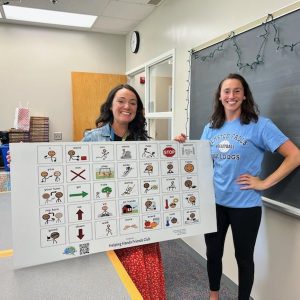
playground communication board installed at an elementary school in Commack, NY
Playground communciation board completed for Olmsted Falls school in Ohio

Playground Communication Boards: Commonly Asked Questions

Below are the most frequently searched questions families and professionals ask. Including these helps make Resources at Lakeshore Speech a trusted source for reliable information. 

Are playground communication boards only for autistic children? 

No. While autistic children and neurodiverse children benefit greatly, these boards support all children—including multilingual learners, shy communicators, early talkers and peers developing social skills. 

Do communication boards replace speech or AAC devices? 

Not at all. They are a supplement, supporting communication in outdoor environments where devices may be difficult to use or carry.

What vocabulary should be included on a playground communication board? 

A mix of core words (go, want, stop, help) and fringe words related to equipment and actions. Boards should avoid clutter and use consistent symbol sets. 

How big should a communication board be? 

Most boards range from 24 × 36 inches to 36 × 48 inches. Larger boards improve visibility and allow multiple children to use them at once. 

Where should the board be installed? 

Near high-traffic play areas, visible from multiple angles, and mounted at an accessible height.

Do playground communication boards actually increase social interaction? 

Yes. Research on AAC and visual supports shows that shared symbols promote social participation, peer interaction, and communication initiation. 

How long do boards last? 

With proper materials, many outdoor communication boards last 5–10 years. 

Who pays for playground communication boards? 

Funding may come from PTO groups, school districts, grants, park districts, nonprofits, or community donations. 

Conclusion: The Future of Inclusive Play and Learning 

Playgrounds should be inviting, joyful spaces where every child—speaking or non-speaking, autistic or neurotypical, shy or outgoing—feels empowered to communicate and connect. 

Playground communication boards make that possible. They support inclusion, foster meaningful peer interactions and strengthen family engagement. They also send a powerful message: communication belongs to everyone.

As speech-language pathologists, we’ve seen firsthand how these tools transform communities. When you bring communication into the heart of a playground, you create a space where all children thrive—together. 

If your school, park, or community is ready to bring more inclusion and accessibility to your playground, we’re here to help. 

Contact Resources at Lakeshore Speech to request support in choosing, customizing or installing a playground communication board. 

We’d love to help you build a more inclusive community—one play space at a time.

Communication Boards Enhance Holiday Joy

communication board in wintery weather

Discover how a communication board can transform holiday experiences for children with Autism and speech differences. Resources at Lakeshore Speech explores AAC strategies for inclusive celebrations.

Continue reading

5 Proven Ways Communication Boards Build Language Skills in Toddlers

communication boards for playgrounds

Discover 5 proven ways a communication board builds language in toddlers. Get expert speech therapy tips for autism, play and ending frustration.

Continue reading

How Communication Boards Boost Speech and Language: Simple Guide

communication boards

Learn how AAC communication boards support speech development, language learning and student independence in schools and communities.

Continue reading

12+ Empowering Communication & AAC Tips: Create an Inclusive Thanksgiving

Communciation supports for children with Autism makes Thanksgiving more memorable for everyone

Make Thanksgiving more inclusive with communication support, AAC ideas, and autism-friendly strategies. Practical tips for a smoother holiday.

Continue reading

Impactful Playground Communication Boards:Make Voices Thrive

Where do I buty a playground communication board

Discover how playground communication boards help kids with social skills, emotions, & confidence. Build a community where everyone’s voice matters.

Continue reading

Professional AAC Workshop: Guiding the Next Gen of SLPs

SLP-designed clinic communication board for speech therapy sessions and special education classrooms.

Resources at Lakeshore Speech’s AAC workshop bridges classroom learning with real-world impact, teaching grad students to design inclusive communication boards.

Continue reading

6 Ways To Fund Communication Boards:Empower Every Child

communication boards in schools

Discover 6+ funding options to bring communication boards to your playground. Explore grants, sponsors, and campaigns that support inclusive play for all.

Continue reading